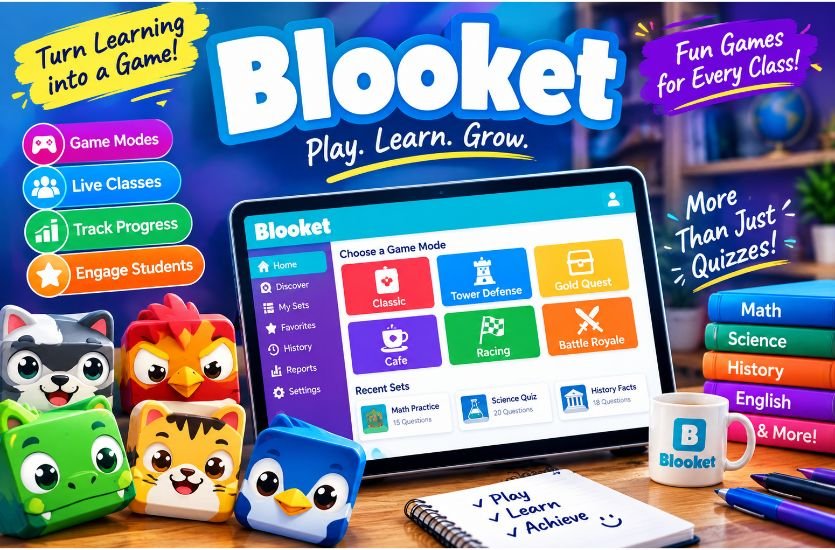
Blooket is a game-based learning platform that combines educational questions with interactive gameplay. Instead of asking students to complete a conventional quiz or worksheet, Blooket allows teachers to turn question sets into different game experiences. Students answer questions while competing, collecting rewards, progressing through challenges, and interacting with virtual characters called Blooks. The platform is designed for classroom review, practice, knowledge checks, and other learning activities where engagement is important.
The basic idea behind Blooket is straightforward: teachers provide the questions, while the platform provides the game environment. A teacher can find an existing question set or create one, select a game mode, and invite students to participate. Blooket can therefore be used for subjects ranging from mathematics and science to history, vocabulary, language arts, and general knowledge. Its official website describes the platform as supporting both live and asynchronous games, along with reports that help educators review student performance.
Read Domikyo.com Explained: Smart Home, IoT, Technology & Digital Guide
Quick Bio of Blooket
| Detail | Information |
|---|---|
| Name | Blooket |
| Type | Game-based learning platform |
| Purpose | Educational review, practice, and classroom activities |
| Main Users | Teachers and students |
| Platform | Web-based |
| Core Content | Question sets and educational games |
| Student Characters | Blooks |
| Gameplay Rewards | Tokens, XP, collectibles and in-game rewards |
| Game Style | Quiz combined with interactive gameplay |
| Pronunciation | “Blue-kit” |
| Main Use | Classroom learning and review |
What Is Blooket?
Blooket is an online educational platform that transforms question-and-answer activities into interactive games. Rather than presenting students with only a traditional list of questions, Blooket places those questions inside different game environments. This allows students to practice academic material while experiencing mechanics normally associated with digital games.
The platform separates the academic content from the gameplay. A question set contains the actual educational questions, while the selected game mode determines what happens around those questions. This means the same set of questions can potentially be used in different ways depending on the activity selected by the teacher.
For example, a teacher might create a set of mathematics questions about fractions. Instead of repeatedly giving students the same conventional quiz, the teacher could use the questions in a racing-style activity, a strategy game, or another available mode. The academic material remains the questions, while the game changes the way students interact with them.
Blooket’s official website presents this process as a simple three-part system: obtain a question set, select a game mode, and then play, learn, and analyze the results.
How Does Blooket Work?
Blooket generally begins with a question set. Teachers can search the platform’s library for existing material or create their own questions. Once the appropriate content has been selected, the teacher chooses a game mode.
The selected mode determines the rules and objectives of the activity. Some modes emphasize speed, while others introduce strategy, resource management, competition, collecting, or other mechanics. Students answer questions during the activity, and their answers affect their progress within the selected game.
For a live classroom session, students can join the teacher’s game using the information supplied by the host. The experience is designed to work through a web browser, which means students can participate using compatible devices without needing a conventional software installation.
After the activity finishes, teachers can examine available results to understand how students performed. This creates a cycle in which the teacher prepares questions, students practice through gameplay, and the teacher uses the resulting information to identify areas that may require additional review.
This structure is one reason Blooket is often used as a review tool rather than as a replacement for direct instruction. The teacher still determines what students need to learn and which questions are appropriate.
Blooket Question Sets
Question sets are at the center of the Blooket experience. They contain the educational material that students actually answer during gameplay.
Teachers can create their own sets when they want questions specifically connected to a lesson, textbook, unit, or examination. They can also search the platform’s existing collection for material that may already match their subject.
Community-created question sets can save preparation time, particularly when teachers need a quick activity for a familiar topic. However, teachers should still review publicly available questions before using them because the quality and suitability of user-created material can vary.
A well-designed question set can make a major difference to the educational value of the game. If the questions are unclear, inaccurate, excessively easy, or unrelated to the lesson objective, an entertaining game may still provide limited academic value.
For that reason, Blooket works best when teachers treat the question set as the foundation of the activity rather than assuming that the game mechanics alone create learning.
Blooket Game Modes
One of Blooket’s most recognizable features is its variety of game modes. Instead of using the same quiz format every time, teachers can select different activities that change the way students experience the questions.
The official platform currently describes a broad selection of game modes, while its catalog can change as new modes are introduced and older ones are updated.
Classic
Classic is one of the more straightforward Blooket experiences. Students answer questions and compete based on their performance. Its simplicity makes it useful when a teacher wants the educational content to remain relatively central without introducing a complicated game system.
Gold Quest
Gold Quest combines question answering with virtual gold and game mechanics that can change a player’s position during the activity. Because the mode includes elements of chance and interaction between players, the final position does not necessarily represent question accuracy alone.
This distinction is important when interpreting results. A student can perform differently in the game from what their raw answer accuracy might suggest.
Tower Defense
Tower Defense combines question answering with a strategic defense system. Students answer questions and use the resulting progress within a tower-defense environment.
The format gives students something to work toward beyond simply reaching a leaderboard position. It can therefore make repeated question practice feel more like a strategy game.
Café
Café places students in a virtual café environment. Correct answers contribute to the activity’s progression, allowing students to manage resources and serve virtual customers while continuing to answer questions.
The mode demonstrates how Blooket can use the same educational question-answering process inside a completely different game setting.
Factory
Factory introduces another progression-oriented environment. Students answer questions and use the results to develop their virtual factory and associated resources.
The game structure can make repeated practice more engaging because students are not simply answering one question after another without a visible objective.
Racing
Racing uses a race-based structure in which answering questions helps students progress toward the finish. The format is easy to understand and can be particularly useful for short review sessions.
Blook Rush
Blook Rush incorporates Blooks into a competitive game environment. Students answer questions while interacting with the virtual characters and attempting to improve their position.
Battle Royale
Battle Royale provides a more competitive format in which students face opponents through question-based gameplay. The structure makes the quiz feel more like a competitive digital game.
Study
Study is designed more directly around independent practice. Rather than relying entirely on elaborate game mechanics, it can provide a more focused way for students to work through educational material.
The variety of modes is a central part of Blooket’s identity because it allows teachers to use similar academic content in different gameplay environments.
What Are Blooks in Blooket?
Blooks are the collectible virtual characters associated with Blooket. They give students a visual identity within the platform and contribute to the collection aspect of the experience.
The collecting system adds a progression element that can encourage students to return to the platform. Instead of every activity ending when the quiz finishes, students can have longer-term goals involving their collection.
Blooket also connects its reward system with tokens and experience points. Students can earn rewards through gameplay and use available systems to develop their collections.
The important distinction is that Blooks are part of the game’s engagement system rather than evidence of academic achievement. Owning a particular Blook does not indicate that a student understands a particular subject.
Blooket Tokens and XP
Tokens and XP are part of Blooket’s progression system. Students can earn rewards through gameplay and use the platform’s collection features to personalize their experience.
This system introduces an additional motivation beyond the immediate outcome of a classroom quiz. A student who enjoys collecting Blooks may become interested in participating in additional activities because gameplay contributes to their virtual collection.
From an educational perspective, however, tokens and XP should be viewed as engagement features. They are not equivalent to grades, mastery, or academic qualifications.
The educational value still depends on the quality of the questions, the relevance of the activity, and what happens after students answer.
How to Join a Blooket Game
Joining a Blooket game is designed to be relatively simple. In a typical live classroom activity, the teacher hosts a game and provides students with the necessary joining information.
Students can use the provided game code or another joining method supplied by the teacher. The platform also supports options such as QR codes and links depending on the type of activity.
A student participating in a live game does not necessarily need to create an account simply to participate. This can reduce the amount of setup required before a classroom activity begins.
For teachers, the process is useful because a class can move from instruction to review without requiring every student to complete a lengthy registration process.
Blooket for Teachers
Blooket gives teachers a way to combine review activities with classroom interaction. Instead of preparing an entirely different activity for every review session, teachers can reuse suitable question sets while changing the game format.
This can be particularly useful after a lesson or unit when students need to practice information that has already been introduced.
Teachers can create questions based on their own curriculum or use existing sets. They can then choose a game mode that fits the class and the intended purpose of the activity.
Blooket also provides reporting tools that can help teachers examine performance after a game. The company’s website specifically highlights reports as a way to identify knowledge gaps and guide students toward improvement.
Recent independent reviews similarly describe Blooket as particularly useful for short review activities, warm-ups, knowledge checks, and factual practice rather than as a complete replacement for classroom teaching.
Blooket for Students
For students, Blooket can make a conventional review session feel more interactive. Instead of answering questions solely for a grade, students may be working toward an in-game objective, collecting characters, earning rewards, or competing with classmates.
The experience can be especially appealing to students who respond positively to game-based activities. Different game modes also provide variety, meaning that a class does not necessarily have to repeat the same format every time it uses Blooket.
However, students can have different reactions to competitive gameplay. Some may enjoy leaderboards and competition, while others may find fast-paced or competitive activities distracting or stressful. A teacher’s choice of game mode therefore matters.
Blooket Homework and Solo Practice
Blooket is not limited to teacher-hosted classroom games. The platform also supports activities that students can complete independently.
Homework activities allow teachers to assign question-based practice that students can complete outside a live classroom session. This can be useful when a teacher wants students to reinforce information after a lesson.
Solo play can also allow students to practice without competing directly against an entire classroom.
The distinction between live games and independent activities makes Blooket more flexible than a platform designed exclusively for synchronous classroom quizzes.
Is Blooket Free?
Blooket offers a free version with core features that allow teachers to create and discover question sets and host classroom activities. This makes it possible to use the platform without immediately purchasing a subscription.
The availability of free features is one reason Blooket can be attractive to teachers who want to experiment with game-based review without committing to a paid educational platform.
At the same time, Blooket also offers paid features through Blooket Plus. The exact feature set and limits can change, so teachers should check the current plan information before making purchasing decisions.
Recent coverage of Blooket Plus notes that premium features can include larger live games, more detailed reporting, organizational tools, audio questions, and longer homework options.
What Is Blooket Plus?
Blooket Plus is the platform’s paid subscription option for users who want additional capabilities beyond the basic experience.
The main distinction is that Plus expands certain teacher-oriented functions rather than simply changing the fundamental purpose of Blooket.
For educators who host games frequently, larger player capacity and more detailed reporting may be particularly relevant. Other premium features can help teachers manage question sets, organize materials, and create more varied activities.
Whether Plus is useful depends largely on how frequently a teacher uses Blooket and which features are needed. Recent reviews note that the free version can already provide enough functionality for occasional classroom use, while frequent users may find additional features more relevant.
Is Blooket Good for Learning?
Blooket can be useful for learning when it is used for an appropriate purpose. Its strongest role is generally review and practice rather than replacing explanation or teaching new concepts.
For example, after teaching vocabulary, multiplication facts, historical dates, scientific terminology, or other information that benefits from repeated recall, a game-based activity can give students an opportunity to retrieve that information.
Recent educational reviews have also highlighted an important limitation: competitive game mechanics can sometimes become more memorable than the educational content. One 2026 review describes Blooket as particularly suitable for short, low-stakes review while cautioning that it should not replace explanation, discussion, writing, or complex problem-solving.
This means the best use of Blooket is often as one part of a broader lesson.
Benefits of Blooket
One major benefit of Blooket is engagement. Turning questions into interactive games can make routine review feel less repetitive.
Another benefit is variety. Different game modes allow teachers to change the experience without necessarily creating an entirely new academic activity.
Blooket can also save preparation time because teachers can use existing question sets instead of always writing every question from scratch.
Its browser-based approach can make classroom setup relatively straightforward, while live games allow students to participate together.
The platform can also provide feedback that helps teachers determine which areas deserve additional attention.
Limitations of Blooket
Blooket’s strengths can also create limitations. Competition, speed, rewards, and game mechanics can sometimes distract students from the questions themselves.
A student who wins a game has not necessarily demonstrated the strongest academic understanding, because certain modes incorporate factors beyond raw accuracy. Blooket’s own descriptions of some game modes make clear that gameplay can involve speed, luck, strategy, or other mechanics.
Another limitation is that Blooket depends heavily on teacher-created or selected questions. If the question set is poorly designed, the game cannot automatically correct the underlying educational problem.
It is also not designed to replace activities such as essays, detailed explanations, long-form problem solving, laboratory work, or classroom discussion.
For these reasons, Blooket is most useful when teachers clearly understand what the game is intended to accomplish.
Blooket vs. Kahoot
Blooket and Kahoot both use questions and game mechanics to make classroom activities more interactive, but their experiences are not identical.
Kahoot is strongly associated with live quiz-show gameplay, while Blooket places greater emphasis on multiple game environments and collectible characters.
Blooket therefore provides more variation in the style of gameplay. A teacher can select a mode involving racing, strategy, collecting, or other mechanics instead of repeatedly using a conventional quiz format.
The better fit depends on the classroom objective. If the purpose is a straightforward live quiz, a quiz-centered platform may be sufficient. If the teacher wants multiple game environments around the same question set, Blooket’s structure offers a different approach.
Blooket vs. Quizizz
Blooket and Quizizz, now associated with the Wayground brand, both support educational question activities, but their designs emphasize different experiences.
Blooket is particularly recognizable for its game modes, collectibles, and classroom competition. Quizizz has historically placed greater emphasis on quizzes, assignments, assessment, and independent practice.
For teachers, the choice can depend on whether the priority is highly game-oriented review or a more assessment-focused digital quiz experience.
Rather than treating one platform as universally superior, teachers can select the tool that matches the lesson objective and the students participating.
Is Blooket Safe for Students?
Safety and privacy are important considerations for any educational platform used by children.
Blooket maintains a privacy policy covering how information is handled and discusses requirements related to educational and children’s privacy. The company’s current policy states that it does not sell or rent personal information and addresses student data and targeted advertising.
However, teachers and schools should still review the current privacy documentation and their own institutional requirements before using any online educational service.
It is also sensible for teachers to review question sets, student names, game settings, and classroom rules before beginning an activity. A controlled classroom environment can help ensure that the competitive elements remain appropriate for the students involved.
Who Should Use Blooket?
Blooket can be useful for teachers who want to make review sessions more interactive. It can work particularly well when students need repeated practice with factual information and the teacher wants a more engaging alternative to a standard worksheet.
Students can use Blooket for live classroom games, homework, or available solo activities. Teachers can use it for warm-ups, revision, formative checks, test preparation, and end-of-unit practice.
The platform is less appropriate as a complete educational system because it does not replace the teacher’s explanation, discussion, written work, practical activities, or deeper forms of assessment.
Final Thoughts
Blooket has developed a distinctive place in educational technology by combining question-based learning with game mechanics. Its core concept is simple: teachers provide questions, students answer them, and the platform turns those answers into different interactive experiences.
The combination of game modes, Blooks, rewards, question sets, live sessions, solo activities, homework, and reporting gives teachers several ways to use the platform. Its strongest potential comes from using these features for purposeful review rather than treating the game itself as the entire lesson.
The most important factor remains the educational content. A well-designed Blooket activity can provide an engaging way to practice previously taught material, identify areas that need more attention, and give students a different experience from a conventional quiz. At the same time, teachers should recognize that competition and entertainment do not automatically equal deeper learning.
Used thoughtfully, Blooket can function as a flexible classroom review tool that brings together learning and interactive gameplay. Its value ultimately depends on how teachers select questions, choose game modes, interpret results, and connect the activity to broader learning goals.
Visit Editorial Magazine for more informational and educational blogs.

One thought on “Blooket: Interactive Learning Games for Students”