
Searching for feedbuzzard advertise usually means looking for information about advertising opportunities, promotional placements, sponsored content, and the process of reaching an audience through FeedBuzzard. The term has become increasingly common in online marketing discussions, but information about the platform is not always presented consistently. Some websites describe FeedBuzzard as a technology-focused publisher, while others discuss it as though it were a conventional advertising network with automated campaign tools.
The distinction is important for advertisers. FeedBuzzard has published its own advertising material describing campaign objectives, audience targeting, creative formats, budgeting, and measurement. Its June 2026 advertising guide also discusses English-speaking audiences, different advertising formats, targeting options, and pricing models such as CPM, CPC, and CPI.
At the same time, several independent articles point out that publicly available information about fixed prices, verified traffic figures, and independently measured campaign performance remains limited. Therefore, anyone researching feedbuzzard advertise should distinguish between information published by FeedBuzzard itself, general advertising benchmarks, and claims made by third-party websites.
What Is FeedBuzzard Advertise?
FeedBuzzard advertise is commonly used to describe the advertising and promotional opportunities associated with FeedBuzzard.com. FeedBuzzard’s own website describes advertising campaigns in terms of reaching audiences, selecting targeting options, choosing advertising formats, establishing budgets, and measuring campaign results.
FeedBuzzard’s website primarily presents itself around technology and digital content. Its advertising material discusses reaching English-speaking audiences and provides information about campaign setup and creative requirements. This makes the keyword relevant to businesses, marketers, technology companies, application developers, publishers, and other organizations interested in digital promotion.
However, the phrase should not automatically be interpreted as the name of a single advertising product. Independent research has noted that the wording “feedbuzzard advertise” is also heavily used as an SEO keyword across third-party websites. Some of those websites make claims about features, prices, and advertising infrastructure that are not clearly confirmed by FeedBuzzard’s own public pages.
For this reason, the safest approach is to treat FeedBuzzard advertising as a promotional opportunity that should be evaluated using current first-party information before money is committed.
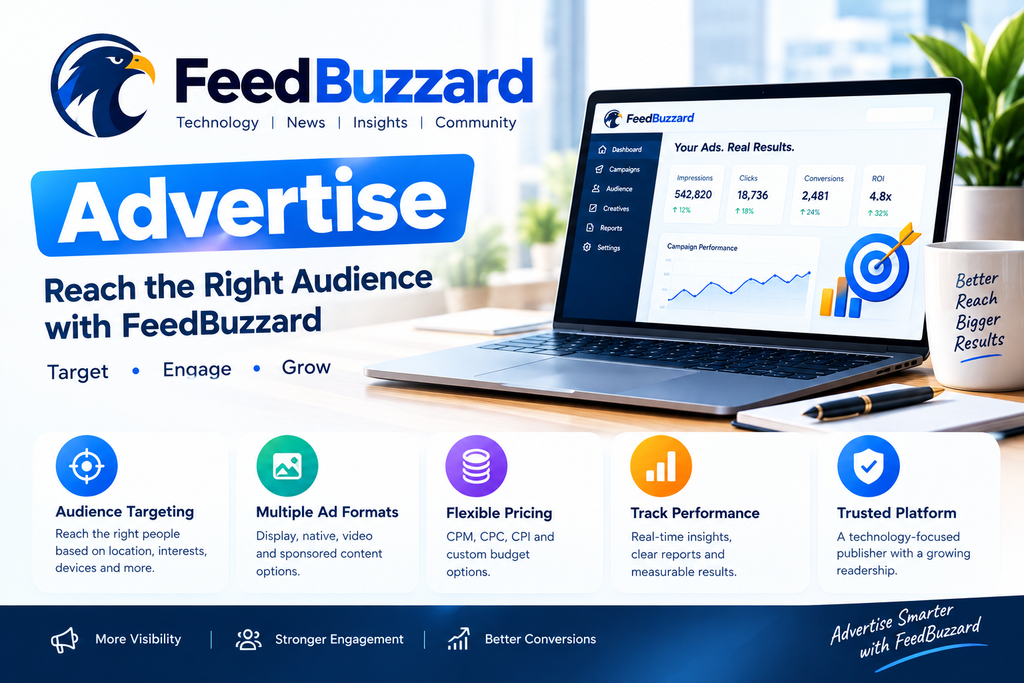
Quick Answer: What Does FeedBuzzard Advertise Mean?
FeedBuzzard advertise refers to advertising opportunities described by FeedBuzzard for marketers and businesses. Its published advertising guide discusses formats, audience targeting, budgets, campaign management, and performance measurement. The platform’s material also mentions CPM, CPC, and CPI pricing models.
The most important point is that there is no clearly established public fixed rate card that should be treated as the universal price for FeedBuzzard advertising. Third-party websites publish different figures, but those figures should not automatically be interpreted as official FeedBuzzard prices.
Why Are Businesses Interested in FeedBuzzard Advertising?
Digital advertising has become increasingly fragmented. Businesses can advertise through search engines, social networks, content publishers, newsletters, applications, and specialized websites. A technology-focused publisher can provide another environment for brands that want their promotional message to appear alongside technology-related content.
FeedBuzzard’s published material emphasizes English-speaking audiences and discusses geographic, demographic, interest, keyword, and device-related targeting. It also describes campaign budgets and different pricing structures.
For a technology company, this type of environment can potentially be useful because the surrounding editorial subject matter is relevant to products such as software, applications, gadgets, digital services, artificial intelligence tools, cybersecurity products, SaaS platforms, and technology education.
However, relevance alone does not guarantee advertising performance. An advertiser still needs to examine audience quality, traffic sources, placement visibility, campaign tracking, and the actual cost of reaching potential customers.
FeedBuzzard’s Main Advertising Formats
FeedBuzzard’s 2026 advertising guide discusses multiple types of creative placements and describes requirements for advertising assets. It mentions image advertisements, video advertisements, text elements, and placements within feeds and article environments.
Native Advertising
Native advertising is designed to appear naturally within the surrounding content environment. Instead of looking like a traditional banner, the promotional material can resemble the format of the content that users are already browsing.
For a technology company, a native placement could promote a software product, application, technology service, research report, product announcement, or educational resource.
The major advantage of native advertising is contextual relevance. A person already reading technology-related content may be more receptive to another technology-related message than someone encountering an unrelated advertisement.
However, advertisers should make sure paid promotional content is clearly distinguishable from independent editorial content. Transparency is important for both readers and the advertiser’s reputation.
Display and Banner Advertising
Display advertising uses visual creative such as banners or other graphical placements. This is one of the most familiar forms of online advertising.
A banner campaign can be useful when the primary objective is brand visibility rather than detailed product explanation. A technology company may use a banner to introduce a brand name, promote a product launch, advertise a special offer, or encourage users to visit a landing page.
The effectiveness of a banner depends heavily on its location, size, visibility, creative quality, audience relevance, and frequency.
A banner placed in a low-visibility location should not be evaluated in the same way as a prominent placement near the beginning of an article or within a high-traffic section.
Video Advertising
Video can communicate more information than a static image. Product demonstrations, application walkthroughs, technology explanations, interviews, and launch announcements can all benefit from video.
FeedBuzzard’s advertising material discusses video creative requirements, including MP4 video with H.264 encoding.
Video advertising can be particularly useful for technology products because many products require explanation before a potential customer understands their value.
The main challenge is that video advertising generally requires more creative preparation than a simple banner. The advertiser needs a clear opening message, strong visuals, appropriate duration, and a compelling reason for the viewer to continue watching.
Sponsored Articles
Sponsored articles are another promotional format associated with the FeedBuzzard advertising discussion. A sponsored article gives a business more space to explain its product, service, research, or brand.
This format is particularly relevant when the product cannot be explained effectively through a short advertisement.
For example, a cybersecurity company might use a detailed article to explain a security problem before introducing its product. A SaaS company could explain an industry challenge and then demonstrate how its software addresses that challenge.
Advertisers should confirm the editorial rules, labeling requirements, link policies, publication duration, and approval process before purchasing a sponsored article.
FeedBuzzard Advertising Pricing
Pricing is one of the most frequently searched aspects of feedbuzzard advertise, but it is also one of the areas where online information should be treated carefully.
FeedBuzzard’s published advertising material discusses pricing models including CPM, CPC, and CPI. CPM means cost per thousand impressions, CPC means cost per click, and CPI generally means cost per install. The site also discusses daily budgets and campaign limits.
However, a publicly verified universal price list is not clearly established in the sources reviewed.
Several third-party websites publish specific figures for FeedBuzzard advertising. Some describe minimum deposits or estimated CPM and CTR ranges, while others provide guest-post prices. These numbers vary significantly between sources. More importantly, some of those sources explicitly acknowledge that their figures are industry benchmarks or estimates rather than FeedBuzzard-reported campaign results.
Therefore, an advertiser should not assume that an amount published on an unrelated blog represents the current official FeedBuzzard rate.
CPM, CPC, and CPI Explained
Understanding pricing models makes it easier to evaluate an advertising quotation.
CPM
CPM stands for cost per thousand impressions. Under this model, an advertiser pays according to the number of times an advertisement is displayed.
CPM can be useful for campaigns focused on visibility and brand awareness. For example, a technology company launching a new product may want to maximize exposure among a relevant audience rather than pay only when someone clicks.
CPC
CPC means cost per click. The advertiser pays when a user clicks the advertisement.
CPC can be useful when the goal is to generate visits to a website, product page, application page, or landing page. However, a click is not the same thing as a sale or lead, so advertisers should measure what happens after the visitor arrives.
CPI
CPI generally means cost per install. It is particularly relevant to mobile applications because the advertiser’s desired action is an installation.
For example, an application developer could use an installation-focused campaign where the advertising objective is to encourage users to download an app.
Audience Targeting
FeedBuzzard’s advertising guide discusses several targeting methods, including demographics, interests, keywords, geography, devices, operating systems, and audience-related targeting.
Geographic targeting can help advertisers focus on specific countries or regions. This is useful for businesses whose products are available only in particular markets.
Device and operating-system targeting can also matter. A mobile application developer, for example, may have different objectives for Android and iOS users.
Interest and keyword targeting can provide additional relevance by connecting promotional material with subjects that are related to the advertiser’s product.
However, advertisers should confirm which targeting options are currently available and how each option is implemented before planning a campaign around a specific targeting feature.
How to Prepare a FeedBuzzard Advertising Campaign
A successful campaign starts before the advertisement is submitted.
The first step is to define a single primary objective. The campaign might focus on website traffic, product awareness, leads, application installations, or another measurable action.
The second step is identifying the intended audience. An advertiser should know the target country, language, age group where applicable, interests, devices, and the problem that the product solves.
The third step is preparing the creative material. Images should communicate the core message quickly, while video should make its value clear during the opening moments. Text should remain concise enough to avoid unnecessary truncation.
The fourth step is preparing the destination page. Sending users to a slow, confusing, or irrelevant landing page can waste advertising expenditure even when the advertisement itself performs well.
The fifth step is tracking results. A campaign should have measurable indicators such as clicks, conversions, leads, installations, or sales.
FeedBuzzard’s own advertising guide discusses campaign setup, creative uploads, campaign objectives, audience selection, budgets, conversion tracking, previews, approval, and monitoring during the initial campaign period.
Measuring FeedBuzzard Advertising Performance
Advertising should not be evaluated solely by impressions.
A campaign can generate thousands of impressions without producing meaningful business results. Similarly, a campaign with a relatively small number of impressions can produce valuable customers if the audience is highly relevant.
Important measurements include impressions, clicks, click-through rate, conversion rate, cost per click, cost per acquisition, leads, sales, and return on advertising spend.
For example, suppose an advertiser spends $100 and receives 500 clicks. The CPC would be $0.20. If those visitors generate 10 leads, the cost per lead would be $10.
These calculations help advertisers evaluate the actual business outcome rather than focusing only on traffic volume.
The Serious Problem: Unverified Pricing and Performance Claims
One of the biggest problems surrounding the feedbuzzard advertise keyword is the large amount of inconsistent information published by third-party websites.
Some articles claim exact prices, specific minimum deposits, particular CTR figures, advertising dashboards, or detailed campaign capabilities. Other articles explicitly state that these numbers are estimates or general industry benchmarks rather than verified FeedBuzzard statistics.
This creates a serious risk for advertisers because a person could mistake a third-party estimate for an official price.
Quick Solution
Do not rely on a third-party article as the final source for FeedBuzzard advertising prices or campaign performance. Before paying, obtain the current terms directly from FeedBuzzard, request the available advertising information or media kit, confirm the exact placement, duration, audience, pricing model, tracking method, and refund or cancellation terms, and start with a controlled test budget rather than committing a large amount immediately.
This approach does not assume that the platform is good or bad. It simply reduces the risk created by incomplete public information.
How to Verify a FeedBuzzard Advertising Opportunity
Before paying for an advertising placement, an advertiser should confirm that the communication is actually coming from the legitimate publisher or an authorized advertising representative.
The advertiser should verify the exact domain, ask for the current media kit or advertising terms, and request written confirmation of the agreed placement.
The advertiser should also ask where the advertisement will appear, how long it will remain active, whether the placement is guaranteed, what audience is expected to see it, and how performance will be measured.
If a seller provides traffic or audience statistics, those figures should be examined carefully. A large number of page views does not automatically mean that an advertiser will receive valuable customers.
Third-party research into FeedBuzzard advertising similarly recommends checking traffic, requesting placement details, and distinguishing direct publisher pricing from reseller or broker pricing.
FeedBuzzard Advertise and Guest Posting
Another reason the keyword attracts attention from SEO professionals is that some third-party websites discuss FeedBuzzard in connection with sponsored posts and guest-post placements.
This is different from conventional advertising.
A banner advertisement is primarily designed to generate visibility or clicks. A sponsored article provides editorial-style space for promotional information. A guest post may also be purchased for content marketing or backlink purposes.
Several third-party articles claim that FeedBuzzard placements are available through SEO marketplaces, sometimes quoting prices around the $150–$200 range. However, those figures are marketplace claims rather than a confirmed universal FeedBuzzard rate.
Anyone interested specifically in SEO backlinks should therefore verify the actual link attributes, editorial requirements, permanence, indexing status, and sponsorship labeling rather than relying on a marketplace description.
Who May Benefit From FeedBuzzard Advertising?
Technology companies are an obvious potential audience for a technology-oriented publisher.
Software companies can use advertising to introduce new applications or services. SaaS companies can promote trials, product demonstrations, and educational resources. Gadget manufacturers can promote product launches and reviews. Digital agencies can use sponsored content to explain specialized services.
Technology educators and publishers may also use promotional campaigns to introduce courses, reports, newsletters, or other digital resources.
The relevance of the audience is more important than simply having access to a website. A business selling a technology product should first establish whether FeedBuzzard’s actual audience matches the locations, interests, and purchasing behavior it needs.
What Advertisers Should Avoid
One common mistake is buying advertising solely because a website has a high claimed authority score.
Domain authority, domain rating, traffic estimates, and similar third-party metrics can be useful for research, but none of them guarantees conversions.
Another mistake is selecting a format without defining the objective. A banner may make sense for awareness, while a detailed sponsored article may make more sense for explaining a complicated service.
A third mistake is spending a large amount before conducting a small test.
A controlled campaign makes it easier to determine whether the audience is relevant before increasing the budget.
Advertisers should also avoid accepting unsupported performance guarantees. No advertising placement should automatically be assumed to deliver a particular number of sales, leads, or conversions without reliable historical evidence.
Is FeedBuzzard Advertise a Self-Service Advertising Network?
This is an area where online sources disagree.
FeedBuzzard’s own 2026 advertising guide uses terminology associated with structured advertising campaigns, including targeting, campaign budgets, creative assets, pricing models, conversion tracking, and campaign monitoring.
At the same time, several independent articles argue that public information does not clearly demonstrate a large, conventional self-service advertising network comparable to major global advertising platforms.
Because of this uncertainty, advertisers should confirm the current campaign process directly rather than assuming that every feature described by third-party websites is available.
Why Transparency Matters
Advertising transparency is important because marketers need enough information to calculate whether a campaign makes financial sense.
A clear advertising arrangement should specify what is being purchased, where the advertisement will appear, how long it will run, what pricing model is being used, and how performance will be measured.
If an advertiser receives a quotation, the quotation should ideally distinguish the media cost from additional fees such as creative production, content writing, campaign management, or third-party agency charges.
This becomes especially important when an advertiser works through a reseller or broker. A reseller may add a margin to the publisher’s underlying price. That is not necessarily a problem, but the buyer should understand what is included in the final price.
Final Takeaway
FeedBuzzard advertise is a useful search term for businesses and marketers researching promotional opportunities associated with FeedBuzzard. FeedBuzzard’s own published material describes advertising campaigns involving audience targeting, creative formats, budgets, campaign tracking, and pricing models such as CPM, CPC, and CPI.
The biggest challenge is not understanding the basic concept of online advertising. It is separating confirmed information from the many third-party claims surrounding the keyword.
There is no reliable reason to treat every published price, CTR estimate, traffic figure, or platform feature as an official FeedBuzzard statistic. Independent articles themselves acknowledge that some of the available numbers are industry benchmarks or estimates rather than FeedBuzzard-specific performance data.
For that reason, the safest advertising strategy is to verify current terms directly, obtain written pricing and placement details, establish clear campaign objectives, track measurable results, and test a manageable budget before scaling.
When approached this way, FeedBuzzard advertising can be evaluated on actual evidence rather than assumptions created by repetitive search-engine articles.
Visit: Editorial Magazine for more high quality blogs.