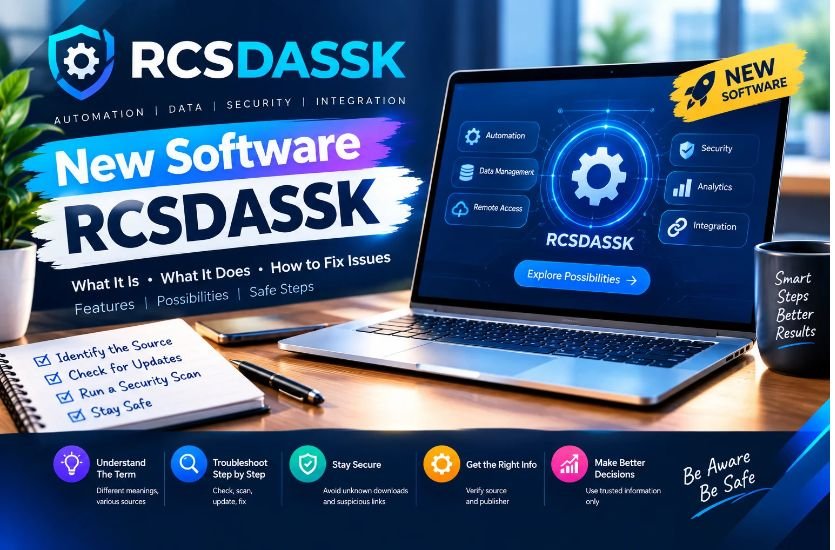
When people search for New Software RCSDASSK, they are usually looking for a simple explanation of an unfamiliar software name, a possible new digital tool, or a solution to an error they have encountered. The term has appeared across several technology and software blogs during 2025 and 2026, but researching it reveals an important problem: different websites do not consistently describe RCSDASSK in the same way.
Some online articles present RCSDASSK as a modern software platform associated with automation, data management, system integration, remote access, analytics, and security. Other sources describe it as a technical identifier, error-related term, placeholder, or an ambiguous keyword rather than a clearly established application. A 2026 analysis from SIIT specifically notes that RCSDASSK is not a clearly defined or officially recognized software product from a major technology company.
This makes it important to separate documented information from claims published on individual blogs. Rather than assuming that every description online refers to the same program, users should first determine where the term appeared and what system generated it. This article explains what is currently known about New Software RCSDASSK, why the term is confusing, possible interpretations, common problems, security considerations, and the safest way to investigate it.
What Is New Software RCSDASSK?
New Software RCSDASSK is a search term associated with an apparently unfamiliar software or technical concept. Several websites have published articles describing it as an emerging digital solution, while others take a more cautious approach and state that there is no clear evidence of a mainstream, officially documented application with this exact name.
One RCSDASSK-focused website describes the term in connection with software releases, updates, errors, troubleshooting, compatibility, and performance improvements. Another article published on the same website in July 2025 describes RCSDASSK as a proposed platform combining remote access, automation, data synchronization, analytics, security, and system integration.
However, those descriptions should be treated as claims made by the websites publishing them rather than independently verified specifications. There is currently no consistent technical documentation showing that all of these descriptions refer to one established software product.
For that reason, the most accurate way to describe New Software RCSDASSK is as an ambiguous software-related term with multiple online interpretations.
Why Is RCSDASSK Difficult to Understand?
The biggest difficulty is the lack of a consistent definition. When a well-established program is searched online, users normally find an official developer, documentation, download information, version history, support information, screenshots, reviews, and technical requirements.
RCSDASSK does not currently have that same level of independently verifiable documentation.
A 2026 TechQuite investigation points out that searches for RCSDASSK produce articles using descriptions such as AI-driven automation and enterprise software, but those articles do not consistently identify an official company, official download page, or independent product documentation. The publication therefore concludes that there is no clear, verifiable official software product under that name at present.
This does not automatically prove that every reference to RCSDASSK is meaningless. It simply means that users should not assume that every article using the keyword is describing a verified commercial application.
What Does RCSDASSK Mean?
There is no universally confirmed expansion of the term RCSDASSK.
One 2025 article expands the acronym as “Remote Control System for Data Automation, Security, and Software Kit.” That same article presents the term as the name of a multipurpose platform. However, this expansion appears to originate from the website publishing the article and should not be treated as an officially established definition without independent documentation.
Other technical discussions take a completely different approach. They suggest that RCSDASSK could be a system-generated identifier, an internal software reference, a debugging string, a placeholder, or an error-related keyword.
Therefore, if someone asks, “What does RCSDASSK stand for?” the safest answer is that there is currently no independently confirmed standard expansion of the acronym.
RCSDASSK as a Software Platform
Some online sources describe RCSDASSK as a modern digital platform intended to bring different software operations together.
According to the RCSDASSK-focused material published online, the proposed platform may involve workflow automation, remote system access, data synchronization, system monitoring, security functions, analytics, and integration between different digital environments.
The basic concept is understandable even without accepting every product claim. Modern businesses commonly use multiple applications for communication, file storage, project management, customer data, monitoring, and automation. Integration software can connect these systems and reduce repetitive manual work.
However, readers should distinguish between what modern software platforms commonly provide and what has actually been verified about RCSDASSK. The existence of similar features in established software does not prove that RCSDASSK itself provides them.
RCSDASSK and Workflow Automation
Workflow automation is one of the most frequently associated concepts in recent RCSDASSK articles.
A workflow automation system normally allows a user to create a sequence of actions that would otherwise have to be performed manually. For example, a system might move information between applications, trigger a notification after an event, organize incoming data, or start another process when a particular condition is met.
A recent RCSDASSK.org article describes its version of the RCSDASSK platform as a digital organization and workflow-efficiency tool focused on automation and system integration.
That description provides context for why the keyword is sometimes associated with productivity and automation. Nevertheless, because the underlying product documentation is limited, readers should not assume that every claimed automation capability has been independently confirmed.
RCSDASSK and Data Management
Data management is another area frequently connected with RCSDASSK.
Modern software systems often need to collect, organize, transfer, synchronize, and analyze information. A properly designed data-management system can help reduce repetitive work and improve consistency between different applications.
Some RCSDASSK articles describe the software as a platform capable of coordinating data processes and integrating information between systems.
If RCSDASSK is encountered inside an actual software environment, however, users should look at the surrounding information rather than relying only on the name. The application that generated the message, the file location, the process name, the publisher, and the operating system can provide much stronger evidence about what the term actually represents.
Could RCSDASSK Be an Error or Technical Identifier?
Yes, this is one of the possibilities discussed by recent sources.
An unusual string can appear in software when an application displays an internal identifier instead of a normal user-facing message. It can also occur in logs, debugging information, database references, scripts, plugins, APIs, or failed processes.
One February 2026 RCSDASSK article explains that unusual strings may represent system-generated codes, internal software identifiers, error tags, debug strings, placeholder variables, or backend references.
A separate 2026 guide from SIIT similarly discusses RCSDASSK as a possible debug identifier, system-generated fallback token, testing placeholder, or non-standard error label.
This interpretation is particularly important for users who did not intentionally install anything called RCSDASSK. If the term appeared suddenly inside an error message, log file, browser page, or application window, it may not represent a separate program at all.
Common RCSDASSK Problems
The phrase “RCSDASSK problem” can refer to several different situations because the term itself does not have one confirmed technical meaning.
A user might encounter the name during installation, while opening a program, after an update, inside a system log, or on a website. The correct solution depends on the environment in which it appears.
The RCSDASSK website identifies outdated software, incorrect installation, damaged files, compatibility problems, and insufficient system resources as possible causes of software-related problems.
These are general troubleshooting possibilities rather than confirmed causes of a specific RCSDASSK error.
Quick Answer: What Should You Do If RCSDASSK Causes an Error?
If New Software RCSDASSK appears as an unexpected error or unknown program on your device, do not immediately download another file claiming to “fix” it.
First, identify where the term appeared. Check the name of the application, the complete error message, the file or process location, and the date when the problem started. If the problem began after installing unfamiliar software, remove that software only after confirming what it is and backing up important data.
Next, restart the device and install legitimate operating-system and application updates from the original developer or operating-system provider. If the problem continues, run a reputable security scan and check whether the suspicious process or file has a verified publisher.
The most important solution is source verification. Because RCSDASSK does not currently have a consistently documented official product identity, downloading an unknown “RCSDASSK fix” from an unrelated website could create a greater security risk than the original problem.
How to Troubleshoot an RCSDASSK-Related Issue
Identify Where the Term Appears
Start by recording exactly where you saw RCSDASSK. An error appearing inside a browser is very different from an executable process appearing in Windows Task Manager.
The surrounding text can provide valuable clues. If the message contains a program name, file path, error number, publisher, or module name, record that information before attempting major changes.
Restart the System
A restart is a simple first step when dealing with temporary software conflicts. Background processes, incomplete updates, memory problems, and temporary application failures can sometimes disappear after restarting.
A restart does not prove that RCSDASSK has been fixed, but it can help determine whether the issue is temporary or persistent.
Check Recent Software Changes
Think about what changed immediately before the problem appeared. A newly installed application, browser extension, driver, operating-system update, plugin, or security program can create compatibility problems.
If the RCSDASSK message appeared immediately after a particular installation, that installation deserves closer investigation.
Update Trusted Software
Outdated applications can contain compatibility problems and known bugs. If the software generating the RCSDASSK message has an official update mechanism, use that mechanism rather than downloading replacement files from random websites.
Operating-system updates should also be installed through the normal system settings.
Check the File Location
If RCSDASSK appears as a process or executable, inspect its file location before assuming that it is legitimate or malicious.
A recognized publisher and an expected installation directory provide useful evidence. An unfamiliar executable located in a temporary directory or an unexpected user folder deserves additional investigation.
The name alone is not enough to determine whether a file is safe.
Is New Software RCSDASSK Safe?
There is not enough reliable evidence to declare a generic RCSDASSK file or program safe or unsafe.
This distinction matters because several websites use the term differently. A website discussing RCSDASSK does not automatically establish that an executable using the same name is legitimate.
The RCSDASSK.com domain itself has been assessed by ScamAdviser. Its report notes a valid SSL certificate and some positive technical indicators, but also identifies the site’s young age, hidden WHOIS ownership, low traffic ranking, and other factors that warrant caution. The report does not establish that RCSDASSK software itself is malicious.
Therefore, users should avoid both extremes. It would be inaccurate to say that RCSDASSK is definitely malware, but it would also be premature to claim that every RCSDASSK-related download is trustworthy.
Should You Download RCSDASSK?
Users should not download an unfamiliar RCSDASSK file simply because a search result describes it as “new software.”
Before installing any unknown program, verify the developer, official distribution source, digital signature where applicable, version information, system requirements, privacy policy, and independent reputation.
If none of those details can be established, there is little reason to take unnecessary installation risks.
This is especially important when a website asks users to disable antivirus protection, run an unknown executable as administrator, replace system files, or install unrelated browser extensions as part of a supposed RCSDASSK fix.
Why Are There So Many Articles About RCSDASSK?
The unusual amount of content surrounding a poorly documented term is itself worth examining.
TechQuite argues that RCSDASSK may be an example of a search-driven content cycle in which websites see an unusual keyword and publish articles attempting to rank for it. Once several pages exist, additional websites may create their own explanations, even when the underlying product has not been independently verified.
SIIT also describes RCSDASSK as a multi-interpretation technical keyword and notes that its appearance across different contexts contributes to confusion.
This explains why readers may encounter apparently authoritative articles that make very different claims about the same term.
What Can Actually Be Confirmed?
The strongest conclusion from the available information is that RCSDASSK is an online software-related keyword with no consistently verified identity as a mainstream standalone software product.
There are websites that describe it as a platform for automation, data management, remote access, security, and integration. There are also websites that describe it as an error, identifier, placeholder, or technical reference.
Because these descriptions conflict, readers should not treat promotional descriptions as established technical facts.
The safest interpretation depends on context. If RCSDASSK appears in a product advertisement, investigate the company and distribution source. If it appears in an error message, investigate the application that generated the message. If it appears in a system log, examine the associated process, file path, timestamp, and surrounding entries.
New Software RCSDASSK and Future Updates
If RCSDASSK eventually becomes a genuine, independently documented software product, reliable information should become easier to find.
A mature software product normally develops an identifiable publisher, official documentation, version history, support resources, privacy information, installation instructions, and independent user or technical coverage.
Until those elements are consistently available, users should treat claims about future RCSDASSK releases, advanced AI functions, enterprise capabilities, pricing, and specific system requirements as unverified unless they can be confirmed through authoritative documentation.
Final Thoughts
New Software RCSDASSK is an unusual search term because the online information surrounding it is much more extensive than the independently verifiable information about the supposed software itself.
Some websites describe RCSDASSK as a modern platform involving automation, integration, data management, analytics, remote access, and security. Other sources argue that it may instead be a technical identifier, error reference, placeholder, or search-driven keyword.
For users, the practical lesson is simple: do not judge an unfamiliar program by its name alone. Find out where RCSDASSK appeared, identify the software or process associated with it, verify the publisher, and use trusted update and security mechanisms.
If RCSDASSK is causing an error, the safest first response is to document the complete error message, identify the application responsible, update legitimate software, restart the system, and scan unfamiliar files before downloading any supposed repair tool.
At present, the evidence supports treating RCSDASSK as an ambiguous and insufficiently documented software-related term, rather than confidently presenting it as a verified mainstream software application.
Visit: Editorial Magazine for more informational blogs