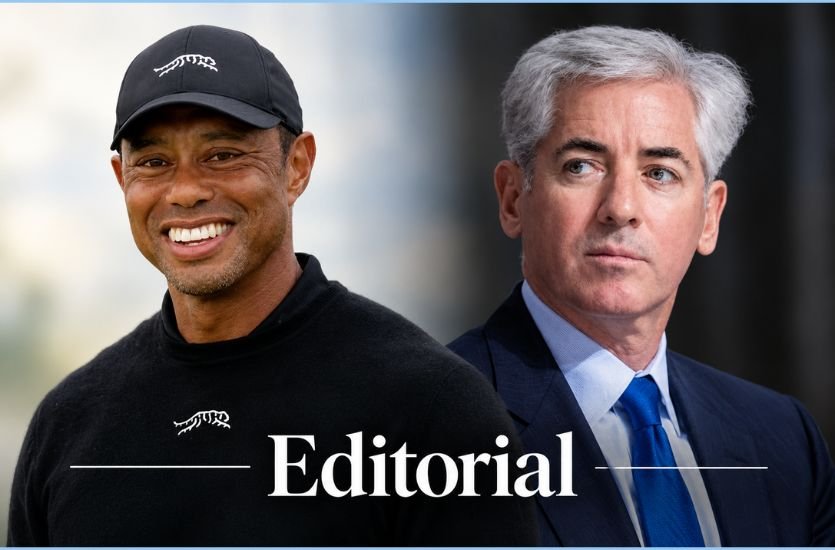
Tiger Woods and Bill Ackman are prominent figures in two different industries: professional golf and investment management. Woods built an international reputation through championship victories and commercial partnerships, while Ackman became known for his investment strategies and leadership of Pershing Square Capital Management. Although their careers followed different paths, their names are connected through Nike, the global sportswear company that sponsored Woods for more than 27 years and later became an investment for Ackman’s firm.
Understanding the relationship between Tiger Woods and Bill Ackman requires looking beyond their public profiles. Their connection illustrates how professional athletes can influence a company’s brand identity while investors evaluate that same company’s financial performance and future potential. However, it is important to distinguish this indirect corporate connection from a direct business partnership between the two men.
Quick Bio: Tiger Woods and Bill Ackman
| Detail | Tiger Woods | Bill Ackman |
|---|---|---|
| Full name | Eldrick Tont Woods | William Albert Ackman |
| Known as | Tiger Woods | Bill Ackman |
| Nationality | American | American |
| Profession | Professional golfer and entrepreneur | Investor and hedge fund manager |
| Main achievement | 15 men’s major golf championships | Founder of Pershing Square Capital Management |
| Major organization | TGR | Pershing Square |
| Nike connection | Long-term athlete and brand ambassador | Investment through Pershing Square |
| Main industry | Sports and golf | Finance and investment management |
Who Is Tiger Woods?
Tiger Woods is one of the most recognizable athletes in modern sports history. Born Eldrick Tont Woods on December 30, 1975, in Cypress, California, he developed an interest in golf at a very young age. His father, Earl Woods, introduced him to the sport, and Tiger’s early appearances demonstrated the potential that would later transform professional golf.
Woods became widely known as an exceptional amateur golfer before turning professional in August 1996. His arrival attracted considerable attention because of his technical ability, competitive confidence, and capacity to appeal to audiences beyond traditional golf fans. His professional success soon established him as one of the sport’s leading figures.
In 1997, Woods won the Masters Tournament by 12 strokes, setting a record for the largest winning margin at that tournament. The victory made him the youngest Masters champion at the time and marked a defining moment in his career. Over the following years, he collected major titles and became a central figure in golf’s international popularity.
Woods has won 15 men’s major championships and 82 PGA TOUR events. His major victories include five Masters titles, four PGA Championships, three U.S. Open titles, and three Open Championships. These accomplishments place him among the most successful golfers in history.
His influence extends beyond tournament results. Woods helped attract new audiences to golf, increased interest in televised competitions, and became an internationally recognized sports personality. His presence also created commercial opportunities for brands seeking to reach sports fans through athlete endorsements.
Woods’ career has included serious injuries, personal challenges, and extended periods away from competition. Nevertheless, his return to win the 2019 Masters demonstrated his ability to compete successfully after significant setbacks. That victory became one of the defining moments of his later career.
Beyond professional golf, Woods developed business and philanthropic activities under the TGR umbrella. These include golf-related ventures, educational initiatives, and projects designed to support young people. His career illustrates how elite athletes can build businesses and charitable organizations alongside their sporting achievements.
Who Is Bill Ackman?
Bill Ackman is an American investor best known for founding Pershing Square Capital Management in 2003. The investment firm became recognized for taking significant positions in publicly traded companies and analyzing how management decisions, business strategies, and market conditions affect shareholder value.
Ackman studied at Harvard University, earning an undergraduate degree from Harvard College and an MBA from Harvard Business School. His academic background helped prepare him for a career focused on corporate finance, investment research, and business strategy.
Before establishing Pershing Square, Ackman co-founded Gotham Partners, an investment management firm. His experience there helped shape his approach to evaluating companies and identifying opportunities where he believed business performance could improve.
Pershing Square became particularly associated with activist investing. This strategy involves acquiring an ownership stake in a company and, in some circumstances, advocating changes intended to improve its performance or increase shareholder value. Such changes can involve leadership, operations, capital allocation, or broader corporate strategy.
Ackman’s investment career has included prominent positions in businesses across several industries. His public profile increased through investments involving companies such as Chipotle Mexican Grill, Canadian Pacific Railway, and other major corporations. His strategies have generated both substantial gains and significant controversy, reflecting the risks associated with concentrated investment decisions.
Unlike Tiger Woods, whose professional achievements are measured largely through tournament victories and sporting records, Ackman’s career is evaluated through investment performance, capital allocation, and business decisions. Both, however, operate in environments where public reputation and confidence can influence commercial outcomes.
Ackman has also supported philanthropic initiatives through the Pershing Square Foundation, which he established with his wife, Neri Oxman. The foundation supports selected projects in areas including education, healthcare, scientific research, and social innovation.
His role in investment management explains why Nike became relevant to his professional activities. For Ackman, Nike represented a publicly traded company whose brand strength, market position, business decisions, and financial outlook could be evaluated as an investment opportunity.
The Nike Connection Between Tiger Woods and Bill Ackman
The most clearly documented connection between Tiger Woods and Bill Ackman is Nike. However, they interacted with the company in different ways.
Woods represented Nike as an athlete, wearing its apparel and promoting its products through his public profile. Ackman, through Pershing Square, acquired shares in Nike as part of an investment strategy.
These relationships intersect at the corporate level. Woods contributed to Nike’s visibility in professional golf, while Ackman’s firm evaluated Nike as a business in which to invest capital.
The distinction matters because an athlete endorsement and a stock investment are fundamentally different arrangements. An endorsement typically involves a commercial agreement under which an athlete represents a brand. A stock investment involves acquiring an ownership interest in a company and accepting the financial risks associated with its performance.
There is no established evidence that Woods and Ackman entered a direct business partnership, jointly managed an enterprise, or collaborated on Nike’s commercial strategy. Their association is best understood through their separate relationships with the same company.
Tiger Woods and Nike: A Historic Sports Partnership
Tiger Woods began his Nike relationship in 1996, when he entered professional golf. The partnership became one of the most recognizable athlete-brand relationships in sports, linking Nike’s marketing ambitions with Woods’ extraordinary achievements on the course.
Nike was already building its reputation through prominent athletes and sports sponsorships. Woods offered an opportunity to strengthen the company’s position in golf while reaching viewers who might not previously have followed the sport closely.
The partnership developed alongside Woods’ rise to international fame. As he won major tournaments and became one of golf’s most influential personalities, Nike products appeared throughout his professional career. His clothing, footwear, advertising campaigns, and signature branding helped establish a recognizable association between the golfer and the company.
One of the most familiar images in professional golf was Woods wearing a red shirt during the final round of major championships. Over time, this became closely associated with his public identity and Nike’s golf marketing.
The relationship also extended beyond apparel. Nike previously offered golf clubs and other equipment associated with its golf division, although the company exited the golf equipment business in 2016. Woods subsequently used equipment from other manufacturers while continuing to wear Nike apparel for several years.
The partnership lasted more than 27 years before ending in January 2024. Woods publicly acknowledged the conclusion of the relationship and thanked Nike co-founder Phil Knight and the company’s employees for their role in the partnership.
The end of the agreement marked a significant change in Woods’ commercial career. He subsequently launched Sun Day Red, a golf apparel brand developed with TaylorMade. This move represented a new chapter in his business activities, separate from Nike and from Ackman’s investment decisions.
Woods’ Nike relationship demonstrates how long-term athlete endorsements can become closely connected to a company’s identity. His association with the brand extended across victories, injuries, comebacks, and changing commercial conditions, giving the partnership a significance beyond any single advertising campaign.
Bill Ackman’s Investment in Nike
Bill Ackman’s connection to Nike developed through the financial markets rather than sports sponsorship. Pershing Square had invested in Nike before 2024, and the firm later established another position in the company during the second quarter of 2024.
In August 2024, financial reporting based on regulatory disclosures indicated that Pershing Square held approximately 3.04 million Nike shares at the end of June. The reported position was valued at approximately $229 million at that time.
The investment attracted attention because Nike was facing business challenges, including slower sales growth and increased competition in the athletic footwear and apparel market. Investors were assessing how the company could strengthen its performance, improve its product strategy, and maintain its competitive position.
Ackman’s investment approach often involves evaluating whether a company’s market position and future prospects are reflected accurately in its share price. In Nike’s case, its global brand recognition and established position in athletic apparel were important considerations in assessing its business potential.
However, an investment does not automatically indicate that an investor will influence a company’s decisions. Investors can hold shares without seeking board representation or demanding operational changes. Pershing Square’s Nike position therefore needs to be understood in the context of its investment strategy rather than assumed to be a response to Woods’ departure.
The timing is particularly important. Woods announced the end of his Nike partnership in January 2024, while Pershing Square’s renewed Nike investment became public later that year. This sequence establishes that the events occurred in the same period, but it does not prove that one caused the other.
Pershing Square subsequently changed its exposure to Nike and exited the investment in 2025, according to the firm’s later disclosures. Its experience demonstrates that even a well-known brand with a strong market position can present investment risks.
For an article about Tiger Woods and Bill Ackman, this investment history offers context for understanding why their names are associated with Nike. It does not establish that Ackman invested in Woods, financed his golf career, or participated in the decisions surrounding his endorsement agreement.
How Athlete Endorsements and Stock Investments Differ
The connection between Woods and Ackman also highlights two distinct ways people participate in the commercial success of a major brand.
An athlete endorsement is based on the commercial value of an individual’s reputation, achievements, audience, and ability to represent a product. Companies may pay athletes to wear their products, appear in advertisements, participate in promotional campaigns, or associate their public image with a brand.
For an athlete such as Woods, an endorsement agreement can provide substantial income while helping a company gain visibility and credibility among consumers. The value of such a relationship may depend on sporting achievements, public recognition, audience engagement, and the wider marketing environment.
A stock investment operates differently. Investors purchase shares in a company and potentially benefit if the value of those shares increases or if the company distributes dividends. They can also lose money if the share price declines.
Ackman’s Nike investment represented a financial position in the company rather than a sponsorship arrangement. Its outcome depended on Nike’s business performance, market expectations, share price, and the timing of the investment and exit.
The difference is important because the two arrangements create different financial incentives. An athlete may continue representing a brand under a contract even when the company’s share price fluctuates. An investor, by contrast, may buy or sell shares based on changing expectations about the company’s future.
Woods and Ackman therefore illustrate two separate roles in the business world. One helped promote Nike through a long-term sporting relationship, while the other evaluated Nike as a potential investment.
Did Bill Ackman Invest in Tiger Woods?
There is no reliable public evidence establishing that Bill Ackman or Pershing Square directly invested in Tiger Woods personally.
The documented investment involved Nike shares. Purchasing stock in Nike gives an investor an ownership interest in Nike, not in every athlete who has represented the company.
Woods has his own commercial activities through TGR and his golf-related business ventures. These activities are distinct from Nike’s corporate ownership structure and Pershing Square’s investment portfolio.
It is also important not to confuse an athlete’s endorsement income with investment capital. Woods received compensation through his commercial relationship with Nike, while Pershing Square invested money in the company itself. These arrangements do not demonstrate a direct financial transaction between Woods and Ackman.
Without credible documentation of a joint venture, personal investment, or other formal agreement, claims that Ackman financed Woods or owns a stake in his personal business interests should not be presented as facts.
Are Tiger Woods and Bill Ackman Friends or Business Partners?
Publicly available evidence does not establish that Tiger Woods and Bill Ackman are close personal friends or formal business partners.
Both men are prominent Americans whose professional activities intersect with major corporations, wealthy investors, and influential public figures. Their participation in overlapping commercial environments, however, does not prove that they have a personal relationship.
A documented business partnership would ordinarily require evidence such as a joint venture announcement, a shared company role, a formal agreement, or reliable reporting that identifies the parties’ collaboration. No such evidence has been established for Woods and Ackman.
Their connection through Nike is sufficient to explain why their names may appear together in discussions about sports, business, and finance. It is not sufficient to conclude that they have collaborated directly.
For readers researching the topic, this distinction is especially useful because online articles sometimes combine unrelated details about prominent people to suggest a stronger relationship than the available evidence supports.
Why the Tiger Woods and Bill Ackman Connection Matters
The relationship between Woods, Ackman, and Nike provides a useful example of how a single corporation can connect individuals from very different professional backgrounds.
Woods demonstrates the commercial influence that an athlete can develop through exceptional performance and sustained public recognition. His long-running Nike partnership helped connect the company’s products with some of golf’s most memorable moments.
Ackman’s investment history illustrates another side of corporate influence. Investors evaluate companies based on their competitive advantages, business performance, leadership, and future prospects. A well-known brand may attract investment because of its market position, but that reputation does not eliminate financial risk.
Nike’s experience also shows how corporate relationships evolve. Athlete sponsorships can end, marketing strategies can change, and investors can enter or exit positions as their views about a company’s prospects develop.
These developments are related through Nike’s business environment, but they should not be confused with direct collaboration between every individual involved. Woods’ departure from Nike and Pershing Square’s investment decisions were separate events unless reliable evidence establishes otherwise.
The broader lesson is that sports branding and investment management can intersect without creating a personal or professional partnership between the people associated with them.
Frequently Asked Questions
What is the connection between Tiger Woods and Bill Ackman?
Their clearest documented connection is Nike. Woods represented the company as a professional golfer for more than 27 years, while Ackman’s investment firm purchased Nike shares. Their relationships with Nike were separate, and no direct partnership has been established.
Did Bill Ackman invest in Tiger Woods?
There is no reliable public evidence establishing a direct investment by Ackman in Woods personally. Pershing Square’s documented investment involved Nike, the publicly traded sportswear company.
When did Tiger Woods leave Nike?
Woods announced the end of his Nike partnership on January 8, 2024. The relationship had begun in 1996 and lasted more than 27 years.
What is Bill Ackman known for?
Ackman is known for founding Pershing Square Capital Management and pursuing high-profile investment strategies. His work includes investments in major publicly traded companies and efforts to improve shareholder value.
Is Tiger Woods a business partner of Bill Ackman?
No formal business partnership between the two has been established in the publicly available evidence reviewed. Their association is indirect and primarily connected to Nike.
Does Pershing Square still hold its Nike investment?
Pershing Square exited its Nike investment in 2025, according to subsequent disclosures. The investment was separate from Woods’ former endorsement agreement.
Conclusion
Tiger Woods and Bill Ackman represent two different forms of commercial influence. Woods became a global sports icon through his golf achievements and long-standing brand partnerships, while Ackman established his reputation through investment management and corporate analysis.
Their strongest documented connection is Nike. Woods represented the company for more than 27 years, helping make its golf apparel recognizable worldwide. Ackman, through Pershing Square, invested in Nike shares as part of his broader investment activities before eventually exiting the position.
Although these connections provide an interesting intersection between sports and finance, there is no established evidence that Woods and Ackman are direct business partners or that Ackman invested in Woods personally. Understanding this distinction makes it possible to explain the subject accurately without overstating their relationship.
The story ultimately illustrates how athletes, global brands, and investors can become connected through the same company while maintaining entirely separate professional interests.
READ MORE : Dave Calhoun and María Asunción Aramburuzabala
READ MORE : Bianca Beets


One thought on “Tiger Woods and Bill Ackman: The Nike Connection Between Golf and Investment”