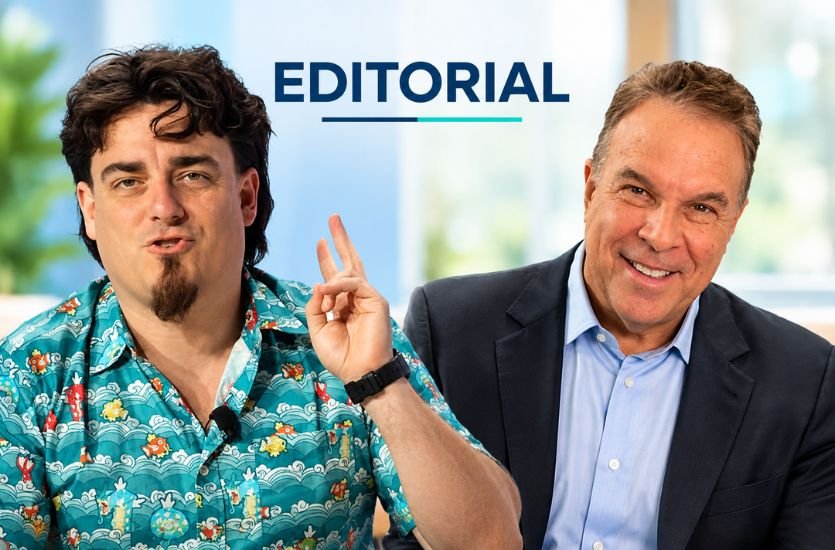
Palmer Luckey and Jeff Greene are American entrepreneurs known for building substantial wealth through different business strategies. Palmer Luckey became widely recognized for his work in virtual reality and later established himself in the defense technology industry through Anduril Industries. Jeff Greene built his fortune primarily through real estate investments and financial-market strategies, including a major position against subprime mortgage-backed bonds before the 2008 financial crisis. Although both men are associated with entrepreneurship, investment, and considerable wealth, their professional backgrounds reveal two distinct approaches to business.
The keyword Palmer Luckey and Jeff Greene brings together two business figures whose careers illustrate how opportunities in technology, property, and financial markets can produce very different paths to success. Understanding their backgrounds requires examining their early lives, education, major business ventures, investment decisions, and influence on their respective industries. It is also important to distinguish a comparison between the two men from a documented personal or professional relationship, as their shared appearance in online searches does not establish that they are relatives, business partners, or collaborators.
Quick Bio: Palmer Luckey and Jeff Greene
| Detail | Palmer Luckey | Jeff Greene |
|---|---|---|
| Full name | Palmer Freeman Luckey | Jeff Greene |
| Nationality | American | American |
| Profession | Inventor, entrepreneur, technology founder | Real estate investor and entrepreneur |
| Known for | Oculus VR and Anduril Industries | Real estate investments and financial-market strategies |
| Major industries | Virtual reality, artificial intelligence, defense technology | Real estate, finance, property development |
| Major business milestone | Facebook’s acquisition of Oculus VR in 2014 | Profiting from investments tied to the subprime mortgage crisis |
| Education | Attended California State University, Long Beach | Johns Hopkins University and Harvard Business School |
| Business approach | Building and developing technology companies | Acquiring property and investing in financial markets |
Who Is Palmer Luckey?
Palmer Luckey is an American inventor and entrepreneur who helped bring modern virtual reality to a wider audience. He became internationally known after developing the Oculus Rift, a virtual-reality headset designed to provide an immersive digital experience. His early work attracted the attention of technology investors, game developers, and major companies interested in the future of interactive entertainment.
Luckey’s career demonstrates how technical experimentation can develop into a major commercial enterprise. Rather than beginning with an established technology corporation, he pursued his interest in electronics and virtual reality through independent projects. His willingness to experiment with available hardware helped him develop an early headset that attracted attention from people who believed immersive computing could become a significant consumer market.
His professional story later expanded beyond entertainment. After the sale of Oculus VR, Luckey founded Anduril Industries, a company focused on defense technology, autonomous systems, sensors, and artificial intelligence. This transition connected his experience in hardware and software development with a sector that traditionally relied on established defense contractors.
Palmer Luckey’s Early Life and Interest in Technology
Palmer Luckey grew up in Long Beach, California, where he developed an interest in computers, electronics, and video games. He spent considerable time experimenting with computer components and modifying hardware to improve performance. His interest in immersive gaming eventually led him to investigate virtual-reality headsets and the technical limitations that had prevented many earlier products from becoming successful consumer devices.
Virtual reality had existed for decades before Luckey entered the industry. Researchers and companies had experimented with head-mounted displays, motion tracking, and computer-generated environments, but many products were expensive, uncomfortable, or limited by display quality and processing power. Luckey became interested in whether relatively affordable components could be combined to produce a more accessible experience.
He began building and modifying headsets using components available to independent developers. These experiments helped him understand the relationship between display resolution, field of view, latency, motion tracking, and immersion. His work was not simply about creating a screen that users could wear. It involved addressing several technical problems that affected how convincing and comfortable a virtual environment could feel.
Luckey also pursued college-level education at a young age, attending institutions including Golden West College and Long Beach City College before studying at California State University, Long Beach. He eventually left university to concentrate on Oculus VR. His decision illustrates a career path in which a developing commercial opportunity became more important to his immediate professional plans than completing a traditional academic route.
Oculus VR and the Rise of Virtual Reality
In 2012, Palmer Luckey founded Oculus VR and introduced the Oculus Rift development project. The project attracted attention from gaming enthusiasts and developers who wanted a more immersive way to experience digital environments. A crowdfunding campaign helped demonstrate that there was meaningful interest in the technology, while subsequent investment supported further development.
Oculus became an important name in the revival of consumer virtual reality. The company worked on improving headset hardware, developer support, and the software ecosystem required to create interactive experiences. Its progress encouraged game studios and technology companies to pay closer attention to virtual reality as a potential platform for entertainment, communication, simulation, and training.
One of the company’s defining milestones came in 2014, when Facebook acquired Oculus VR. The transaction was announced with a value of approximately $2 billion, with some institutional accounts describing the deal at around $2.3 billion when additional considerations are included. The acquisition reflected Facebook’s interest in immersive computing and its belief that virtual reality could become an important part of future digital experiences.
The deal placed Oculus within a much larger technology organization and gave the company access to substantial resources. It also made Luckey a prominent young entrepreneur in the technology industry. The acquisition demonstrated that a project developed by an independent inventor could attract the interest of a major corporation when it addressed an emerging market with significant growth potential.
However, the acquisition did not mean that virtual reality immediately became a universal consumer product. Hardware costs, comfort, processing requirements, software availability, and the need for compelling experiences continued to influence adoption. Nevertheless, Oculus helped accelerate investment and competition in the industry, contributing to the broader development of consumer VR.
Why Palmer Luckey Founded Anduril Industries
Palmer Luckey’s career took a different direction in 2017 when he founded Anduril Industries with a group of co-founders. The company focuses on developing technology for defense and national security, including autonomous systems, surveillance equipment, sensors, and software that helps operators interpret information from complex environments.
Luckey’s interest in defense technology developed partly through earlier exposure to research involving virtual reality and military applications. He became interested in how modern computing, software development, and hardware design could be applied to problems involving national security. His experience with consumer technology also influenced his view that some defense systems could benefit from faster development cycles and more integrated software.
Anduril’s approach differs from the business model of a traditional defense contractor in several respects. It emphasizes combining hardware, software, sensors, and artificial intelligence into connected systems. Rather than treating every piece of equipment as an isolated product, the company develops technologies intended to share information and support coordinated operations.
Its portfolio has included autonomous aerial systems, underwater vehicles, surveillance platforms, and other defense-related products. These technologies are designed for applications such as monitoring large areas, collecting information, detecting potential threats, and supporting military operations. The precise capabilities and operational performance of individual systems depend on the product and the circumstances in which it is used.
Anduril’s growth has made Luckey a significant figure in the expanding defense technology sector. The company has also attracted debate about the role of private technology businesses in military affairs. Supporters argue that newer companies can accelerate innovation and provide modern capabilities, while critics raise questions about autonomous weapons, surveillance, accountability, and the appropriate limits of artificial intelligence in warfare.
These debates are central to understanding Luckey’s current professional identity. His work is no longer confined to consumer entertainment or gaming hardware. It sits at the intersection of technology development, public procurement, national security, and ethical questions about the use of increasingly autonomous systems.
Who Is Jeff Greene?
Jeff Greene is an American real estate investor and entrepreneur whose wealth grew through property investments and financial-market decisions. Unlike Palmer Luckey, whose career began with technology development, Greene built his professional reputation through acquiring property, managing investment risks, and identifying opportunities in changing markets.
Greene grew up in Worcester, Massachusetts. During his early years, he worked various jobs and relied on financial assistance, employment, and other resources to support his education. His background has frequently been discussed in profiles of his career because it contrasts with the substantial investment portfolio he later developed.
He attended Johns Hopkins University and subsequently earned an MBA from Harvard Business School. His education provided exposure to business management and finance, but his investment career also depended on practical experience, decisions about borrowing and property ownership, and his willingness to enter markets when prices and expectations changed.
Greene began investing in residential property while studying at Harvard Business School. Rather than treating housing solely as a personal expense, he explored the possibility of purchasing a property, living in part of it, and renting out the remaining space. Rental income could help offset ownership costs while allowing him to build an asset.
This approach helped establish his early real estate portfolio. By the time he completed his MBA, he reportedly owned 18 properties. His early experience illustrates a principle commonly associated with property investment: an asset can potentially generate income while also changing in value over time. However, property ownership also involves expenses, financing obligations, maintenance, vacancies, and market risk.
Jeff Greene’s Real Estate Investment Strategy
Real estate became the central component of Greene’s business career. Over time, he expanded beyond his initial residential investments into larger properties and more complex real estate opportunities. His investment interests have included apartment buildings, condominiums, hotels, and other property developments, particularly in markets such as South Florida and Los Angeles.
Property investment can generate returns through several channels. Owners may receive rental income, benefit from property appreciation, improve an asset and sell it at a higher price, or use financing to expand their holdings. Each strategy involves different risks, and the outcome depends on factors such as interest rates, local demand, construction costs, financing terms, and the broader economic environment.
Greene’s career also demonstrates that real estate investors must adapt to changing conditions. A property portfolio that performs well during an expansion may face difficulties when borrowing becomes more expensive or demand weakens. Investors must consider whether rental income can cover costs and whether they can meet financial obligations during a downturn.
Greene experienced challenges during earlier property-market weakness in the 1990s. Such periods can create pressure for investors because property prices may fall while financing costs and operating expenses continue. His ability to remain active in the market and pursue later opportunities became part of the broader story of his investment career.
Rather than relying exclusively on buying and holding buildings, Greene also became known for financial-market investments. His most widely discussed financial decision involved taking a position against mortgage-related securities before the housing crisis of 2008. That investment substantially increased his wealth and helped establish his reputation as an investor who was willing to act on expectations of a market decline.
How Jeff Greene Profited During the 2008 Financial Crisis
The global financial crisis of 2008 was a defining event in Jeff Greene’s financial career. In the years leading up to the crisis, the United States experienced a housing boom accompanied by extensive lending and the expansion of mortgage-backed financial products. Some borrowers received loans they struggled to repay, while financial institutions packaged mortgages into securities that were sold to investors.
As housing prices rose, many market participants assumed that property values would remain strong and that mortgage losses would remain manageable. However, when housing prices began to fall and borrowers defaulted, the weaknesses in parts of the mortgage market became increasingly apparent. Financial institutions and investors holding mortgage-related assets suffered substantial losses.
Greene positioned himself against certain subprime mortgage-backed bonds by purchasing credit default swaps. These financial contracts can provide protection against a specified credit event, depending on their terms. Investors may also use them to take a position based on the expectation that a particular debt instrument will lose value or experience a credit event.
Greene’s position benefited as the housing market deteriorated and the risks associated with subprime mortgage securities became more severe. Forbes reported that his investment produced a windfall of approximately $800 million. The gain was a major turning point in his financial history and contributed substantially to his wealth.
It is important to understand that this outcome was not a routine investment return. Credit default swaps are complex instruments whose value depends on contract terms, counterparties, market pricing, and the timing of events. An investor taking a similar position without accurate analysis or sufficient financial resources could lose a substantial amount of money.
Greene’s experience also illustrates the difference between recognizing a market risk and successfully investing against it. An investor can identify a potential problem but still lose money if the timing is wrong, the position is too expensive, or the expected event does not occur. Greene’s trade became notable because his assessment of the housing market aligned with the subsequent collapse.
Following this success, he directed significant resources toward property and other investments. His career continued to involve decisions about asset allocation, market conditions, and the balance between potential returns and financial risk.
Palmer Luckey and Jeff Greene: Similarities and Differences
The comparison between Palmer Luckey and Jeff Greene is useful because both men developed significant business interests, but they did so through different methods. Luckey’s early success involved creating a product that addressed technical challenges in an emerging industry. Greene’s early investments involved acquiring assets, generating rental income, and expanding his understanding of financial markets.
Luckey’s business model is closely associated with innovation and product development. A technology company must build products, hire specialized employees, invest in research, and respond to competition. Its future value may depend on whether its products work reliably, whether customers adopt them, and whether it can establish a sustainable position in the market.
Greene’s investment model has focused more heavily on capital allocation and asset ownership. A real estate investor evaluates properties, financing, rental income, demand, and the possibility of appreciation. Financial-market investments can add further complexity because returns may depend on credit conditions, security prices, and broader economic developments.
Their careers also demonstrate different kinds of risk. Luckey’s businesses face technological, operational, regulatory, and commercial challenges. Greene’s portfolio has faced property-market cycles, financing risks, and fluctuations in financial markets. Neither business model eliminates uncertainty; each requires decisions based on imperfect information.
There is also a difference in the industries in which they are most widely recognized. Luckey is associated with virtual reality and defense technology, while Greene is primarily associated with real estate and financial investment. These distinct areas of expertise explain why their names may appear together in comparison articles without implying that their careers are directly connected.
Are Palmer Luckey and Jeff Greene Related or Business Partners?
A common question associated with the keyword Palmer Luckey and Jeff Greene is whether the two men share a family relationship, operate a business together, or have another direct connection. Their careers are both prominent in discussions of American entrepreneurship and wealth, but that similarity is not evidence of a personal relationship.
The available biographical information establishes different professional histories. Luckey is known for Oculus VR and Anduril Industries, while Greene is known for real estate investment and his financial position during the subprime mortgage crisis. Their documented business activities belong to different areas of the economy.
Without reliable reporting or an official statement establishing a connection, it would be inaccurate to describe them as relatives, partners, or collaborators. An article comparing their achievements should therefore focus on their individual backgrounds, business decisions, and industries rather than suggesting a relationship that has not been established.
This distinction is particularly important for search-focused content. A keyword may combine two names because readers are looking for a comparison, because another website has discussed them together, or simply because users want to understand who each person is. A well-researched article should answer those questions without turning an unverified connection into a factual claim.
Jeff Greene’s Public Life and Philanthropy
Greene’s public profile extends beyond property ownership and financial investments. He entered electoral politics in Florida, running for the Democratic nomination for the U.S. Senate in 2010 and later seeking the Democratic nomination for governor in 2018. He did not win either nomination, but his campaigns brought additional attention to his background and business career.
His political activities reflected an interest in public policy and government, although running for office does not itself establish the success or effectiveness of a person’s proposed policies. His candidacies are part of his public biography rather than the primary source of his wealth.
Greene has also supported education through the Greene School in Palm Beach, Florida, which he established with his wife. The school focuses on educating students with strong academic potential. His involvement in education adds a philanthropic dimension to a career more commonly associated with investment and property.
Philanthropy can take several forms, including direct financial contributions, establishing institutions, supporting research, and funding educational opportunities. In Greene’s case, the school represents a long-term commitment to an educational institution rather than a single donation.
His public activities illustrate how wealthy entrepreneurs sometimes extend their involvement beyond their core businesses. However, philanthropy, investment, and political participation are distinct activities and should be evaluated on their own evidence.
Palmer Luckey’s Influence on Technology and Defense
Luckey’s influence is particularly visible in the transition from consumer virtual reality to defense-related technology. Oculus helped demonstrate the commercial potential of immersive headsets, while Anduril reflects a broader trend in which software-focused companies are developing products for military and national-security customers.
Artificial intelligence, autonomous vehicles, sensor networks, and data-processing systems have become increasingly important in modern defense planning. These technologies may help personnel monitor large areas, identify objects, process information, and coordinate responses. At the same time, their use creates important questions about reliability, privacy, human oversight, and accountability.
Anduril’s business model places Luckey in an industry where technical performance is only one part of success. Defense companies must also consider procurement requirements, testing, reliability, security, regulation, and the consequences of deploying their products in real-world environments.
Luckey’s career therefore offers an example of how skills developed in one sector can be applied to another. Experience with displays, computing, software, and rapid product development can be relevant to military systems, even when the customers, operating conditions, and responsibilities are very different from those in consumer entertainment.
What Palmer Luckey and Jeff Greene Reveal About Entrepreneurship
The careers of Palmer Luckey and Jeff Greene highlight two broad routes to business success. One involves creating technology that solves a problem or opens a new market. The other involves identifying assets or financial opportunities that may be undervalued, mispriced, or positioned to benefit from changing economic conditions.
Luckey’s path shows the importance of experimentation, technical development, investment, and commercial execution. His work on Oculus helped attract a major acquisition, while Anduril established a new enterprise focused on defense technology. Both ventures required more than an initial idea: they depended on turning concepts into products and building organizations capable of developing them.
Greene’s career shows how investing can involve both gradual asset accumulation and concentrated financial decisions. His early property purchases helped build a portfolio, while his position against subprime mortgage-backed bonds became a major source of wealth. His experience also demonstrates that successful investing requires understanding downside risk rather than focusing only on potential gains.
Neither story should be treated as a guaranteed formula for wealth. Luckey’s achievements depended on particular technological conditions, market interest, and the development of successful companies. Greene’s financial outcomes depended on specific property opportunities and unusual conditions in credit markets. Different circumstances could produce different results.
For readers interested in business, the central lesson is that entrepreneurship and investment involve research, risk assessment, adaptability, and execution. The details of each career matter more than simplified claims that any single strategy can reliably produce extraordinary wealth.
Conclusion
Palmer Luckey and Jeff Greene represent two different approaches to building a business career in the United States. Luckey gained recognition through virtual-reality innovation and later founded Anduril Industries, extending his work into defense technology and autonomous systems. Greene built his fortune through real estate investments and financial-market strategies, most notably his position against subprime mortgage-backed bonds before the 2008 financial crisis.
Their professional histories demonstrate how wealth can develop through very different industries and decisions. Luckey’s career emphasizes product innovation and company building, while Greene’s emphasizes asset ownership, financial analysis, and investment timing. Both have also developed public profiles beyond their original business activities, through defense technology in Luckey’s case and politics and education in Greene’s.
Although the two names appear together in the search phrase Palmer Luckey and Jeff Greene, their shared prominence in business discussions should not be mistaken for proof of a direct relationship. The most reliable comparison focuses on their independently documented careers, the opportunities they pursued, and the different risks involved in their industries. Their stories provide useful examples of how technology, real estate, and finance can shape entrepreneurial careers without offering a universal blueprint for success.
READ MORE : Li Ka-shing and Ola Källenius
READ MORE : Kevin Corke Spouse



2 thoughts on “Palmer Luckey and Jeff Greene: Careers, Wealth, Business Success, and Key Differences”