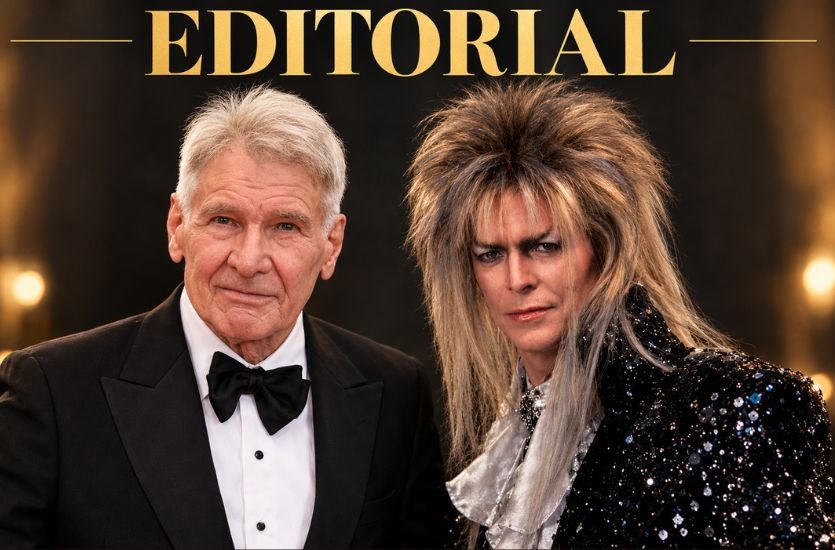
Harrison Ford and David Bowie are two influential figures whose careers helped shape modern entertainment. Ford became one of Hollywood’s most recognizable actors through memorable performances in science-fiction, adventure, and dramatic films. Bowie transformed popular music through his distinctive voice, creative reinvention, theatrical performances, and interest in futuristic ideas. Although they followed different professional paths, their names became connected through the science-fiction film Blade Runner and its sequel, Blade Runner 2049. Director Denis Villeneuve revealed that Bowie had been his first choice for a significant role in the sequel, which eventually featured Ford as the returning character Rick Deckard.
Their connection is particularly interesting because both artists developed careers that extended beyond conventional expectations. Ford built a reputation for portraying complex characters who combine strength with vulnerability, while Bowie frequently challenged the boundaries between music, fashion, performance, and cinema. Their stories demonstrate how different forms of creativity can influence the same cultural landscape, even when two artists do not share a confirmed personal relationship or appear together in a film.
Quick Biography of Harrison Ford and David Bowie
| Detail | Harrison Ford | David Bowie |
|---|---|---|
| Full name | Harrison Ford | David Robert Jones |
| Date of birth | July 13, 1942 | January 8, 1947 |
| Birthplace | Chicago, Illinois, United States | Brixton, London, England |
| Profession | Actor | Singer, songwriter, musician, actor |
| Career breakthrough | American Graffiti and Star Wars | “Space Oddity” |
| Famous roles | Han Solo, Indiana Jones, Rick Deckard | Thomas Jerome Newton, Jareth, Nikola Tesla |
| Notable film | Blade Runner | The Man Who Fell to Earth |
| Date of death | — | January 10, 2016 |
| Main legacy | Major Hollywood film performances | Music, artistic reinvention, and screen performances |
Harrison Ford’s Early Life and Journey to Hollywood
Harrison Ford was born on July 13, 1942, in Chicago, Illinois. Before becoming an internationally recognized actor, he experienced a relatively ordinary upbringing and attended college before pursuing opportunities in the entertainment industry. His early professional journey was not an immediate success, and he spent time taking smaller acting roles while developing his skills and looking for more substantial opportunities. His career eventually grew through a combination of supporting performances, persistence, and opportunities to work with influential filmmakers.
One of Ford’s important early film appearances was in American Graffiti (1973), directed by George Lucas. The film helped introduce him to a wider audience and established a professional connection with Lucas that would later prove significant. Ford subsequently appeared in Star Wars (1977), playing Han Solo, a confident but imperfect smuggler whose journey became central to the original trilogy.
Han Solo helped establish Ford as a major film star. The character was memorable because he was not presented as a conventional heroic figure from the beginning. He was independent, sarcastic, and motivated partly by personal interests, but his relationships and experiences gradually revealed a more generous and courageous side. Ford’s performance gave the character a distinctive combination of humor, confidence, and emotional depth.
Ford’s success in Star Wars opened the door to other major productions. He later became closely associated with Indiana Jones, the adventurous archaeologist introduced in Raiders of the Lost Ark (1981). The role demanded a different style of performance, combining physical action with comedy, suspense, and intellectual curiosity. Ford’s ability to move between these elements helped make Indiana Jones one of his most enduring characters.
His career continued to expand through films such as Witness (1985), The Fugitive (1993), and Air Force One (1997). These productions demonstrated that he could work across several genres rather than remain limited to science-fiction or adventure. His performance in Witness earned him an Academy Award nomination for Best Actor, further demonstrating his range beyond blockbuster entertainment.
David Bowie’s Early Life and Rise to Fame
David Bowie was born David Robert Jones on January 8, 1947, in Brixton, London. He developed an interest in music during his youth, learning to play the saxophone and exploring different musical styles. Before achieving international fame, he performed with several bands and worked to establish an individual artistic identity. His early career involved experimentation, and he gradually developed the distinctive approach that would make him one of the most recognizable musicians of his generation.
A major turning point arrived in 1969 with the release of “Space Oddity.” The song, which tells the story of fictional astronaut Major Tom, became associated with the era’s fascination with space exploration. Its unusual narrative, atmospheric sound, and memorable melody helped distinguish Bowie from many contemporary performers.
Bowie’s rise continued during the early 1970s, when he introduced the Ziggy Stardust persona. This fictional rock star allowed him to explore theatrical performance, unusual clothing, striking makeup, and themes of fame, identity, and transformation. Rather than presenting himself as a musician with a fixed public image, Bowie repeatedly reinvented his appearance and musical direction.
Albums such as The Rise and Fall of Ziggy Stardust and the Spiders from Mars and Aladdin Sane helped establish his reputation as an artist willing to challenge expectations. Later releases, including Heroes and Let’s Dance, showed that his work could evolve while remaining recognizable to audiences. His musical influence extended beyond individual songs, affecting fashion, stage performance, music videos, and the presentation of popular artists.
Bowie also developed an acting career. His performances often suited his unusual screen presence, which combined theatricality with a sense of mystery. He appeared in The Man Who Fell to Earth (1976), Labyrinth (1986), and The Prestige (2006), among other productions. These films demonstrated that his interest in storytelling was not restricted to music and concert performances.
Bowie died on January 10, 2016, at the age of 69, following a private battle with cancer. His final album, Blackstar, was released two days before his death. The timing contributed to the album’s lasting significance, while its experimental musical arrangements and themes of mortality and transformation further strengthened its place in his artistic legacy.
The Connection Between Harrison Ford and David Bowie
The most important connection between Harrison Ford and David Bowie is their association with the Blade Runner franchise. Ford starred in the original film, released in 1982, while Bowie was considered for a major role in its sequel, Blade Runner 2049. This connection became widely discussed when director Denis Villeneuve revealed his casting ideas during interviews around the sequel’s release in 2017.
Their connection was not the result of a documented collaboration on the same film. Instead, it developed through a creative history in which Bowie’s artistic identity was considered relevant to the world of Blade Runner. Ford represented the franchise through his portrayal of Rick Deckard, while Bowie was an influential figure whose music, visual presentation, and screen persona aligned with the film’s futuristic atmosphere.
This distinction matters because celebrity articles sometimes turn a professional or cultural association into an unsupported claim about friendship. There is no reliable evidence establishing that Ford and Bowie were close friends or had a substantial personal relationship. Their documented connection is primarily artistic and cinematic.
Harrison Ford and the Original Blade Runner
Released in 1982, Blade Runner was directed by Ridley Scott and featured Harrison Ford as Rick Deckard, a specialist tasked with tracking down artificial humans known as replicants. Set in a dark, technologically advanced future, the film combines science-fiction with elements of detective fiction and film noir.
The story examines questions about artificial intelligence, human identity, memory, mortality, and the meaning of life. Its fictional replicants possess advanced physical and intellectual abilities, yet their experiences raise difficult questions about whether humanity should be defined by biological origin or by individual feelings and experiences.
Ford’s performance was central to the film’s emotional perspective. Deckard is not portrayed as an invulnerable action hero. He is a weary investigator working within a morally complicated system, and his encounters with replicants challenge his understanding of the task he has been assigned.
The film’s visual style also became highly influential. Its crowded streets, towering buildings, neon lighting, and combination of futuristic technology with urban decay created a distinctive vision of the future. The atmosphere encouraged audiences to think about technological advancement alongside inequality, environmental decline, and the consequences of corporate power.
Although the film received a mixed response from critics upon its initial release, it gradually gained a strong following and became widely regarded as a landmark of science-fiction cinema. Its reputation grew through home-video releases, critical reassessment, and continuing discussion of its philosophical themes.
Ford’s involvement in Blade Runner became an important part of his career because it showed him working in a more restrained and ambiguous role than some of his better-known adventure performances. Rather than relying entirely on action, the film required him to convey uncertainty, fatigue, and moral conflict.
Why David Bowie Was Considered for Blade Runner 2049
The story connecting Bowie to the franchise became particularly noteworthy after Villeneuve revealed that he had initially imagined Bowie playing Niander Wallace in Blade Runner 2049. Wallace is a powerful figure whose corporation develops replicants and whose ambitions influence the world in which the sequel takes place. The role ultimately went to Jared Leto.
Villeneuve’s explanation focused on Bowie’s artistic qualities and his connection to the film’s visual imagination. Bowie had spent decades creating performances and personas that blended music, fashion, science-fiction imagery, and theatrical presentation. For a filmmaker working on a sequel to a movie known for its striking aesthetic, those qualities offered an appealing starting point for casting the character.
The idea also carried a symbolic dimension. The original Blade Runner had become associated with a particular vision of the future, and Villeneuve viewed Bowie as an artist whose own image and creative work seemed compatible with that world. Casting him would have connected the franchise with an entertainer whose career frequently explored unfamiliar identities and futuristic concepts.
However, the proposed casting never became reality. Bowie died in January 2016, before production of the sequel, and the filmmakers eventually selected Leto. The director’s comments describe a casting intention rather than a completed agreement or an on-screen performance.
This is the central factual detail for an article titled “Harrison Ford and David Bowie.” It explains why the names of two artists from different entertainment fields can legitimately appear together in discussions of the same film franchise.
Jared Leto’s Role in the Story
Jared Leto portrayed Niander Wallace in Blade Runner 2049. Wallace is a wealthy industrialist whose work involves the production of replicants, artificial beings designed for particular purposes. His ambitions help drive the film’s wider conflict and introduce questions about scientific progress, control, and the ethical responsibilities of powerful corporations.
Leto brought a controlled and theatrical quality to the character. Wallace is presented as a figure whose immense power is matched by a highly personal vision of humanity’s future. His approach to replicant development makes him important to the film’s exploration of creation, ownership, and the limits of technological ambition.
The role is often discussed alongside the story of Bowie’s potential casting because Villeneuve explicitly identified Bowie as his first choice. Nevertheless, Leto’s performance belongs to the finished film, whereas Bowie’s involvement remained an unrealized possibility.
It would be inaccurate to describe Bowie as having played Wallace or to suggest that Ford acted opposite him in the sequel. Ford returned as Deckard, Leto played Wallace, and Ryan Gosling starred as Officer K, the new blade runner at the center of the story. These distinctions help preserve the article’s accuracy while explaining the connection that makes the keyword interesting.
David Bowie’s Own Contributions to Science-Fiction Cinema
Bowie’s relevance to the Blade Runner story becomes clearer when his acting career is considered alongside his music. He was not simply a recording artist who happened to be mentioned during a casting discussion. His screen work demonstrated a long-standing interest in unusual characters, speculative settings, and stories that challenged conventional ideas about identity.
One of his best-known film performances was in Nicolas Roeg’s The Man Who Fell to Earth (1976). Bowie played Thomas Jerome Newton, an extraterrestrial who arrives on Earth seeking resources to help his home planet. The film uses its central character to explore isolation, alienation, technology, commercial power, and the difficulty of belonging to an unfamiliar society.
Bowie’s performance was distinctive partly because his public persona already seemed unconventional. His appearance and restrained screen presence contributed to the character’s otherworldly quality, making the casting particularly effective for a story about an outsider navigating human society.
He later played Jareth, the Goblin King, in Labyrinth (1986), a fantasy film that combined live-action performances with elaborate puppetry and imaginative visual design. The role demonstrated his ability to use music, costume, and theatrical expression within a family-oriented fantasy setting.
In The Prestige (2006), Bowie portrayed inventor Nikola Tesla. Although the film is primarily a period mystery about rival magicians, his appearance as Tesla connected his screen presence to themes of scientific experimentation and technological possibility.
These performances illustrate why Bowie could attract the attention of filmmakers seeking a character with a strong visual identity. His screen career did not define all of his artistic legacy, but it reinforced his reputation as a performer comfortable with unusual worlds and unconventional roles.
Similarities Between Harrison Ford and David Bowie
Despite working primarily in different fields, Ford and Bowie shared several broad characteristics as entertainers. Both developed recognizable public identities, but neither was limited to a single type of work throughout an entire career.
Ford became famous for characters such as Han Solo and Indiana Jones, yet he also appeared in dramas, thrillers, and science-fiction films. His performances often relied on understatement, dry humor, and an ability to make extraordinary situations feel grounded in recognizable human behavior.
Bowie, by contrast, built his reputation through musical experimentation and deliberate artistic reinvention. His work could change dramatically in sound, appearance, and presentation from one period to another. His approach challenged the idea that a successful entertainer must maintain a fixed public identity.
Their professional methods were different, but both demonstrated the importance of distinctive creative choices. Ford developed memorable characters within stories created by writers and directors, while Bowie frequently used music, fashion, performance, and persona to shape the artistic experience himself.
Both also crossed between entertainment mediums. Ford became a major figure in cinema across several genres, while Bowie moved between recording studios, concert stages, film sets, and visual art. Their careers show how artists can reach different audiences while retaining qualities that make their work recognizable.
It is important, however, not to treat these similarities as evidence that the two men shared the same personality, working methods, or personal beliefs. Their careers offer useful points of comparison, but their individual achievements should be understood on their own terms.
The Cultural Impact of Their Work
Harrison Ford and David Bowie influenced popular culture in different but identifiable ways. Ford helped shape the modern Hollywood adventure hero. His characters often begin as reluctant participants in extraordinary events, but their decisions reveal courage, loyalty, and a willingness to accept responsibility. Han Solo and Indiana Jones became recognizable figures because their flaws and humor made them feel more human than traditional heroes.
Ford’s contribution to science-fiction cinema is particularly evident in Blade Runner. The film helped establish a more philosophical approach to the genre, presenting futuristic technology alongside questions about morality, memory, and identity. His performance gave audiences a human perspective through which to explore these ideas.
Bowie’s influence developed through a different creative process. His music challenged expectations about genre, gender presentation, stage performance, and celebrity identity. His willingness to experiment helped demonstrate that popular music could be theatrical, intellectually ambitious, and visually expressive without losing its ability to reach a broad audience.
His interest in science-fiction imagery also extended beyond individual songs. The characters he created, the clothing he wore, and the worlds suggested by his music videos helped establish a distinctive artistic language. This broader visual identity explains why filmmakers could see him as a potential addition to a franchise with such a strong aesthetic foundation.
Their legacies therefore intersect most clearly through the broader relationship between entertainment and imagination. Ford helped bring complex fictional characters to life on screen, while Bowie expanded the possibilities of artistic identity across music and cinema.
Why the Blade Runner Connection Remains Interesting
The proposed casting of Bowie in Blade Runner 2049 offers an intriguing example of how a filmmaker’s artistic vision can connect seemingly unrelated careers. Ford was already associated with the original film, while Bowie represented an artistic influence that Villeneuve believed could complement the sequel’s atmosphere.
The connection also invites audiences to consider how a film might have differed if an alternative casting decision had become possible. Bowie’s distinctive presence could have offered a different interpretation of Niander Wallace, a character defined by technological ambition and unusual ideas about the future. However, any discussion of how Bowie might have performed the role remains speculative because he never played it.
The finished film provides the actual evidence for evaluating the creative decision. Leto’s portrayal, Ford’s return as Deckard, and Gosling’s central performance shaped the released movie. Bowie’s proposed involvement belongs to the production’s history rather than its final cast.
For readers interested in celebrity biographies, this story is valuable because it connects the careers of two major entertainers through a specific, verifiable event. It also demonstrates how casting decisions can reveal the influences and ideas that directors bring to a project.
Frequently Asked Questions
Were Harrison Ford and David Bowie friends?
No reliable evidence establishes that they were close friends. Their documented connection concerns the Blade Runner franchise and Bowie’s proposed role in its sequel.
Did Harrison Ford and David Bowie appear together in a movie?
No confirmed joint film appearance has been identified. Ford starred in Blade Runner and returned for Blade Runner 2049, while Bowie was considered for a role in the latter film but did not appear in it.
Why was David Bowie considered for Blade Runner 2049?
Director Denis Villeneuve considered Bowie for the role of Niander Wallace because he believed Bowie’s distinctive artistic identity and futuristic visual influence suited the world of Blade Runner. The role eventually went to Jared Leto.
What character did Harrison Ford play in Blade Runner?
Ford played Rick Deckard, a blade runner tasked with tracking down replicants. He reprised the character in Blade Runner 2049, which takes place decades after the original story.
What was David Bowie’s most famous contribution to music?
Bowie is widely recognized for influential recordings such as “Space Oddity” and albums such as The Rise and Fall of Ziggy Stardust and the Spiders from Mars. His legacy also includes theatrical performances and repeated artistic reinventions.
What films featured David Bowie as an actor?
Bowie appeared in several films, including The Man Who Fell to Earth, Labyrinth, and The Prestige. These roles demonstrated his interest in cinema alongside his career as a musician.
Conclusion
Harrison Ford and David Bowie built very different careers, but both left lasting marks on entertainment. Ford became one of Hollywood’s most recognizable actors through memorable characters, genre-defining films, and performances that balanced strength with vulnerability. Bowie transformed popular music through experimentation, theatrical presentation, and an enduring interest in artistic reinvention.
Their most clearly documented connection emerged through Blade Runner 2049, when director Denis Villeneuve revealed that he had considered Bowie for the role of Niander Wallace. Following Bowie’s death in 2016, Jared Leto took the part, while Ford returned to the franchise as Rick Deckard.
Although the two entertainers should not be described as confirmed friends or film co-stars, their connection offers a meaningful way to explore their individual contributions to science-fiction and popular culture. Their careers demonstrate how distinct forms of creativity can influence the same cinematic world, leaving audiences with stories and artistic ideas that continue to attract attention long after their original release.
READ MORE : How Heidi Klum and Simon Cowell Became Colleagues on America’s Got Talent
READ MORE : Tom Cruise and Emma Stone