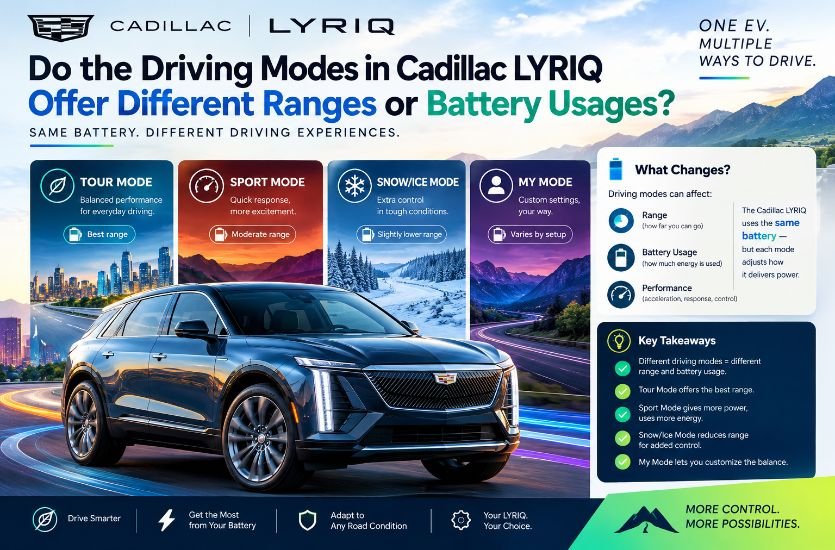
The question “Do the driving modes in Cadillac LYRIQ offer different ranges or battery usages?” is important for drivers who want to understand how much energy their electric SUV uses in different situations. The Cadillac LYRIQ offers selectable driving modes that change aspects of the vehicle’s behavior, but these modes do not give the vehicle different battery capacities or separate EPA-estimated range ratings.
Cadillac’s documentation describes Tour as an economical setting intended for everyday driving, while Sport changes the vehicle’s response for a more performance-focused experience. Snow/Ice is designed to improve traction on slippery surfaces, and My Mode allows drivers to customize available vehicle settings. These changes can influence real-world energy consumption, but Cadillac does not publish a fixed percentage of range gained or lost for each driving mode.
Understanding this distinction is important. A driver using Sport Mode may consume more electricity if the sharper response leads to more aggressive acceleration, but the mode itself does not remove usable energy from the battery. Similarly, using Tour Mode does not guarantee a particular number of miles from a charge because speed, weather, terrain, climate control, tires, and driving style can have major effects on efficiency.
Quick Answer
No, Cadillac does not provide separate official range ratings for each LYRIQ driving mode. Switching between Tour, Sport, Snow/Ice, and My Mode does not change the physical capacity of the battery. Instead, the modes modify vehicle behavior and calibration, which can affect how quickly stored energy is consumed during real-world driving.
Cadillac identifies Tour/Normal as its most economical setting for everyday driving. Sport emphasizes responsiveness and performance, while Snow/Ice prioritizes traction and controlled power delivery. My Mode allows customization, so its effect on energy consumption depends on the selected settings and driving behavior.
Short Overview
The Cadillac LYRIQ uses a 102-kWh rated energy capacity battery, while its EPA-estimated range varies according to the vehicle’s configuration rather than the selected driving mode. Current Cadillac specifications list up to 326 miles for the LYRIQ RWD, 319 miles for the LYRIQ AWD, and 285 miles for the high-performance LYRIQ-V.
Those figures should not be interpreted as guaranteed real-world distances. EPA estimates are standardized measurements, while actual energy consumption changes with driving conditions and habits.
What Are the Cadillac LYRIQ Driving Modes?
Driving modes allow the LYRIQ to change certain vehicle characteristics according to the driver’s needs. Instead of changing the battery itself, they modify how systems such as acceleration response, steering, suspension, traction control, and other vehicle settings behave.
The exact modes and available adjustments can vary according to model year and equipment. Cadillac’s LYRIQ documentation identifies several important settings.
Tour Mode
Tour is the normal everyday driving setting. Cadillac describes Tour/Normal Mode as the most economical setting and recommends it for everyday use.
Its purpose is to provide a balanced driving experience rather than maximize acceleration or sporty response. Because smooth driving generally requires less energy than repeated aggressive acceleration, Tour can be a practical choice when efficiency is a priority.
However, selecting Tour does not guarantee the longest possible range under every condition. A LYRIQ driven at high highway speeds in Tour can use considerably more energy than another LYRIQ driven smoothly at moderate speeds.
Sport Mode
Sport Mode changes the LYRIQ’s driving characteristics to create a more responsive experience. Cadillac’s documentation describes changes involving areas such as steering effort, pedal tuning, suspension tuning, and other available vehicle settings.
The important connection to battery usage is acceleration. Strong acceleration requires more electrical power from the battery. Therefore, a driver who frequently takes advantage of Sport Mode’s sharper response can consume more energy.
There is no official Cadillac figure stating that Sport Mode reduces range by a particular percentage. Energy consumption depends on how the vehicle is driven.
A driver could select Sport Mode but accelerate gently, while another driver could remain in Tour and repeatedly accelerate hard. Their energy consumption could therefore be very different despite using different modes.
Snow/Ice Mode
Snow/Ice Mode is designed for slippery driving conditions. Cadillac states that it modifies pedal tuning to optimize traction and can change electric all-wheel-drive and steering behavior when equipped.
The purpose of this mode is therefore control and traction rather than maximum range.
When Snow/Ice Mode is used during winter weather, several factors can affect range at the same time. Cold temperatures, cabin heating, snow-covered roads, tire conditions, and increased rolling resistance can all increase energy consumption.
Consequently, it would be misleading to attribute a winter range reduction entirely to Snow/Ice Mode.
My Mode
My Mode provides customization rather than one fixed driving character. Depending on the LYRIQ’s equipment, drivers can customize settings such as acceleration feel, brake feel, steering, suspension, and motor sound.
Because the configuration can vary, My Mode does not have one specific effect on range. Its energy consumption depends on the selected settings and the way the vehicle is driven.
A more relaxed configuration combined with smooth driving may support efficient operation, while settings that encourage a more responsive driving experience can result in greater consumption when used aggressively.
Do Different Driving Modes Change the Battery Capacity?
No.
Selecting a driving mode does not physically increase or decrease the capacity of the LYRIQ’s battery pack. The same battery remains available regardless of whether the vehicle is operating in Tour, Sport, Snow/Ice, or My Mode.
The distinction is between battery capacity and energy consumption.
Battery capacity refers to how much electrical energy the battery can store. Energy consumption refers to how quickly the vehicle uses that stored energy.
Changing a driving mode affects vehicle behavior and calibration. It can therefore influence consumption without changing the amount of energy the battery can store.
For example, if a driver accelerates aggressively in Sport Mode, the vehicle can draw energy from the battery at a higher rate. The battery has not become smaller; more energy is simply being consumed over that period.
Does Sport Mode Reduce LYRIQ Range?
Sport Mode can contribute to higher energy consumption, particularly when its more responsive characteristics result in stronger acceleration.
However, there is no reliable universal percentage that can be applied to every LYRIQ.
Cadillac does not publish a specification such as:
- Sport Mode reduces range by 5%.
- Sport Mode reduces range by 10%.
- Sport Mode reduces range by 15%.
Such figures should therefore not be presented as factory specifications.
Real-world consumption depends on the driver’s behavior. If Sport Mode is used but the driver maintains a steady speed and accelerates gently, the difference can be much smaller than it would be during repeated hard acceleration.
Is Tour Mode the Most Efficient Setting?
Cadillac’s general Driver Mode Control documentation describes Tour/Normal Mode as the most economical setting and recommends it for everyday use.
That makes Tour a reasonable choice for drivers who want a balanced, efficiency-oriented driving experience.
Still, the mode is only one part of the equation. Driving style can have a major effect on energy consumption. Smooth acceleration, moderate speeds, anticipating traffic, and avoiding unnecessary rapid changes in speed can all help conserve energy.
Therefore, it is more accurate to say that Cadillac identifies Tour as its economical everyday setting than to claim that Tour will always produce the longest range in every real-world situation.
Does Snow/Ice Mode Use More Battery?
Snow/Ice Mode should primarily be understood as a traction mode.
Its purpose is to provide more controlled vehicle behavior when road surfaces are slippery. If the vehicle is being driven in snow, ice, or other difficult conditions, overall energy consumption can change for several reasons.
Cold weather can reduce EV efficiency. Heating the cabin requires energy, and snow or ice can increase resistance between the tires and road. Lower temperatures can also affect battery performance.
Therefore, if a LYRIQ shows lower range during a winter trip in Snow/Ice Mode, it would not be accurate to say the mode alone caused the reduction.
How Much Does Driving Style Matter?
Driving style can have a substantial influence on an electric vehicle’s energy consumption.
Acceleration is particularly important. The harder and more frequently a vehicle accelerates, the more power it generally requires from the battery.
Once the vehicle reaches a steady cruising speed, maintaining that speed usually requires less power than repeatedly accelerating and decelerating.
This means a driver can potentially achieve better efficiency through smooth inputs even without changing modes.
For example, two LYRIQ drivers could use Tour Mode but obtain different efficiency results because one drives smoothly while the other frequently accelerates hard.
The same principle applies to Sport Mode. The mode provides a more responsive driving experience, but the driver’s actual use of that response determines how much additional energy is consumed.
Does Highway Speed Affect LYRIQ Range?
Yes. Highway speed can have a significant influence on electric-vehicle efficiency because aerodynamic drag increases as speed rises.
A LYRIQ traveling at a steady moderate speed can therefore use less energy per mile than the same vehicle traveling considerably faster.
This is one reason why a particular drive mode should not be treated as the only explanation for differences in range.
Independent testing demonstrates how real-world results can differ from EPA estimates. InsideEVs recorded 330 miles in a 70-mph range test of a rear-wheel-drive LYRIQ, while Consumer Reports recorded 315 miles in its 70-mph highway test of an AWD LYRIQ. These results illustrate that actual range depends on the vehicle configuration and testing conditions rather than simply the EPA number.
Does Regenerative Braking Affect Battery Usage?
Regenerative braking is another important part of an electric vehicle’s energy management.
During deceleration, the electric motor can operate as a generator and recover some kinetic energy. The recovered energy can then be returned to the battery.
The LYRIQ also offers One-Pedal Driving and Regen on Demand features. These systems influence how the vehicle slows and how energy can be recovered during deceleration.
However, it is important not to oversimplify this relationship by saying that Tour automatically provides a particular level of regenerative braking compared with Sport unless the specific model documentation confirms it.
Regenerative braking is better treated as a separate factor that can influence efficiency alongside driving mode.
What Other Factors Affect LYRIQ Range?
Driving mode is only one factor affecting the distance available from a charge.
Temperature
Cold and hot temperatures can affect EV energy consumption. Cold weather can increase energy requirements for battery and cabin temperature management, while hot weather can increase air-conditioning demand.
Climate Control
Heating and cooling use electrical energy. Heavy HVAC use can therefore reduce the energy available for propulsion.
Preconditioning the cabin while the LYRIQ is connected to external power can help reduce the amount of battery energy needed to bring the cabin to a comfortable temperature after departure.
Tires and Wheels
Tire pressure, tire type, wheel size, and rolling resistance can influence efficiency.
Incorrect tire pressure can increase rolling resistance, while certain wheel and tire combinations can affect energy consumption.
Terrain
Climbing hills requires additional energy because the vehicle is gaining elevation. Descending can allow regenerative braking to recover some energy, but the entire amount used during the climb is not necessarily recovered.
Vehicle Load
Carrying additional passengers or cargo increases the vehicle’s weight. The effect may be relatively small during some trips but can contribute to higher energy consumption, particularly during repeated acceleration and climbing.
What Is the Current Cadillac LYRIQ Range?
Cadillac’s current specifications provide range figures based on vehicle configuration rather than driving mode.
| LYRIQ Configuration | Battery Rated Energy Capacity | EPA-Estimated Range |
|---|---|---|
| LYRIQ RWD | 102 kWh | Up to 326 miles |
| LYRIQ AWD | 102 kWh | 319 miles |
| LYRIQ-V AWD | 102 kWh | 285 miles |
These figures should not be interpreted as the guaranteed distance a driver will achieve on every trip. Cadillac’s estimates are standardized figures, while actual range can vary according to temperature, driving conditions, speed, terrain, vehicle load, and other factors.
Why Real-World Range Can Be Different From the EPA Rating
EPA range testing provides a standardized way to compare vehicles. Real-world driving is much less predictable.
A driver traveling at moderate speeds in favorable weather may achieve a result close to or even above the official estimate. Another driver traveling quickly on a cold day while using substantial heating may see considerably lower efficiency.
Independent testing demonstrates this variation. InsideEVs achieved 330 miles from a LYRIQ during a standardized 70-mph test, while Consumer Reports recorded 315 miles from an AWD LYRIQ in its own 70-mph testing.
These results should be understood as individual test outcomes rather than universal LYRIQ range guarantees.
Can You Improve LYRIQ Range Without Changing Modes?
Yes. Drivers can focus on several behaviors that can improve efficiency regardless of the selected mode.
Drive Smoothly
Avoid unnecessary hard acceleration and sudden changes in speed. Smooth inputs generally reduce unnecessary energy consumption.
Maintain Moderate Highway Speeds
Higher speeds require more energy because aerodynamic resistance increases. Maintaining a reasonable speed can therefore help preserve range.
Use Climate Control Carefully
Heating and cooling consume electricity. Preconditioning while plugged in can help reduce the initial energy demand from the battery.
Maintain Proper Tire Pressure
Keeping tires inflated according to Cadillac’s recommendations can help maintain appropriate rolling resistance and vehicle efficiency.
Plan Charging Around Longer Trips
Cadillac’s charging system allows owners to adjust charging behavior according to their needs. For everyday driving, the vehicle can be charged to an appropriate target, while longer journeys may justify a higher charge level.
Does Charging to 100% Change Battery Usage?
Charging to 100% does not change the battery’s physical capacity. It simply raises the battery’s state of charge to its available maximum.
Cadillac provides charging guidance for the LYRIQ, including the ability to set a charging target. For everyday use, Cadillac documentation recommends an 80% charging target, while drivers can increase the target when additional range is needed for a trip.
Owners should follow the charging recommendations for their specific model year and configuration.
Are There Official Range Differences Between Tour and Sport?
No official fixed range difference is published by Cadillac.
This is one of the most important points when discussing LYRIQ driving modes.
Cadillac provides EPA range ratings according to vehicle configuration, such as RWD, AWD, and performance variants. It does not publish a table assigning an official EPA range to Tour, Sport, Snow/Ice, or My Mode.
As a result, statements such as “Tour provides 326 miles while Sport provides 280 miles” should not be presented as official Cadillac specifications.
The actual difference can vary according to driving behavior and conditions.
Which Mode Should You Use for Long Trips?
For drivers primarily concerned with everyday efficiency, Tour Mode is the natural choice because Cadillac identifies Tour/Normal as its economical setting.
That does not mean Sport Mode is unsuitable for a road trip. A LYRIQ can still be driven efficiently in Sport if the driver uses moderate acceleration and maintains steady speeds.
The most important factors are therefore not just the mode selected on the screen but also how the vehicle is driven during the journey.
Does Snow/Ice Mode Make the Battery Last Longer?
Snow/Ice Mode is not designed as a battery-saving mode. Its purpose is to improve traction and controlled power delivery when road conditions are slippery.
If it is used during cold weather, the vehicle may show reduced range because of the combined effects of temperature, heating, road conditions, and driving conditions.
Therefore, Snow/Ice Mode should be selected when traction is the priority rather than simply to try to increase range.
Final Takeaway
The answer to “Do the driving modes in Cadillac LYRIQ offer different ranges or battery usages?” is that the modes can influence real-world energy consumption, but they do not provide separate battery capacities or official EPA range ratings.
Tour is Cadillac’s economical everyday setting. Sport changes the vehicle’s response for a more performance-focused driving experience and can consume more energy when used for aggressive acceleration. Snow/Ice focuses on traction and controlled power delivery, while My Mode allows drivers to customize available vehicle characteristics.
There is no official Cadillac percentage showing exactly how much range is lost or gained by switching between these modes. Instead, actual consumption depends on the mode, driving style, speed, temperature, terrain, climate-control use, tires, vehicle load, and road conditions.
For that reason, LYRIQ owners looking to maximize range should focus not only on selecting an appropriate mode but also on smooth acceleration, sensible speeds, proper tire pressure, suitable climate-control use, and Cadillac’s recommended charging practices. The driving mode changes how the vehicle behaves; it does not change the size of the battery itself.
Frequently Asked Questions
Do LYRIQ driving modes change battery capacity?
No. Selecting a driving mode does not change the physical capacity of the LYRIQ’s battery pack. It changes vehicle behavior and calibration.
Does Sport Mode reduce LYRIQ range?
It can increase energy consumption when the more responsive calibration results in stronger or more frequent acceleration. Cadillac does not publish a fixed Sport Mode range penalty.
Is Tour Mode more efficient?
Cadillac describes Tour/Normal Mode as its most economical setting and recommends it for everyday use. Actual efficiency still depends on driving conditions and driver behavior.
Does Snow/Ice Mode use more electricity?
It can influence energy consumption, but its purpose is traction and controlled power delivery. During winter, temperature, heating, road conditions, and tire behavior can also affect range.
Does My Mode have a specific range?
No. My Mode is customizable, so its effect on energy consumption depends on the settings selected and how the LYRIQ is driven.
What is the LYRIQ’s battery capacity?
Cadillac lists a 102-kWh rated energy capacity for the LYRIQ.
What is the maximum LYRIQ EPA range?
For the current LYRIQ specifications discussed here, Cadillac lists up to 326 miles for RWD, 319 miles for AWD, and 285 miles for the LYRIQ-V.
Can driving style affect range more than driving mode?
Yes. Acceleration, highway speed, temperature, terrain, climate-control use, tires, and other conditions can have a substantial effect on real-world energy consumption.
Visit: Editorial Magazine for more quality blogs.