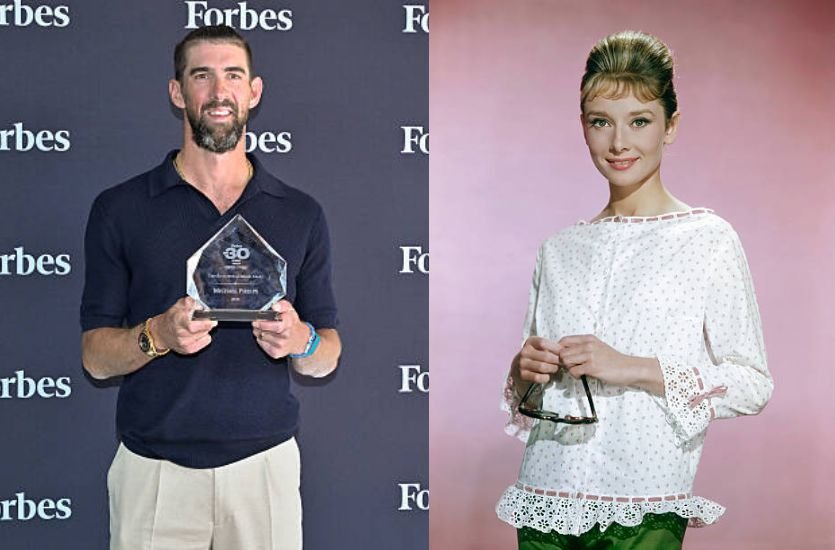
The names Audrey Hepburn and Michael Phelps come from two completely different worlds. Hepburn became one of the most recognizable actresses of Hollywood’s golden era, while Phelps became the most decorated Olympian in history through an extraordinary swimming career. One was celebrated for her performances, elegance, fashion influence, and humanitarian work, while the other became famous for discipline, athletic ability, Olympic records, and competitive swimming.
At first glance, there may seem to be little reason to place Audrey Hepburn and Michael Phelps in the same conversation. They belonged to different generations, worked in different industries, and achieved fame through entirely different talents. Hepburn was born in 1929 and died in 1993, while Phelps was born in 1985 and began his Olympic career in 2000. Phelps was only a child when Hepburn died.
There is also no well-documented personal, family, romantic, or professional relationship between the two. Recent articles using the exact keyword generally treat their connection as a comparison between two globally recognized personalities rather than suggesting that they actually knew one another.
Yet, comparing Audrey Hepburn and Michael Phelps can be surprisingly interesting. Both achieved extraordinary levels of recognition, both became symbols of excellence in their respective fields, and both developed legacies that extended beyond the careers that initially made them famous.
Audrey Hepburn and Michael Phelps Quick Bio Table
| Detail | Audrey Hepburn | Michael Phelps |
|---|---|---|
| Full Name | Audrey Kathleen Hepburn | Michael Fred Phelps II |
| Born | May 4, 1929 | June 30, 1985 |
| Birthplace | Brussels, Belgium | Baltimore, Maryland, United States |
| Main Profession | Actress and humanitarian | Competitive swimmer |
| Primary Field | Film and entertainment | Olympic swimming |
| Major Achievement | Academy Award-winning film career | 28 Olympic medals |
| Olympic Career | Not applicable | Five Olympic Games |
| Humanitarian Association | UNICEF Goodwill Ambassador | Philanthropic and swimming advocacy work |
| Death | January 20, 1993 | Living |
| Global Legacy | Cinema, fashion and humanitarianism | Swimming, Olympic sport and philanthropy |
Who Was Audrey Hepburn?
Audrey Hepburn was an actress and humanitarian whose influence reached far beyond traditional Hollywood fame. Born in Brussels on May 4, 1929, she eventually became one of the defining screen personalities of the twentieth century.
Her career developed during an era when Hollywood was producing some of its most memorable films. Hepburn stood out because of her distinctive screen presence, elegance, acting ability, and ability to portray characters with both sophistication and emotional warmth.
Her breakthrough came with Roman Holiday, which established her as a major international star. She subsequently appeared in several highly regarded films and became closely associated with classic cinema.
However, describing Hepburn only as an actress would leave out an important part of her story. Her later life was increasingly connected with humanitarian work, especially through UNICEF.
UNICEF records that Hepburn became a Goodwill Ambassador in 1988 and devoted considerable energy to advocating for children affected by poverty, hunger, disease, conflict, and displacement. Her humanitarian work was informed in part by her own experience during World War II, when she experienced hunger and hardship in occupied Europe.
She traveled to different countries on UNICEF missions, spoke publicly about children’s welfare, participated in international events, and used her celebrity status to attract attention to humanitarian problems.
This became one of the most meaningful parts of her legacy. Hepburn died in Switzerland on January 20, 1993, but her humanitarian reputation has continued long after her death.

Audrey Hepburn’s Career and Hollywood Legacy
Hepburn’s Hollywood career remains one of the strongest reasons she continues to be remembered decades after her death.
Her appeal was not based simply on physical appearance. She developed a distinctive acting style that combined grace, humor, vulnerability, and emotional depth. Her performances helped establish her as a major figure of classic cinema.
Her work also influenced fashion and popular culture. Hepburn became associated with an understated form of elegance that remained influential across generations. Her screen image became so recognizable that she eventually represented more than individual films. She became a cultural symbol.
At the same time, Hepburn did not spend her entire life chasing Hollywood success. Toward the later part of her career, she increasingly prioritized her family and humanitarian interests. UNICEF’s biography describes the final years of her life as a period in which she devoted herself strongly to humanitarian work.
Her transition from international movie star to humanitarian advocate is an important part of understanding her life.
Audrey Hepburn and UNICEF
Hepburn’s connection with UNICEF is particularly significant when discussing her lasting legacy.
She became a UNICEF Goodwill Ambassador in 1988 and quickly became one of the organization’s most recognizable public advocates. Instead of simply lending her name to the organization, she traveled, met children and families, visited humanitarian projects, gave interviews, spoke to governments and encouraged public support for UNICEF’s work.
According to UNICEF, she visited areas affected by severe humanitarian conditions and worked extensively to bring international attention to children’s needs. She also testified before the United States Congress and participated in major international children’s initiatives.
Her humanitarian work was deeply connected to her personal history. Having experienced wartime hunger as a young person, she understood that children suffering from hunger and deprivation were not merely statistics. Her own memories contributed to the compassion that characterized her later work.
This is why Audrey Hepburn’s legacy cannot be reduced to movies and fashion. Her public image ultimately became connected with compassion, children’s rights, humanitarian advocacy, and service.
Who Is Michael Phelps?
Michael Phelps is an American former competitive swimmer and one of the most successful athletes in the history of modern sport.
Born on June 30, 1985, in Baltimore, Maryland, Phelps began swimming at a young age and developed into an elite competitor. His extraordinary combination of technique, endurance, speed, discipline, and training made him one of the most dominant swimmers ever seen.
Phelps first appeared at the Olympic Games in 2000 in Sydney when he was only 15 years old. Although he did not win a medal at those Games, his Olympic career eventually developed into an unprecedented record of success.
Across five Olympic Games, Phelps won 28 Olympic medals, including 23 gold medals. His medal total made him the most decorated Olympian in history.
His greatest individual Olympic performance came at the 2008 Beijing Games, where he won eight gold medals. That achievement became one of the defining performances in Olympic history.

Michael Phelps and Olympic Greatness
The story of Michael Phelps is fundamentally a story about consistency.
Winning one Olympic medal is an extraordinary achievement. Winning several medals across multiple Olympic Games requires years of preparation, physical conditioning, technical development, mental resilience, and the ability to perform under enormous pressure.
Phelps repeatedly demonstrated those qualities.
His Olympic career covered more than a decade and included victories in multiple swimming disciplines. Rather than being dominant in only one event, he became successful across several events and distances.
His 2008 Beijing performance was particularly important because he won eight gold medals at one Olympic Games. That performance established a new standard for Olympic achievement.
Phelps later competed at the London 2012 Olympics and Rio 2016 Olympics before retiring from competitive swimming.
His career therefore represents a different type of cultural achievement from Hepburn’s. Hepburn created memorable characters and influenced cinema and fashion, whereas Phelps created an unprecedented competitive record in international sport.
Audrey Hepburn and Michael Phelps: Did They Ever Meet?
One of the most obvious questions surrounding the keyword Audrey Hepburn and Michael Phelps is whether the two ever met.
There is no credible, widely documented evidence showing that they had a meaningful personal or professional relationship.
The timeline itself explains why such a connection would be unlikely. Audrey Hepburn died on January 20, 1993. Michael Phelps was born in 1985, meaning he was only seven years old when Hepburn died.
Phelps did not make his Olympic debut until 2000, seven years after Hepburn’s death.
Consequently, claims that the two were collaborators, close friends, romantic partners, or professional associates should not be presented as facts without strong documentary evidence. Recent articles discussing the exact keyword similarly conclude that their relevance to each other is primarily comparative.
Are Audrey Hepburn and Michael Phelps Related?
There is also no credible evidence establishing a family relationship between Audrey Hepburn and Michael Phelps.
Their biographies describe two separate family histories and two completely different career paths.
Hepburn was born in Belgium and became associated with British and American cinema, while Phelps was born in the United States and became an elite American swimmer.
Therefore, the most accurate interpretation of the phrase Audrey Hepburn and Michael Phelps is not that they were related. Instead, it refers to a comparison between two famous people whose extraordinary achievements occurred in different areas.
The Biggest Difference Between Audrey Hepburn and Michael Phelps
The most obvious difference is their profession.
Audrey Hepburn’s achievements were artistic and humanitarian. Her career required acting ability, emotional expression, communication, timing, performance, and an ability to connect with audiences.
Michael Phelps’ achievements were athletic. His success depended on physical conditioning, swimming technique, training, competition strategy, mental preparation, and the ability to perform consistently at the highest level.
Their measurements of success were also different.
Hepburn’s accomplishments were reflected through films, awards, cultural influence, public recognition, and humanitarian contributions.
Phelps’ achievements can be measured much more directly through Olympic medals, world records, championships, and competition results.
Despite those differences, both demonstrated extraordinary commitment to their chosen fields.
What Do Audrey Hepburn and Michael Phelps Have in Common?
The strongest similarity between Audrey Hepburn and Michael Phelps is not a shared workplace or personal relationship. It is the scale of their influence.
Both became internationally recognizable names.
Hepburn became known across generations because of her films, fashion influence, humanitarian work, and distinctive public image. Phelps became known around the world because of his Olympic performances and record-breaking medal collection.
Both also demonstrated that exceptional achievement requires more than natural talent.
Hepburn had to develop her acting abilities and establish herself in an extremely competitive entertainment industry. Phelps had to train relentlessly for years to compete against the world’s best swimmers.
Another similarity is that neither person’s legacy ended with the peak of their primary career.
Hepburn’s humanitarian work became one of the defining features of her later years. Phelps continued to remain involved with swimming, philanthropy, and public advocacy after retiring from competition.
Two Different Forms of Discipline
The comparison becomes even more interesting when looking at discipline.
For an actor such as Hepburn, discipline involves learning scripts, preparing for performances, understanding characters, working with directors and other actors, and maintaining professionalism throughout demanding productions.
For an Olympic swimmer such as Phelps, discipline involves repeated training sessions, technical practice, strength and conditioning, nutrition, recovery, travel, competitions, and mental preparation.
The environments are completely different, but the underlying principle is similar.
Both careers demonstrate the importance of sustained effort.
Talent can create an opportunity, but maintaining international success requires preparation and consistency.
Their Influence Beyond Their Careers
Another important similarity is that both Hepburn and Phelps eventually became larger than their professions.
Hepburn was no longer simply an actress. Her name became associated with elegance, classic cinema, fashion, humanitarianism, and UNICEF.
Phelps became more than a swimmer. His name became associated with Olympic excellence, athletic discipline, competitive swimming, and the pursuit of extraordinary performance.
This transformation from professional achievement into cultural influence is what makes both personalities relevant decades apart.
Audrey Hepburn’s Humanitarian Legacy Compared With Phelps’ Philanthropic Work
Hepburn’s humanitarian work was particularly prominent during the final years of her life. UNICEF documents extensive advocacy and international travel undertaken on behalf of children.
Phelps has also participated in charitable and advocacy initiatives, particularly those connected with swimming and youth development.
The scale and nature of their humanitarian activities were not identical, so they should not be presented as equivalent. Hepburn’s UNICEF role became a central part of her public identity, while Phelps’ philanthropic activities developed alongside his identity as an elite athlete.
Still, the broader similarity is important. Both used their fame to influence people beyond the entertainment or sporting environments that originally made them famous.
Why Audrey Hepburn Remains Famous
More than three decades after her death, Audrey Hepburn continues to attract public interest.
Part of this comes from the timeless reputation of her films. Another part comes from her fashion influence. Her image remains recognizable even among people who may not have watched all of her movies.
Her humanitarian work provides another reason for continued interest.
Modern discussions about Hepburn increasingly emphasize the complete person rather than only the glamorous movie star. Her childhood experiences, family life, acting career, humanitarian missions, and commitment to children all contribute to the understanding of her legacy. Recent coverage featuring her family has also renewed attention to the personal side of her life and her relationship with her children.
Why Michael Phelps Remains Famous
Michael Phelps remains one of the most recognizable names in Olympic history because his achievements are exceptionally difficult to match.
His 28 Olympic medals and 23 Olympic gold medals provide a simple explanation for his extraordinary reputation. His five Olympic appearances also demonstrate the longevity required to remain competitive at the highest level.
But his story is not only about medal counts.
Phelps represents an era of swimming in which one athlete dominated multiple events and repeatedly performed under the enormous pressure associated with the Olympic Games.
His career has therefore become an example of elite athletic performance and long-term dedication.
Audrey Hepburn and Michael Phelps: A Comparison of Legacy
When comparing Audrey Hepburn and Michael Phelps, it is important not to ask which person was “better.” Their achievements cannot realistically be measured on the same scale.
Hepburn’s contribution belongs primarily to cinema, culture, fashion, and humanitarian advocacy.
Phelps’ contribution belongs primarily to competitive swimming, Olympic sport, athletic performance, and philanthropy.
Instead, the better question is what each person accomplished within their own field.
Hepburn became one of the most enduring stars of classic cinema and later used her fame to advocate for children around the world.
Phelps became the most decorated Olympian in history and helped define an era of international swimming.
Their stories demonstrate that greatness does not have a single form.
The Generational Difference
The generational gap between Audrey Hepburn and Michael Phelps is another important part of the story.
Hepburn’s major period of fame began in the 1950s, decades before the internet and modern social media existed. Her international influence was built through cinema, newspapers, magazines, television, fashion photography, and personal appearances.
Phelps rose to worldwide prominence during the digital age. His biggest achievements occurred when international sports coverage, online media, television broadcasting, and eventually social media could spread information almost instantly.
This difference shows how the meaning of global celebrity has changed.
Hepburn became globally famous through traditional entertainment media. Phelps became globally famous through international sport and a modern media environment.
Yet both achieved something that transcends technology: enduring public recognition.
What Their Stories Teach Us
The comparison between Audrey Hepburn and Michael Phelps offers a broader lesson about success.
Hepburn’s story shows that a person’s legacy can evolve. Someone can become famous for entertainment and later become equally respected for humanitarian work.
Phelps’ story shows how consistency and long-term commitment can transform natural ability into historic achievement.
Together, their lives demonstrate the value of discipline, resilience, adaptability, and using public influence responsibly.
They also show that fame itself is not necessarily the final measure of success. What a person does with that fame can become an important part of their legacy.
Final Thoughts on Audrey Hepburn and Michael Phelps
Audrey Hepburn and Michael Phelps were never known for working together, and there is no credible evidence of a significant personal relationship between them. They belonged to different generations and completely different professional worlds.
Hepburn was a legendary actress whose career helped shape classic cinema and fashion before she devoted significant energy to humanitarian work with UNICEF. Her wartime experiences contributed to the compassion that later defined her advocacy for children.
Phelps was an extraordinary swimmer whose Olympic career produced 28 medals, including 23 gold medals, making him the most decorated Olympian in history.
Their lives therefore should not be presented as a shared biography. They are better understood as two separate stories of exceptional achievement.
One transformed cinema and became a humanitarian symbol. The other transformed Olympic swimming and became a symbol of athletic excellence.
That is ultimately what makes the keyword Audrey Hepburn and Michael Phelps interesting. Their connection is not based on a shared career or personal history, but on the broader idea that greatness can emerge in radically different forms. Hepburn and Phelps each demonstrated what can happen when exceptional talent is combined with dedication, perseverance, and a willingness to create a legacy that lasts beyond the moment of fame.
Visit Editorial Magazine for more quality blogs on celebrity.