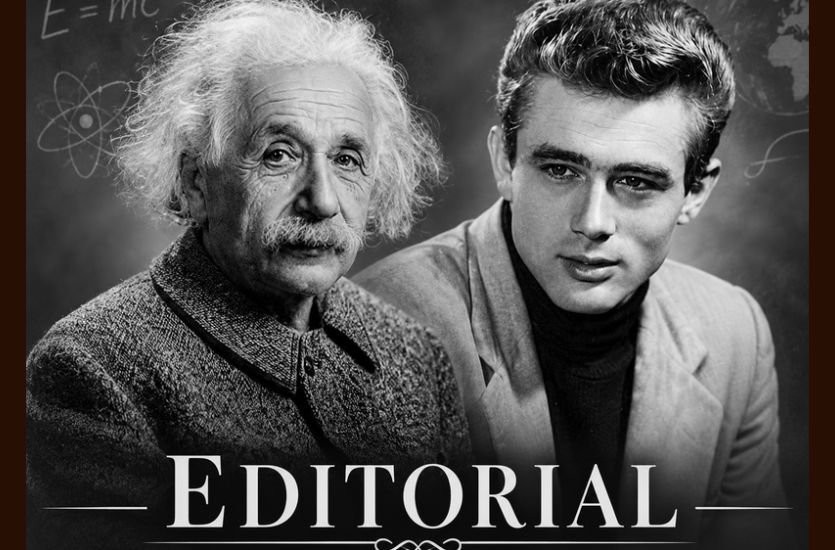
Albert Einstein and James Dean are two of the most recognizable names in modern history. Although they belonged to completely different generations and professional worlds, both became influential figures whose legacies continued long after their deaths. Einstein transformed the scientific understanding of the universe through his groundbreaking theories, while Dean changed the image of young Hollywood actors through his memorable performances and distinctive screen presence. Their lives followed different paths, but an unusual historical coincidence connects them: both died in 1955.
Albert Einstein became internationally famous for his contributions to physics, particularly the theory of relativity and his famous equation, E = mc². James Dean, on the other hand, became a symbol of youthful rebellion, individuality, and emotional expression through films such as East of Eden, Rebel Without a Cause, and Giant. Their stories represent two different forms of influence, demonstrating how individuals can leave a permanent mark on society through science, creativity, and cultural change.
Quick Biography of Albert Einstein and James Dean
| Details | Albert Einstein | James Dean |
|---|---|---|
| Full Name | Albert Einstein | James Byron Dean |
| Date of Birth | March 14, 1879 | February 8, 1931 |
| Birthplace | Ulm, Germany | Marion, Indiana, USA |
| Profession | Theoretical Physicist | Actor |
| Nationality | German-born, later Swiss and American | American |
| Famous For | Theory of Relativity | Rebel Without a Cause |
| Major Achievement | Nobel Prize in Physics | Three iconic major films |
| Spouse | Mileva Marić and Elsa Einstein | Never married |
| Date of Death | April 18, 1955 | September 30, 1955 |
| Age at Death | 76 | 24 |
| Place of Death | Princeton, New Jersey | Near Cholame, California |
Who Was Albert Einstein?
Albert Einstein was a German-born theoretical physicist widely regarded as one of the most influential scientists in history. His contributions changed how researchers understood space, time, gravity, energy, and the physical universe. His name became internationally recognized, and his scientific ideas continue to influence modern research and technology.
Einstein was born on March 14, 1879, in Ulm, in the German Empire. His parents were Hermann Einstein and Pauline Koch. His father worked in electrical engineering, which gave Einstein some early exposure to technical ideas and scientific developments. During his childhood, the family moved to Munich, where he spent much of his early education.
Einstein demonstrated an interest in mathematics and scientific questions from a young age. He was particularly interested in understanding how the natural world operated. Rather than simply accepting explanations, he enjoyed exploring complicated questions and developing his own ideas.
His educational journey eventually brought him to Switzerland, where he studied mathematics and physics at the Swiss Federal Polytechnic in Zurich. He completed his studies in 1900 and initially experienced difficulties finding an academic position. His early professional challenges, however, did not prevent him from developing ideas that would eventually transform modern science.
Albert Einstein’s Scientific Achievements
One of the most important periods in Einstein’s career was 1905, commonly known as his miracle year. During this period, he published several groundbreaking scientific papers that introduced important developments in physics.
His research addressed subjects including Brownian motion, the photoelectric effect, special relativity, and the relationship between mass and energy. These contributions helped establish his reputation as an exceptional scientific thinker.
His famous equation, E = mc², became one of the most recognizable formulas in the world. It expresses the relationship between energy and mass, demonstrating that mass can be understood as a concentrated form of energy.
Another major achievement was his development of the special theory of relativity in 1905. This theory changed traditional scientific ideas about space and time by showing that measurements of time and space depend on the relative motion of observers.
Einstein later developed the general theory of relativity, which he presented in 1915. The theory provided a new explanation of gravity, describing it through the curvature of spacetime rather than simply treating it as a conventional force.
His scientific achievements received international recognition. In 1921, Einstein was awarded the Nobel Prize in Physics for his contributions to theoretical physics, particularly his explanation of the photoelectric effect. He received the award in 1922.
Although he became most famous for relativity, the Nobel recognition was specifically associated with his explanation of the photoelectric effect. His discoveries helped establish important foundations for modern physics and later scientific developments.
Albert Einstein’s Personal Life and Family
Einstein’s personal life included two marriages and three children from his first marriage. In 1903, he married Mileva Marić, a fellow student whom he had met during his education in Switzerland.
Their family included Hans Albert Einstein and Eduard Einstein, as well as their daughter Lieserl, whose life remains less clearly documented in historical records. The marriage eventually ended in divorce in 1919.
During the same year, Einstein married Elsa Löwenthal, who had been part of his extended family circle. She remained his wife until her death in 1936.
Outside his scientific work, Einstein enjoyed music, particularly playing the violin. He also appreciated sailing and spent time thinking about philosophical and social questions.
His public identity extended beyond science. He expressed views on peace, international cooperation, human rights, and the responsibilities of scientists. These interests helped establish him as an influential public intellectual rather than someone known exclusively for scientific research.
Albert Einstein’s Later Years and Death
The political situation in Germany changed significantly during the 1930s. Following the rise of Adolf Hitler and the Nazi regime, Einstein faced increasing hostility because of his Jewish background and political positions.
In 1933, while visiting the United States, he decided not to return to Germany. He eventually settled in Princeton, New Jersey, where he worked at the Institute for Advanced Study.
Einstein continued his research during his American years and remained involved in international discussions about science and society. He also became an important public voice on the dangers of nuclear weapons and the need for international cooperation.
His health gradually declined during his later years. Einstein died on April 18, 1955, in Princeton, New Jersey, at the age of 76. His death marked the end of a remarkable scientific career, but his theories and discoveries continued to shape research across the world.
Who Was James Dean?
James Dean was an American actor whose relatively short career made him one of the most memorable personalities in Hollywood history. He became famous for portraying emotionally complicated young characters who struggled with identity, family relationships, independence, and social expectations.
James Byron Dean was born on February 8, 1931, in Marion, Indiana, United States. His parents were Winton Dean and Mildred Wilson. During his early childhood, his family moved to California because of his father’s employment.
Dean experienced a difficult childhood after his mother died when he was young. He subsequently returned to Indiana, where he was raised by his aunt and uncle. These early experiences became an important part of his personal story, although they should not be treated as a complete explanation of his later acting style.
During his school years, Dean developed interests in performance, sports, art, and creative activities. After completing high school, he attended Santa Monica Junior College and later studied at the University of California, Los Angeles.
His interest in acting gradually became stronger, encouraging him to pursue opportunities in television, theater, and film. He eventually left traditional academic studies to concentrate on building an entertainment career.
James Dean’s Acting Career and Hollywood Breakthrough
James Dean began his professional career with smaller entertainment opportunities, including television appearances and minor film roles. These early experiences helped him develop his performance skills and understand the professional demands of the entertainment industry.
In 1951, he moved to New York City to pursue more serious acting opportunities. He appeared in television productions and theatrical performances, gradually gaining experience and attracting attention from people working in entertainment.
His major breakthrough came with the 1955 film East of Eden, directed by Elia Kazan. Dean played Cal Trask, a complicated young man struggling with family relationships and his desire for acceptance.
His performance attracted considerable critical attention. Audiences recognized his ability to communicate emotional conflict through facial expressions, body language, and natural dialogue delivery.
Later in 1955, Dean starred in Rebel Without a Cause, one of the films most closely associated with his name. He portrayed Jim Stark, a teenager experiencing emotional difficulties and struggling to find his place in society.
The film became an important cultural reference for discussions about teenage identity, generational differences, and rebellion. Dean’s performance helped establish an image that remained closely associated with young people during the 1950s.
His third major film was Giant, directed by George Stevens. In this production, Dean played Jett Rink, a character whose life and ambitions develop across several decades.
The film was released in 1956, after Dean’s death. It further strengthened his reputation as a talented performer and demonstrated that his acting career had considerable potential beyond his earlier teenage roles.
James Dean’s Personal Life and Interests
James Dean was known for his independent personality and interest in creative activities. Outside his acting career, he enjoyed photography, art, motorsports, and automobiles.
His passion for racing became particularly important during the final period of his life. He enjoyed driving and participating in motorsport activities, viewing automobiles as more than simply a means of transportation.
Dean also developed a distinctive public image through his clothing, hairstyle, and relaxed appearance. His leather jackets, casual clothing, and expressive performances became associated with a generation seeking individuality.
His popularity was not based entirely on appearance. His performances communicated emotions that many young viewers recognized, including loneliness, frustration, uncertainty, and the desire to be understood.
Although his career lasted only a few years, his influence extended beyond the films in which he appeared. His name became associated with a particular period of American cinema and the changing identity of young people in postwar society.
James Dean’s Death and Lasting Legacy
James Dean died on September 30, 1955, at the age of 24. His death followed a fatal automobile accident near Cholame, California.
At the time, he was deeply interested in motorsports and had been driving a Porsche 550 Spyder. The accident shocked Hollywood and attracted widespread public attention.
His death occurred before the release of Giant, meaning that audiences experienced one of his most important performances after he had already passed away.
Dean received two posthumous Academy Award nominations for Best Actor, for East of Eden and Giant. These nominations demonstrated the critical recognition of his performances and strengthened his place in film history.
Over time, his reputation developed into something larger than his relatively limited filmography. He became a symbol of youthful independence, emotional authenticity, and rebellion.
His photographs, performances, and distinctive personal style continue to attract interest from film enthusiasts, historians, and admirers of classic Hollywood.
What Connects Albert Einstein and James Dean?
The connection between Albert Einstein and James Dean is primarily historical and cultural rather than personal. They worked in completely different professions and belonged to different generations, but their names are remembered together because both died in 1955.
Einstein died on April 18, 1955, while Dean died on September 30 of the same year. Their deaths occurred approximately five and a half months apart.
This coincidence is particularly interesting because their lives represented two different areas of human achievement. Einstein influenced the scientific understanding of the universe, while Dean influenced film, entertainment, and youth culture.
There is no established historical evidence that the two men personally met, developed a friendship, or collaborated professionally. Therefore, it would be inaccurate to describe them as friends or acquaintances without reliable documentation.
Their shared year of death remains the clearest connection between their biographies.
Different Generations, Different Contributions
Albert Einstein was born in 1879, while James Dean was born in 1931. Their birth years were separated by more than five decades, meaning that they experienced different historical periods and social environments.
Einstein lived through major scientific, political, and technological transformations during the late nineteenth and early twentieth centuries. His career developed during a period when researchers were reconsidering traditional explanations of the physical universe.
Dean, meanwhile, belonged to a younger generation that experienced the cultural changes of postwar America. His films reflected the concerns of young people navigating family expectations, social pressure, and personal identity.
Their professional achievements also differed considerably. Einstein produced scientific theories and research that changed academic understanding, while Dean created memorable performances that influenced the entertainment industry.
Despite these differences, both demonstrated how individual talent and original thinking can create lasting influence.
Why Albert Einstein and James Dean Remain Famous Today
The continuing popularity of Albert Einstein and James Dean comes from the lasting relevance of their contributions.
Einstein’s name remains central to discussions of physics, mathematics, astronomy, and scientific discovery. His theories are still studied in educational institutions, and his image has become a familiar representation of intelligence and creativity.
James Dean remains an important figure in film history because of his distinctive acting performances and the cultural impact of his characters. His work continues to attract audiences interested in classic cinema and the development of modern acting.
Both personalities also became recognizable beyond their professional achievements. Einstein became a cultural symbol of scientific genius, while Dean became an enduring representation of youthful independence.
Their stories demonstrate that historical influence can take different forms. Some individuals change how people understand the world, while others influence how people express themselves and understand society.
Final Thoughts on Albert Einstein and James Dean
Albert Einstein and James Dean remain two remarkable figures whose lives and achievements continue to attract worldwide interest. Although their professional backgrounds were completely different, both left legacies that extended far beyond their lifetimes.
Einstein transformed scientific thought through his theories of relativity, research into the photoelectric effect, and other important discoveries. James Dean established himself as a memorable Hollywood actor through a small number of influential performances, particularly in East of Eden, Rebel Without a Cause, and Giant.
Their deaths in 1955 provide an unusual historical connection, but their individual accomplishments are what make their stories significant. There is no confirmed evidence of a personal relationship between them, yet their names can be discussed together as examples of two influential personalities from different fields.
Ultimately, Albert Einstein and James Dean represent different dimensions of human creativity and achievement. One changed the scientific understanding of the universe, while the other helped shape the image of a generation through cinema. Their lasting recognition demonstrates how remarkable contributions can remain relevant long after the people behind them are gone.
READ MORE : Chris Pine and Chris Hemsworth
READ MORE : Susie McAllister and Gary Morton



One thought on “Albert Einstein and James Dean: Two Legendary Figures Who Died in 1955”