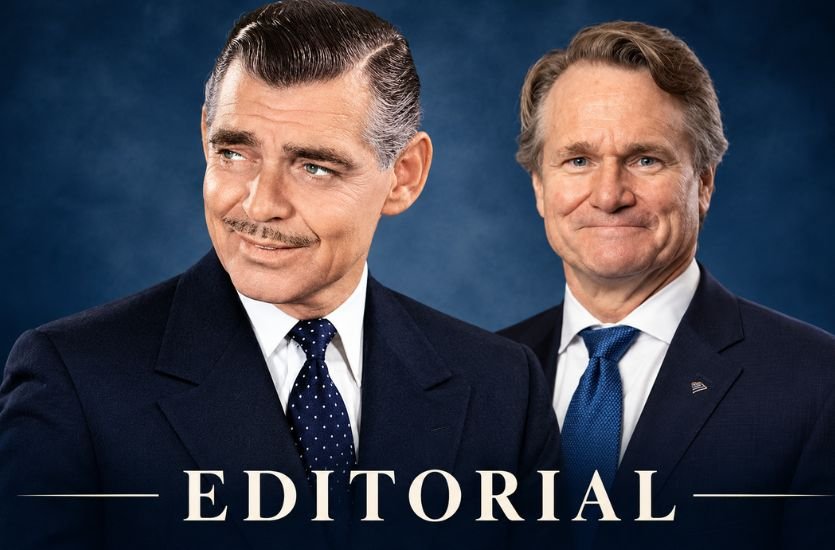
The names Brian Moynihan and Clark Gable represent two different eras of American influence. One is recognized for his leadership in the financial industry, while the other became one of the most celebrated actors in Hollywood history. Although they built their reputations in completely different professions, both achieved remarkable public recognition through their professional accomplishments and contributions to American society. Their stories demonstrate how dedication, ambition, and the ability to succeed in competitive industries can shape a person’s legacy.
Brian Moynihan is best known as the chairman and chief executive officer of Bank of America, one of the world’s major financial institutions. His career reflects decades of experience in banking, corporate management, and financial services. Clark Gable, meanwhile, became an international entertainment icon through his memorable performances in classic Hollywood films, particularly Gone with the Wind and It Happened One Night. Often called the King of Hollywood, Gable helped define the image of the leading man during the Golden Age of American cinema.
Although there is no established family, professional, or personal relationship between Brian Moynihan and Clark Gable, examining their lives together offers an interesting comparison of two influential American figures. Their backgrounds, careers, achievements, and lasting reputations highlight the different ways individuals can leave their mark on history.
Quick Bio: Brian Moynihan and Clark Gable
| Details | Brian Moynihan | Clark Gable |
|---|---|---|
| Full name | Brian Thomas Moynihan | William Clark Gable |
| Birthplace | Marietta, Ohio, USA | Cadiz, Ohio, USA |
| Nationality | American | American |
| Profession | Banker, lawyer, business executive | Actor |
| Known for | Bank of America leadership | Classic Hollywood films |
| Education | Brown University, University of Notre Dame Law School | Attended school in Ohio; later pursued acting |
| Major recognition | Chairman and CEO of Bank of America | King of Hollywood |
| Notable achievement | Leading a major international financial institution | Academy Award for Best Actor |
| Major institution | Bank of America | Metro-Goldwyn-Mayer |
| Historical era | Modern business era | Hollywood Golden Age |
Who Is Brian Moynihan?
Brian Thomas Moynihan is an American business executive recognized for his leadership in the banking and financial services industry. He is particularly known for his long association with Bank of America, where he became chief executive officer in 2010 and chairman of the board in 2014. His professional journey demonstrates how legal knowledge, financial experience, and corporate leadership can contribute to success in a highly competitive business environment.
Unlike individuals who enter executive positions through family-owned companies or entertainment careers, Moynihan developed his reputation through years of professional experience. His career involved working in legal services, managing financial divisions, and overseeing major banking operations. These responsibilities helped prepare him for one of the most influential leadership positions in American banking.
Early Life and Educational Background
Brian Moynihan was raised in an environment that valued education and professional development. He attended Brown University, where he studied history and graduated in 1981. During his university years, he also participated in rugby, demonstrating an interest in activities beyond academic studies.
After completing his undergraduate education, Moynihan attended the University of Notre Dame Law School and earned his law degree. His legal background became an important foundation for his professional career because financial institutions regularly deal with complex regulations, corporate agreements, risk management, and legal responsibilities.
His education provided him with knowledge that could be applied to different areas of business. Rather than limiting himself to legal practice, he gradually developed expertise in financial management and corporate leadership.
Beginning of His Professional Career
Moynihan began building his professional experience in the legal and financial sectors before becoming a senior banking executive. In 1993, he joined Fleet Financial as deputy general counsel. This position gave him valuable exposure to the legal responsibilities of a major financial organization.
Working in the banking industry allowed him to understand how financial institutions operate and how legal decisions influence business activities. His responsibilities gradually expanded, and he gained experience in areas that would later become important to his executive career.
In 2004, following Bank of America’s merger with FleetBoston Financial, Moynihan joined Bank of America. He initially became president of Global Wealth and Investment Management. This position placed him in charge of an important division that served wealthy individuals, families, and institutional clients.
Over time, he took on additional leadership responsibilities across different parts of the organization. His experience included consumer banking, wealth management, and corporate and investment banking.
Becoming the CEO of Bank of America
One of the most important milestones in Brian Moynihan’s career occurred on January 1, 2010, when he became chief executive officer of Bank of America.
His appointment came during a challenging period for the American financial industry. The global financial crisis had affected banks, businesses, investors, and ordinary consumers. Financial institutions were facing pressure to rebuild confidence, strengthen their operations, and respond to changing economic conditions.
Moynihan’s responsibilities included overseeing business strategy, managing financial risks, improving operational performance, and maintaining relationships with customers and investors. His leadership required balancing the interests of shareholders with the needs of customers, employees, regulators, and communities.
In October 2014, he also became chairman of the bank’s board of directors. Holding both positions placed him at the center of the company’s strategic direction and corporate governance.
Leadership Philosophy and Business Influence
An important theme associated with Moynihan’s leadership is responsible growth. Bank of America has used this approach to emphasize sustainable business development, customer relationships, risk management, and long-term financial performance.
The banking industry operates in an environment where decisions can affect millions of people. Financial institutions must maintain public confidence while adapting to technology, regulatory requirements, economic changes, and competition.
Moynihan has overseen the development of banking services across consumer finance, commercial banking, wealth management, and investment banking. These activities make Bank of America an important participant in the American and international financial systems.
His role also involves communicating with investors, policymakers, business leaders, and financial organizations. Such responsibilities require an understanding of economic trends and the ability to make decisions that consider both immediate challenges and long-term objectives.
Role Beyond Bank of America
Brian Moynihan’s influence extends beyond his responsibilities at Bank of America. He has participated in several major business and economic organizations, including the Business Roundtable, the Financial Services Forum, and the World Economic Forum’s International Business Council.
His involvement in these organizations provides opportunities to discuss financial regulation, economic development, corporate responsibility, and the future of international markets.
Education has also remained an important part of his public activities. In 2024, Brown University elected him as its 22nd chancellor. The position reflects his continued relationship with the institution where he completed his undergraduate education.
His connection with Brown University began years earlier through service on its governing bodies. His appointment as chancellor represents another dimension of his professional life, demonstrating an interest in higher education and institutional leadership.
Who Was Clark Gable?
William Clark Gable, professionally known as Clark Gable, was an American actor who became one of the biggest movie stars of the twentieth century. Born on February 1, 1901, in Cadiz, Ohio, he developed a reputation for his confident screen presence, distinctive personality, and memorable performances.
Gable became particularly popular during Hollywood’s Golden Age, a period when American film studios produced many of the most recognizable movies in cinema history. His performances helped establish him as a leading figure in romantic dramas, comedies, and adventure films.
His nickname, the King of Hollywood, reflected his popularity and influence within the entertainment industry. Even decades after his death, audiences continue to recognize his name through his classic films and contribution to American cinema.
Early Life and Interest in Acting
Clark Gable experienced personal difficulties during his childhood. His mother died when he was still an infant, and he was raised by his father and other family members. His early life in Ohio was very different from the glamorous Hollywood environment in which he would eventually become famous.
As a young man, Gable developed an interest in theater and acting. He was attracted to the performing arts and gradually began exploring opportunities to work in stage productions.
His path toward becoming a professional actor was not immediate. Like many performers of his generation, he faced financial and professional difficulties while attempting to establish himself.
He worked different jobs during his early years and gained experience through theatrical performances. His first wife, Josephine Dillon, also played an important role in his development as an actor. She helped him improve his acting skills and presentation, supporting his efforts to enter the film industry.
His Entry Into Hollywood
Clark Gable’s career gradually progressed from theater to motion pictures. Early film opportunities helped him gain experience, although he did not immediately become a major star.
His career received an important boost when he joined Metro-Goldwyn-Mayer, commonly known as MGM. The studio was one of the most influential companies in Hollywood and played a major role in developing his screen image.
Gable’s appearance, acting ability, and confident personality made him suitable for a wide variety of leading roles. He became particularly popular in romantic films because of his natural delivery and ability to portray strong, independent characters.
During the 1930s, his popularity increased significantly. He appeared in several successful productions and became one of the most recognizable actors associated with the studio system.
It Happened One Night and Academy Award Success
One of Clark Gable’s most important career achievements came with the 1934 romantic comedy It Happened One Night.
Directed by Frank Capra, the film featured Gable alongside Claudette Colbert. The story followed two individuals from different backgrounds who become involved in an unexpected journey together.
Gable’s performance received widespread appreciation, and he won the Academy Award for Best Actor for his role.
The film was also historically significant because it became the first production to win all five major Academy Awards: Best Picture, Best Director, Best Actor, Best Actress, and Best Adapted Screenplay.
This achievement helped establish Gable as one of Hollywood’s leading performers. It also demonstrated his versatility as an actor, showing that he could succeed in comedy as well as dramatic roles.
Gone with the Wind and Worldwide Recognition
Clark Gable’s most internationally recognized performance came in the 1939 historical romantic drama Gone with the Wind.
The film was based on Margaret Mitchell’s bestselling novel and featured Gable as Rhett Butler alongside Vivien Leigh, who played Scarlett O’Hara.
His portrayal of Rhett Butler became one of the most memorable performances in classic American cinema. The character’s confidence, complicated personality, and relationship with Scarlett made him an important part of the film’s lasting appeal.
Gone with the Wind became a major cultural and commercial phenomenon. It received significant attention for its production, performances, and place in American film history.
Although the film is now also discussed critically for its romanticized depiction of the American South and its treatment of slavery and race, its historical significance in cinema remains considerable.
Gable received an Academy Award nomination for Best Actor for his performance. His association with the film further strengthened his reputation as the King of Hollywood.
Other Important Films and Acting Achievements
Although Gone with the Wind remains his most famous movie, Clark Gable appeared in many other important productions.
His role in Mutiny on the Bounty (1935) earned him another Academy Award nomination. The film featured a historical story involving a rebellion aboard a British naval vessel.
He also appeared in San Francisco (1936), a drama that became known for its portrayal of the devastating 1906 earthquake. Other notable productions included The Call of the Wild, The Hucksters, Command Decision, and Teacher’s Pet.
These performances demonstrated his ability to work across different genres. He could portray romantic characters, military figures, adventurous personalities, and individuals dealing with complicated personal circumstances.
His acting career helped establish a recognizable model of the Hollywood leading man, influencing the public image of male movie stars for generations.
Military Service During World War II
An important but sometimes overlooked part of Clark Gable’s life was his military service during World War II.
Following the death of his wife, actress Carole Lombard, in a plane crash in January 1942, Gable experienced a difficult period in his personal life. Later that year, he enlisted in the United States Army Air Forces.
Although he was already an established Hollywood star, he chose to serve his country during the war.
Gable received officer training and became involved in aerial gunnery activities. In 1943, he traveled to England and was assigned to the 351st Bomb Group. He participated in operational missions over Europe while gathering footage for a military training film titled Combat America.
His service was notable because he was not simply acting in a military-themed production. He experienced the realities of wartime aviation and flew on actual missions.
He returned to the United States in 1943 and was eventually relieved from active duty in 1944. His military experience became a significant part of his personal legacy, showing a different side of the actor beyond his Hollywood image.
Personal Life and Family
Clark Gable’s personal life attracted considerable public attention throughout his career. He married five times, and his relationships were frequently discussed by entertainment publications.
His marriage to Carole Lombard was particularly significant. Lombard was also a successful Hollywood actress, and the couple became one of the entertainment industry’s well-known romantic partnerships.
Her unexpected death in 1942 deeply affected Gable. He later married Sylvia Ashley and eventually Kay Williams.
Gable had a son, John Clark Gable, with Kay Williams. His son was born in March 1961, several months after Gable’s death.
Despite his fame, Gable’s personal life included both happiness and tragedy. These experiences contributed to the public interest surrounding his biography and helped make him a subject of continuing historical and entertainment coverage.
Final Years and Death
Clark Gable continued acting during the later years of his life, although the film industry was changing significantly.
His final completed film was The Misfits, which also starred Marilyn Monroe and Montgomery Clift. Directed by John Huston, the movie became notable for bringing together several major Hollywood personalities.
Gable completed filming shortly before his death. On November 16, 1960, he died following a heart attack in Los Angeles, California.
He was 59 years old. His death was widely reported and marked the loss of one of the most recognizable actors of Hollywood’s Golden Age.
The Misfits was released in 1961, after his death. The film became an important part of his final cinematic legacy.
Brian Moynihan and Clark Gable: Key Differences
Brian Moynihan and Clark Gable achieved recognition through different professional abilities. Their careers offer an interesting comparison between the modern financial industry and the entertainment world of the twentieth century.
Moynihan’s work involves managing financial operations, developing corporate strategies, overseeing employees, and maintaining relationships with customers and investors. His success depends on business judgment, organizational leadership, financial knowledge, and the ability to respond to changing economic conditions.
Gable’s achievements were based on acting ability, screen presence, performance, and his capacity to connect with audiences. His career depended on film studios, directors, production teams, and the public’s interest in cinema.
Their professional environments were also very different. Moynihan works within a highly regulated financial industry where corporate decisions can influence businesses, consumers, and markets. Gable worked in an entertainment industry where films, performances, and cultural trends shaped public popularity.
Despite these differences, both men demonstrate the importance of professional development. Moynihan built his career through education and years of experience in banking, while Gable developed his acting abilities through theater, film opportunities, and practical experience.
Their Influence on American Society
The influence of Brian Moynihan and Clark Gable can be understood through the industries they helped shape.
Moynihan represents the modern American financial sector. His leadership at Bank of America has placed him in a position where decisions involving banking services, corporate strategy, and financial stability receive considerable attention.
His participation in business organizations and educational institutions also demonstrates the wider responsibilities associated with senior corporate leadership.
Clark Gable represents a significant period in American entertainment history. His films helped shape Hollywood’s international reputation and influenced the image of leading actors during the Golden Age of cinema.
His portrayal of memorable characters continues to attract audiences, film historians, and people interested in classic movies.
Their influence is not measured in the same way. Moynihan’s professional importance is associated with financial institutions and corporate leadership, while Gable’s historical importance comes from his contribution to film and popular culture.
What Makes Their Legacies Different?
The legacy of Brian Moynihan is connected to an ongoing professional career and his leadership of a major banking organization. His responsibilities involve adapting to modern financial challenges, supporting business growth, managing risk, and maintaining the institution’s position in a competitive market.
Clark Gable’s legacy is largely historical and cultural. His performances have become part of Hollywood’s cinematic heritage, and his name remains associated with some of the most recognizable films of the twentieth century.
Another important difference is the way their achievements are experienced by the public. People may encounter Moynihan through financial news, banking developments, corporate announcements, and business discussions. Gable’s work is experienced through films, historical documentaries, entertainment publications, and cinema retrospectives.
Both men demonstrate how professional achievements can establish a lasting reputation, even when the industries and circumstances surrounding their careers are completely different.
Conclusion
Brian Moynihan and Clark Gable represent two distinct forms of American achievement. Moynihan built his reputation through education, legal experience, financial expertise, and corporate leadership. His position at Bank of America has made him an influential figure in modern banking and business.
Clark Gable achieved international recognition through his acting career and became one of the defining stars of Hollywood’s Golden Age. His performances in It Happened One Night, Gone with the Wind, and other classic productions established a cinematic legacy that continues to attract attention.
Although there is no documented direct relationship between the two men, their stories provide an interesting comparison of business leadership and entertainment success. Their professional journeys show that influence can take many forms, whether through managing a major financial institution or creating memorable performances that remain part of film history.
Both Brian Moynihan and Clark Gable earned recognition in their respective fields, and their biographies offer valuable perspectives on ambition, professional development, achievement, and lasting public influence.
READ MORE : Marilyn Monroe and Bill Gates
READ MORE : Marion Cotillard and Azim Premji



One thought on “Brian Moynihan and Clark Gable: Careers, Achievements, and Lasting Legacies”