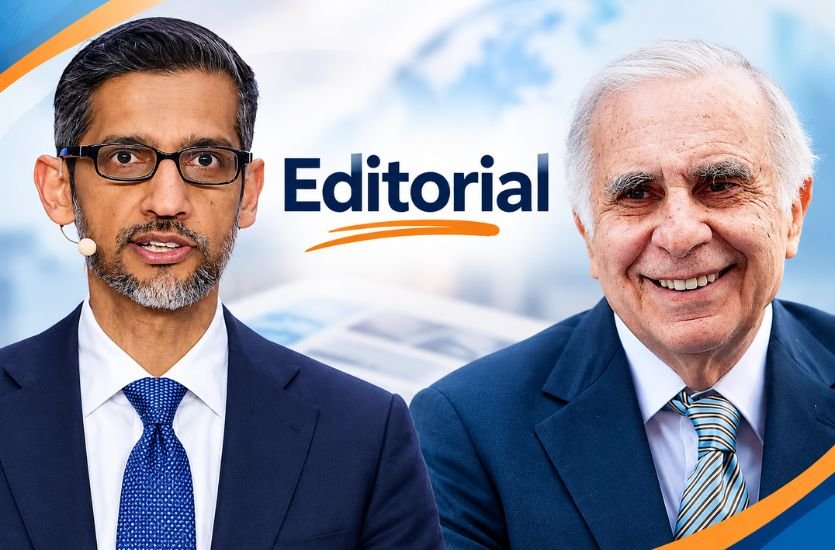
Sundar Pichai and Carl Icahn are two highly recognizable names in the business world, but they became successful through very different careers. Pichai rose through the technology industry, eventually becoming CEO of Google and Alphabet, while Icahn built his reputation as an investor known for taking substantial positions in companies and pushing for corporate changes. At first glance, there appears to be little connection between the two. However, their names can be discussed together because of an important chapter in Google’s history: the 2011 acquisition of Motorola Mobility.
The connection requires some clarification. Pichai and Icahn were not documented as direct business partners, and Pichai was not one of the Google executives identified in the relevant transaction documents as negotiating the Motorola acquisition. Instead, the connection comes from their positions within a much larger technology and investment story involving Google, Motorola Mobility, Android, patents, and shareholder activism. Understanding that distinction makes the story more accurate and more interesting.
Quick Bio: Sundar Pichai and Carl Icahn
| Detail | Sundar Pichai | Carl Icahn |
|---|---|---|
| Full Name | Pichai Sundararajan | Carl Celian Icahn |
| Profession | Technology Executive | Investor and Activist Shareholder |
| Known For | CEO of Google and Alphabet | Corporate investing and shareholder activism |
| Google Connection | Joined Google in 2004 | Major Motorola Mobility shareholder in 2011 |
| Major Role | Led Google and Alphabet | Influenced companies through substantial investments |
| Education | IIT Kharagpur, Stanford, Wharton | Princeton University |
| Major Business Area | Technology, software, AI and digital platforms | Investments, corporate strategy and shareholder activism |
Who Is Sundar Pichai?
Sundar Pichai, whose full name is Pichai Sundararajan, is one of the most prominent technology executives of the modern era. He joined Google in 2004 and gradually moved through increasingly important leadership positions before becoming CEO of Google in 2015. In 2019, he also became CEO of Alphabet, Google’s parent company.
Pichai’s career is notable because his rise was closely connected with some of Google’s most important products. Alphabet’s corporate biography says that he has led product and engineering efforts across major platforms including Search, Chrome, Maps, Android, Gmail and Google Workspace. Before becoming Google CEO, he served as Senior Vice President of Android, Chrome and Apps and later as Senior Vice President of Products.
His educational background also contributed to his international reputation. Pichai studied metallurgical engineering at the Indian Institute of Technology Kharagpur before earning a master’s degree from Stanford University and an MBA from the Wharton School of the University of Pennsylvania.
Pichai’s importance to Google’s history extends beyond one particular product. During his leadership, Google has expanded its focus on artificial intelligence, cloud computing, digital services, hardware and other technology areas. His career therefore represents the path of a technology professional who moved from product management and engineering-related leadership into the highest levels of corporate management.
However, when discussing Sundar Pichai and Carl Icahn together, it is important not to place Pichai at the center of the Motorola Mobility acquisition. Google announced that transaction in 2011 while Larry Page was CEO. Pichai did not become Google’s CEO until 2015.
Who Is Carl Icahn?
Carl Icahn is an American investor widely associated with activist investing. Unlike a passive shareholder who simply buys stock and waits for its value to increase, an activist investor may seek to influence a company’s management, board, strategic direction, asset sales, restructuring or other major decisions.
Icahn became one of the best-known figures on Wall Street through his willingness to take significant positions in companies and push for changes that he believed could increase shareholder value. His career has involved numerous major corporate situations, and his name has become closely associated with shareholder activism.
His connection to Motorola Mobility in 2011 is particularly important to the story involving Sundar Pichai. At the time of Google’s acquisition, Icahn and related entities were among Motorola Mobility’s largest shareholders. The company’s SEC filing identified Icahn and related entities as beneficial owners of 33,505,706 shares, representing approximately 11.39% of Motorola Mobility’s outstanding common stock.
This substantial ownership position gave Icahn a meaningful interest in Motorola Mobility’s future. His involvement became especially relevant as the company considered the value of its intellectual property and ultimately entered into an agreement to be acquired by Google.
What Connects Sundar Pichai and Carl Icahn?
The most important connection between Sundar Pichai and Carl Icahn is the business environment surrounding Google’s acquisition of Motorola Mobility.
The two men came from different sides of the corporate world. Pichai was a Google executive whose career was focused on technology products and platforms. Icahn was a major Motorola Mobility shareholder whose approach was centered on investment and shareholder value.
In 2011, Motorola Mobility possessed a significant portfolio of mobile technology patents. Icahn had already been interested in the potential value of those patents. According to Motorola Mobility’s SEC filing, Icahn and Motorola director Daniel Ninivaggi contacted Motorola CEO Sanjay Jha in July 2011 and discussed the possibility of exploring alternatives concerning the company’s patent portfolio.
Around the same period, Google was discussing strategic possibilities involving Motorola Mobility. Those discussions eventually resulted in Google’s proposal to acquire the entire company.
This is where the stories of Pichai and Icahn can be placed within the same historical narrative. Pichai was working at Google during the period, while Icahn was a major shareholder of Motorola Mobility. But the available transaction records do not establish that the two personally negotiated the deal or worked together.
That distinction is essential for an accurate article.
Google’s 2011 Acquisition of Motorola Mobility
Google and Motorola Mobility announced their definitive acquisition agreement on August 15, 2011. Google agreed to purchase Motorola Mobility for $40 per share in cash, giving the transaction a total value of approximately $12.5 billion. The announced price represented a 63% premium over Motorola Mobility’s closing share price on August 12.
Google described the acquisition as a strategic move that would strengthen the Android ecosystem and enhance competition in mobile computing. Motorola Mobility was already an important Android partner, and Google said the company would continue operating Motorola Mobility as a separate business while Android would remain an open platform.
The acquisition was significant because Google was primarily known as an internet and software company rather than a traditional smartphone manufacturer. Purchasing Motorola Mobility gave Google access to a major mobile hardware business as well as valuable intellectual property.
Google’s announcement emphasized Motorola’s long history in mobile technology and its commitment to Android. The deal therefore represented a major step in Google’s attempt to strengthen its position in the rapidly developing smartphone market.
Why Motorola’s Patent Portfolio Was Important
One of the most important elements of the Motorola story was intellectual property.
The smartphone industry in 2011 was experiencing intense competition among companies such as Google, Apple, Microsoft and other technology businesses. Patents covering wireless communications and mobile technologies had become strategically important.
The U.S. Department of Justice later described Motorola Mobility as holding a portfolio of approximately 17,000 issued patents and 6,800 patent applications when Google entered its agreement to acquire the company. The portfolio included hundreds of standard-essential patents relevant to wireless devices.
That intellectual-property position helped explain why Motorola Mobility was attractive to Google beyond its hardware business.
Google was trying to expand Android across the smartphone industry while facing legal and competitive pressure involving mobile technology patents. Owning Motorola’s intellectual property gave Google additional assets that could strengthen its position in the broader mobile ecosystem.
This also helps explain why Icahn’s interest in Motorola’s patents matters to the story. As a major shareholder, he had an interest in how Motorola’s valuable assets could be used or monetized.
Carl Icahn’s Role Before the Google Deal
Carl Icahn’s involvement was not simply a matter of owning Motorola Mobility shares.
The Motorola Mobility SEC filing provides a detailed account of the events leading up to the transaction. In July 2011, Icahn and Daniel Ninivaggi contacted Motorola CEO Sanjay Jha and discussed alternatives concerning Motorola’s patent portfolio. Later, Motorola executives and Google’s representatives held discussions regarding Google’s interest in the company.
The timeline is particularly significant because it shows that Icahn was already paying attention to Motorola’s intellectual-property assets before the acquisition was announced publicly.
On August 2, 2011, Icahn contacted Jha again to receive an update and discuss Google’s August 1 proposal. The SEC filing also states that representatives of Motorola and Google continued discussions during early August as Google considered the terms of its proposed transaction.
By August 14, Motorola Mobility’s board was discussing the proposed merger. During that meeting, Ninivaggi informed the board that Icahn had indicated his intention to support the proposed merger, although there was no voting agreement.
These details demonstrate that Icahn was a significant shareholder whose views mattered during the transaction process.
Was Sundar Pichai Involved in Negotiating the Motorola Deal?
This is one of the most important questions surrounding the phrase “Sundar Pichai and Carl Icahn.”
The answer should be handled carefully.
Pichai was working at Google in 2011, having joined the company in 2004. However, the relevant Motorola Mobility transaction documents do not identify him as one of the Google executives directly negotiating the acquisition.
The transaction records instead identify senior Google figures involved in the discussions surrounding the proposed deal. Larry Page was Google’s CEO when the acquisition was announced, and Google’s public announcement quoted Page explaining the strategic importance of the transaction.
Pichai’s later career makes the story more interesting, but it does not change the historical timeline. He became Google’s CEO in 2015, several years after the Motorola acquisition was announced. He later became Alphabet’s CEO in 2019.
Therefore, it would be inaccurate to describe Pichai as the person who negotiated Google’s purchase of Motorola Mobility.
A more accurate description is that Pichai was already a Google employee during the period, while Icahn was a major Motorola Mobility shareholder, and their professional histories intersect through the broader corporate story surrounding the acquisition.
Pichai’s Connection to Android
Although Pichai was not Google’s CEO during the Motorola acquisition, Android later became an important part of his leadership career.
Alphabet’s corporate biography records that Pichai served as Google’s Senior Vice President of Android, Chrome and Apps from March 2013 until October 2014. He then became Senior Vice President of Products before becoming Google CEO in October 2015.
This timeline is especially interesting because Google’s Motorola acquisition happened in 2011, while Pichai assumed direct senior responsibility for Android-related leadership later.
Google’s acquisition was intended to strengthen the Android ecosystem, while Pichai subsequently became one of the senior executives responsible for major Google products and platforms, including Android.
This creates a historical connection between Pichai and the consequences of the Motorola deal, even though he should not be portrayed as its principal negotiator.
The Motorola Acquisition Was Completed in 2012
Google’s Motorola transaction did not end with the 2011 announcement.
The acquisition officially closed on May 22, 2012. Google announced that Motorola Mobility had become part of Google and described Motorola as a company with a long history of innovation in mobile technology.
Larry Page said that Motorola’s commitment to Android had made it a valuable partner for Google. Sanjay Jha stepped down as Motorola Mobility’s CEO, while Dennis Woodside took over leadership of Motorola Mobility.
The completion of the transaction marked a significant change in Google’s relationship with the smartphone hardware industry.
Google could now work more closely with a major device manufacturer while also holding Motorola’s extensive patent portfolio.
Sundar Pichai and Carl Icahn Represent Different Types of Business Influence
The story becomes more meaningful when Pichai and Icahn are compared as examples of two very different forms of business influence.
Pichai’s influence developed through technology leadership. His career involved managing products, engineering organizations, platforms and large teams. His eventual position as CEO of Google and Alphabet gave him responsibility for the company’s overall strategic direction.
Icahn’s influence developed through investment. His approach has often involved acquiring substantial stakes in companies and using shareholder influence to push management or boards toward strategic changes.
The Motorola Mobility story demonstrates how these two types of influence can intersect within a major corporate transaction.
Google approached Motorola from the perspective of technology strategy, Android and intellectual property. Icahn approached Motorola as a major shareholder with a significant financial interest in the company’s assets and future.
Neither approach was identical, but both became part of the same corporate story.
What Happened to Motorola Mobility After Google?
Google’s ownership of Motorola Mobility did not last indefinitely.
In 2014, Google agreed to sell Motorola Mobility to Lenovo. The sale came only a few years after Google’s $12.5 billion acquisition.
Google retained ownership of much of Motorola’s patent portfolio while transferring the hardware business to Lenovo. This later development is important because it demonstrates that Google’s interest in Motorola was not simply about becoming a permanent smartphone manufacturer.
The original acquisition had provided Google with a combination of hardware expertise and intellectual property, but Google’s long-term strategy eventually changed.
The Motorola chapter therefore became one part of the much larger history of Android and Google’s hardware strategy.
Why the Sundar Pichai and Carl Icahn Story Still Matters
The phrase “Sundar Pichai and Carl Icahn” may initially suggest that the two men had a direct business relationship. The available evidence tells a more nuanced story.
Their connection is primarily historical and indirect.
Pichai represents Google’s long-term technology leadership. He joined Google in 2004, became responsible for major products and eventually rose to become CEO of both Google and Alphabet.
Icahn represents the shareholder and investment side of the Motorola story. He held approximately 11.39% of Motorola Mobility and was involved in discussions concerning its patent portfolio before Google acquired the company.
Google’s acquisition brought those different worlds together. The company acquired Motorola for approximately $12.5 billion, partly because of the strategic importance of Motorola’s mobile business and intellectual property.
The connection is therefore not a personal partnership between Pichai and Icahn. It is a connection created by a major corporate event in which Google, Motorola Mobility, Android, patents and shareholder interests all intersected.
Frequently Asked Questions
Who is Sundar Pichai?
Sundar Pichai is the CEO of Google and Alphabet. He joined Google in 2004, became Google’s CEO in 2015 and became Alphabet’s CEO in 2019. He has held leadership responsibilities across major Google products including Android, Chrome, Search, Maps, Gmail and Google Workspace.
Who is Carl Icahn?
Carl Icahn is an American investor and activist shareholder known for taking significant positions in companies and seeking changes that he believes can improve shareholder value.
Did Sundar Pichai and Carl Icahn work together?
There is no reliable evidence in the relevant Motorola transaction records that Pichai and Icahn worked together as direct business partners. Their connection is primarily related to Google, Motorola Mobility and the 2011 acquisition.
What was Carl Icahn’s role in Motorola Mobility?
Icahn and related entities owned approximately 33.5 million Motorola Mobility shares, representing about 11.39% of the company. He also participated in discussions concerning Motorola’s patent portfolio and later indicated that he intended to support Google’s proposed merger.
Was Sundar Pichai CEO of Google when Motorola Mobility was acquired?
No. Larry Page was Google’s CEO when the Motorola Mobility acquisition was announced in 2011. Pichai became Google’s CEO in 2015.
How much did Google pay for Motorola Mobility?
Google agreed to acquire Motorola Mobility for $40 per share in cash, for a total transaction value of approximately $12.5 billion.
Why did Google want Motorola Mobility?
Google said the acquisition would strengthen the Android ecosystem and enhance competition in mobile computing. Motorola’s extensive mobile patent portfolio was also strategically important in the competitive smartphone industry.
When did Google complete the Motorola acquisition?
Google completed the acquisition on May 22, 2012.
Conclusion
Sundar Pichai and Carl Icahn followed very different paths to business prominence, but their professional histories intersect through one important chapter in the technology industry. Pichai built his career at Google and eventually became the leader of Google and Alphabet, while Icahn developed his reputation as a powerful investor and activist shareholder.
Their documented connection centers on Motorola Mobility. Icahn was a major Motorola shareholder and was involved in discussions about the company’s patent portfolio before Google announced its approximately $12.5 billion acquisition in 2011. Google viewed Motorola as an important Android partner and recognized the strategic importance of its mobile technology and intellectual property.
Pichai’s role needs to be described carefully. He was already working at Google during the period, but he was not identified in the available transaction documents as one of the executives negotiating the acquisition. His greater connection to the Android story came later, when he took on senior Android leadership responsibilities and eventually became Google’s CEO.
The story of Sundar Pichai and Carl Icahn is therefore not a story of two executives directly working together. It is a story of how technology leadership, shareholder activism, Android, patents and corporate strategy came together around one of the most significant mobile-industry transactions of the early 2010s.
READ MORE : Roya Nikkhah
READ MORE : Jennifer Lawrence and Jim Taiclet
One thought on “Sundar Pichai and Carl Icahn: The Motorola Mobility Connection Explained”