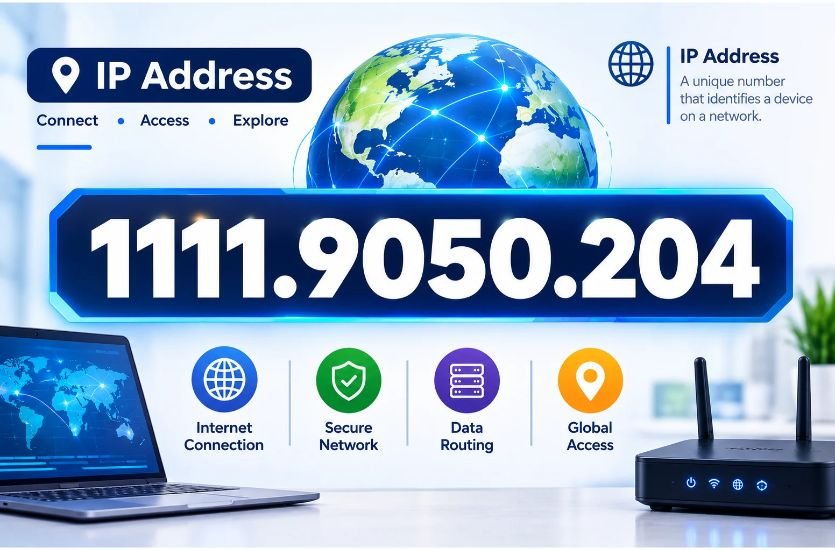
1111.9050.204 looks like an IP address at first glance, but a closer look shows that it does not follow the standard structure of an IPv4 address. It contains only three dot-separated sections, while IPv4 uses four 8-bit sections. In addition, two of its numerical sections are far greater than the maximum value permitted in an IPv4 address.
Understanding why 1111.9050.204 is invalid is useful for anyone researching router addresses, network configuration, private IP addresses, default gateways, or unfamiliar numerical strings found online. A number that resembles an IP address should not automatically be assumed to be a genuine network address.
Read 212.32.226.324: Is It a Valid IP Address?
What Is 1111.9050.204?
1111.9050.204 is not a valid IPv4 address. The standard IPv4 format consists of four decimal numbers separated by periods. Each individual number, commonly called an octet, must fall within the range of 0 through 255.
The string 1111.9050.204 contains three groups:
- 1111
- 9050
- 204
This creates two immediate problems. First, there are three groups rather than four. Second, the values 1111 and 9050 are both considerably greater than 255.
The Internet Protocol specification describes IPv4 addresses as 32-bit addresses made up of four octets.
Therefore, 1111.9050.204 should not be treated as a functional IPv4 address, router IP, public IP, or private IP address without additional evidence showing that the string belongs to some completely different numbering system.
Why Is 1111.9050.204 Invalid?
There are two fundamental formatting problems with 1111.9050.204.
It Has Only Three Sections
A conventional IPv4 address contains four decimal components.
For example:
192.168.1.1
This can be divided into four sections:
192 | 168 | 1 | 1
By comparison:
1111.9050.204
contains only:
1111 | 9050 | 204
A missing fourth section means the string does not conform to the conventional dotted-decimal representation of IPv4.
Two Values Are Above 255
Each IPv4 octet represents eight bits. Eight bits can represent 256 possible values, from 0 through 255.
Consequently:
- 1111 is invalid as an IPv4 octet.
- 9050 is invalid as an IPv4 octet.
- 204 is within the numerical range, but the complete address is still invalid because the other components fail the requirements.
This means that simply adding another dot would not automatically turn 1111.9050.204 into a valid IP address. The numerical values would also need to be corrected.
What Does a Valid IPv4 Address Look Like?
A valid IPv4 address normally follows this pattern:
A.B.C.D
Each section must contain a value from 0 to 255.
Examples include:
- 192.168.1.1
- 192.168.0.1
- 10.0.0.1
- 172.16.0.1
- 8.8.8.8
These examples contain four numerical sections, and each section is within the permitted range.
By contrast, examples such as 1111.9050.204, 256.1.1.1, and 192.168.1 are not valid conventional IPv4 addresses.
The four-octet structure is fundamental to IPv4 addressing.
Is 1111.9050.204 a Real IP Address?
No, 1111.9050.204 is not a valid IPv4 address in standard dotted-decimal notation.
A web search can sometimes produce pages describing the string as a possible identifier, code, reference number, or structured label. However, those descriptions should not be confused with evidence that it has been assigned as an Internet address.
Some indexed pages currently describe 1111.9050.204 as a generic technical identifier, catalog reference, or composite code. Those interpretations do not establish a recognized standard meaning for the string.
The more defensible conclusion is that the string resembles an IP address but fails IPv4 validation.
Is 1111.9050.204 a Private IP Address?
No.
Private IPv4 addresses are taken from specifically reserved ranges. The familiar private ranges include:
10.0.0.0/8
172.16.0.0/12
192.168.0.0/16
Examples include 10.0.0.1 and 192.168.1.1.
Because 1111.9050.204 is not even a valid IPv4 address, it cannot be classified as a private IPv4 address.
This distinction matters because a private IP address can be perfectly legitimate even though it cannot normally be routed directly across the public internet. An invalid address, on the other hand, does not represent an IPv4 endpoint under the standard format.
Is 1111.9050.204 a Public IP Address?
It is not a public IPv4 address either.
A public IPv4 address must first satisfy the basic requirements of IPv4 addressing. Since 1111.9050.204 has an invalid structure and contains values outside the allowable octet range, it cannot function as a conventional public IPv4 address.
Therefore, it would be incorrect to assign a geographic location, ISP, organization, or physical device to 1111.9050.204 merely because the string looks similar to an IP address.
Could 1111.9050.204 Be a Router Address?
It should not be used as a router address.
Home and office routers commonly use private gateway addresses such as:
- 192.168.1.1
- 192.168.0.1
- 10.0.0.1
- 172.16.0.1
The exact gateway depends on the router, network configuration, and internet provider.
If someone entered 1111.9050.204 while attempting to access a router administration page, the likely problem is that the address was entered incorrectly or came from an unreliable source.
A recent web result specifically identifies 1111.9050.204 as an invalid IP and explains that users looking for a router login should instead determine their actual default gateway.
How to Find Your Real Router IP Address
Instead of guessing a router address, it is better to check the device currently connected to the network.
Windows
On Windows, open Command Prompt and enter:
ipconfig
Look for Default Gateway under the active network connection.
An address such as 192.168.1.1 or 192.168.0.1 may appear there.
macOS
On a Mac, open the network settings for your active Wi-Fi or Ethernet connection. The router or gateway information identifies the address used to communicate with the local router.
Android
On Android, open the details for the connected Wi-Fi network. Depending on the phone and Android version, the relevant information may appear under network details, advanced settings, gateway, or router information.
iPhone
On an iPhone, open the Wi-Fi settings and select the connected network. The network information includes a Router field when available.
The important point is that the actual gateway shown by the connected device is more reliable than guessing from an unfamiliar number such as 1111.9050.204.
What Is a Default Gateway?
A default gateway is the network device that forwards traffic from a local network toward other networks.
In a typical home environment, the router performs this role.
For example, a computer might have:
Device IP: 192.168.1.25
Default Gateway: 192.168.1.1
The computer uses the gateway when traffic needs to leave the local network.
This is why people sometimes refer to the router’s local address as the router IP or gateway IP. However, the exact address varies between networks.
Why Do People Mistake Numbers Like 1111.9050.204 for IP Addresses?
The human-readable appearance of dotted numbers makes them easy to mistake for IP addresses.
Many legitimate technical values contain periods. These can include:
- IP addresses
- Software version numbers
- Product codes
- Document references
- Database identifiers
- Internal numbering systems
- Configuration values
As a result, the presence of dots alone does not prove that a number is an IP address.
For 1111.9050.204, the correct approach is to validate the format before trying to determine ownership, location, or network information.
Could 1111.9050.204 Be a Technical Identifier?
It is possible for an organization to use almost any internally defined numbering scheme as an identifier. However, that does not mean 1111.9050.204 has a universally recognized technical meaning.
Some websites currently describe the number as a potential identifier, catalog number, model reference, or internal code. Those claims are speculative unless backed by documentation from the organization or system that supposedly created the identifier.
Therefore, it is better to describe 1111.9050.204 as an unverified numeric string when discussing those possibilities, rather than presenting an unsupported interpretation as fact.
Can You Find the Location of 1111.9050.204?
No reliable IP geolocation can be assigned to 1111.9050.204 as an IPv4 address because the string is invalid under the standard IPv4 format.
IP geolocation services work with recognized IP addresses and associated allocation data. If the input itself does not represent a valid IPv4 address, attempting to identify a city, country, ISP, or organization from it would be misleading.
This is an important distinction for online articles because an invalid IP should not be given an invented geographic location.
Can You Open 1111.9050.204 in a Browser?
Entering 1111.9050.204 into a browser will not make it a valid IPv4 address.
Depending on the browser and operating system, the input may be treated as a search query, rejected, or result in a connection error.
If the purpose is to access a router’s administration page, the correct procedure is to identify the device’s actual default gateway and enter that valid address into the browser’s address bar.
Common IPv4 Address Mistakes
The string 1111.9050.204 illustrates several common IP-address mistakes.
Too Few Sections
An IPv4 address normally contains four sections. Leaving one out creates an invalid conventional address.
Numbers Greater Than 255
An octet cannot exceed 255 in the standard IPv4 dotted-decimal format.
Missing or Incorrect Dots
A small typing mistake can change a valid address into an invalid one.
For example:
192.168.1.1
is valid, while:
192.168.11
does not have the normal four-part IPv4 structure.
Confusing an IP With Another Number
Not every dotted numerical string is an IP address. It could be a version number, identifier, reference, or simply a typing error.
What Should You Do If You Encounter 1111.9050.204?
The best response depends on where the number appeared.
If it appeared in a router setup guide, check the original documentation and verify the manufacturer’s official instructions.
If it appeared in your network settings, compare it with the actual gateway information shown by your operating system.
If it appeared on a website, do not automatically assume that the website’s explanation is technically correct.
If it appeared in a technical document, look for surrounding information that identifies the numbering system.
Most importantly, do not enter passwords or other sensitive information into an unfamiliar website simply because it claims that 1111.9050.204 is a router login address.
1111.9050.204 vs. 192.168.1.1
The difference between these strings is straightforward.
1111.9050.204
- Three numerical groups
- Contains values greater than 255
- Not a valid IPv4 address
- Cannot be treated as a normal router IP
192.168.1.1
- Four numerical groups
- Every group is between 0 and 255
- Valid IPv4 notation
- Falls within the private 192.168.0.0/16 range
This comparison demonstrates why format validation is important before attempting to identify an IP address.
Does 1111.9050.204 Have a Standard Meaning?
There is currently no strong evidence that 1111.9050.204 is a recognized Internet standard, registered IPv4 address, or universally defined technical code.
Search results contain pages that speculate about possible identifier or code meanings, but those claims should be treated cautiously.
The strongest technical conclusion comes from comparing the string with the established IPv4 format: it does not qualify as a conventional IPv4 address. The original IPv4 specification defines Internet addresses as four-octet, 32-bit addresses.
Frequently Asked Questions About 1111.9050.204
Is 1111.9050.204 a valid IP address?
No. 1111.9050.204 does not meet the standard IPv4 format because it contains three sections rather than four, and two sections exceed 255.
Is 1111.9050.204 a private IP?
No. It is not a valid IPv4 address and therefore cannot be classified as a private IPv4 address.
Is 1111.9050.204 a public IP?
No. It is not a valid conventional IPv4 address, so it should not be treated as a public IP.
Can 1111.9050.204 be a router IP?
Not as a conventional IPv4 router address. If you are trying to access your router, find the actual default gateway assigned to your device.
What is wrong with 1111.9050.204?
There are two primary problems: it has only three dot-separated sections, and 1111 and 9050 are greater than the maximum IPv4 octet value of 255.
What should a valid IPv4 address contain?
A conventional IPv4 address contains four numerical sections separated by periods, with each section ranging from 0 to 255.
Could 1111.9050.204 be an internal code?
Possibly, but there is no sufficient evidence to claim that it has a particular standardized meaning. Its context would be necessary to determine whether an organization uses it as an internal identifier.
Can you determine the location of 1111.9050.204?
No reliable IP location can be assigned to it because it is not a valid IPv4 address.
What IP address should I use for my router?
Do not guess. Check your device’s Default Gateway or Router field. Common private gateway addresses include 192.168.1.1, 192.168.0.1, and 10.0.0.1, but your network may use a different address.
Final Thoughts
1111.9050.204 looks like an IP address, but it fails the basic requirements of conventional IPv4 notation. It has three sections instead of four, and two of its numerical components exceed the 0–255 range permitted for IPv4 octets.
There is also no strong evidence that the string represents a recognized public IP address or standardized Internet identifier. Although some websites describe it as a possible technical or composite identifier, those interpretations should not be presented as established facts without supporting documentation.
If you encountered 1111.9050.204 while trying to configure a router, the safest solution is to check your device’s actual default gateway rather than guessing. For technical research, the most accurate description is that 1111.9050.204 is an invalid IPv4-style address whose exact origin or intended meaning depends on the context in which it was encountered.
Visit Editorial Magazine for more informative articles.