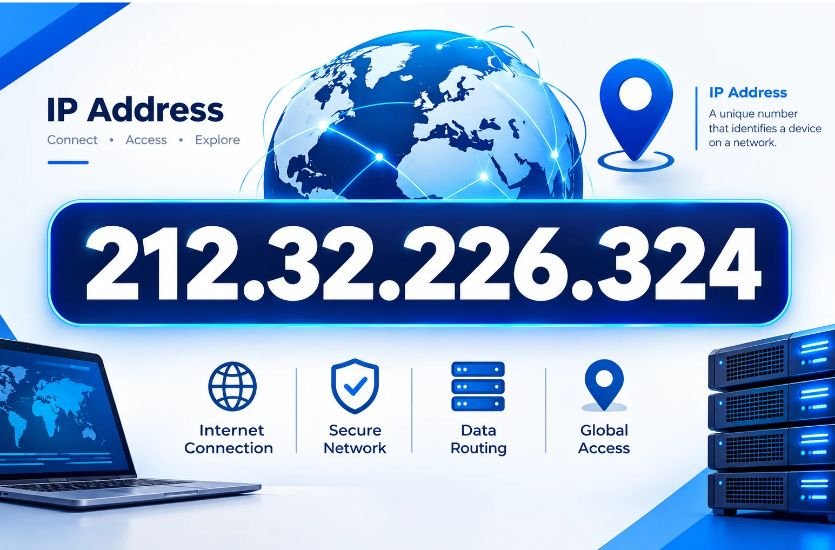
When people encounter 212.32.226.324, they may assume it is an ordinary IP address and search for information about its location, owner, ISP, security reputation, or network activity. At first glance, the string looks like a conventional IPv4 address because it contains four numbers separated by periods. However, a closer examination reveals an important technical problem.
212.32.226.324 is not a valid IPv4 address. The reason is simple: the final number, 324, is greater than the maximum value allowed for an IPv4 octet. Each of the four sections in a standard IPv4 address must contain a number from 0 through 255. The first three sections of 212.32.226.324 meet that requirement, but the fourth does not.
Understanding why this address is invalid can help users interpret unusual network entries, troubleshoot configuration problems, and avoid making incorrect assumptions about an unfamiliar IP-like string.
What Is 212.32.226.324?
212.32.226.324 is an IPv4-style string containing four numerical sections separated by periods. Its structure resembles a normal IPv4 address, but its final section violates the rules of IPv4 addressing.
The four sections are:
| Section | Value | IPv4 Range | Status |
|---|---|---|---|
| First octet | 212 | 0–255 | Valid |
| Second octet | 32 | 0–255 | Valid |
| Third octet | 226 | 0–255 | Valid |
| Fourth octet | 324 | 0–255 | Invalid |
The problem is therefore not the number of sections or the use of periods. The problem is specifically the value 324 in the fourth position.
A standard IPv4 address has four octets. Since each octet contains eight bits, it can represent 256 possible values, starting at 0 and ending at 255. Consequently, a value such as 324 cannot be represented as a normal IPv4 octet.
Why Is 212.32.226.324 Invalid?
The most important fact about 212.32.226.324 is that the fourth octet is outside the permitted IPv4 range.
An IPv4 address contains 32 bits divided into four groups of eight bits. Each group is commonly written as a decimal number. An eight-bit value has a maximum decimal value of 255:
2⁸ − 1 = 255
Therefore, the permitted range for each IPv4 octet is:
0 to 255
In 212.32.226.324, the first three values are acceptable:
212is within 0–255.32is within 0–255.226is within 0–255.
The final value is different:
324is greater than 255.
That single invalid octet makes the complete string an invalid IPv4 address. Search results discussing this exact value consistently identify the fourth octet as the reason it fails standard IPv4 validation.
Understanding IPv4 Addresses
To understand 212.32.226.324, it helps to understand the basic structure of IPv4.
IPv4 stands for Internet Protocol version 4. It uses 32-bit addresses to identify network interfaces and destinations. These addresses are normally represented using dotted-decimal notation.
For example:
192.168.1.1
This address contains four octets:
19216811
Every number is within the permitted range of 0 to 255, so the address has valid IPv4 syntax.
Another example is:
8.8.8.8
Again, all four values are between 0 and 255.
By comparison:
212.32.226.324
contains one value outside that range. Although it looks similar to a normal IPv4 address, it fails the fundamental range requirement.
Can an IPv4 Address Contain 324?
No. A standard IPv4 address cannot contain 324 as an octet.
This is one of the easiest ways to identify the problem with 212.32.226.324. If any of the four numerical sections of an IPv4-style address is greater than 255, the complete address is not a valid conventional IPv4 address.
For example:
| Address | Status | Reason |
|---|---|---|
192.168.1.1 | Valid format | All octets are 0–255 |
8.8.8.8 | Valid format | All octets are 0–255 |
212.32.226.234 | Valid format | All octets are 0–255 |
192.168.1.256 | Invalid | 256 exceeds 255 |
212.32.226.324 | Invalid | 324 exceeds 255 |
This distinction is important because simply having four numbers separated by dots does not automatically make a string a valid IPv4 address.
Is 212.32.226.324 a Public IP Address?
It is not meaningful to classify 212.32.226.324 as a public IPv4 address because the complete string is invalid.
Public and private classifications apply to valid IP address ranges. Common private IPv4 ranges include:
10.0.0.0/8172.16.0.0/12192.168.0.0/16
The supplied address does not fall into those private ranges based on its first three values, but that does not make it a usable public IP. The fourth octet is invalid, so the complete string cannot function as a normal IPv4 address.
In other words, the correct answer is not simply “public IP.” The more accurate answer is invalid IPv4 address.
Is 212.32.226.324 a Private IP?
No meaningful private-IP classification applies to 212.32.226.324 because the complete address is invalid.
A private IP must still be a properly formatted IPv4 address. For example, 192.168.1.20 is syntactically valid and belongs to a private address range. An address ending in .324 cannot be treated in the same way.
This distinction is useful when investigating network configurations. A malformed address should be corrected or traced back to its source rather than classified as public or private.
Can 212.32.226.324 Identify a Device?
Not as written.
A valid IP address can be associated with a network interface or used as a destination for network communication. However, 212.32.226.324 cannot serve as a conventional IPv4 destination because it fails IPv4 validation.
If this value appeared in a server log, security dashboard, application, email, configuration file, or technical document, the original source should be checked.
Possible explanations include a typing mistake, a copy-and-paste error, malformed data, an incorrectly generated value, or an application recording an IP-like string without properly validating it.
Could 212.32.226.324 Be a Typographical Error?
Yes. A typo is one possible explanation, but the intended address cannot be determined simply by looking at the invalid value.
For example, someone could accidentally have entered an incorrect final digit. A similar-looking valid address might contain a different fourth octet, but it would be inappropriate to assume a particular replacement without seeing the original source.
If 212.32.226.324 appeared in a log or document, check:
- The original record.
- The raw server log.
- The application that generated the value.
- Any copied or exported data.
- The surrounding text or network event.
- Whether an OCR or formatting process altered the original value.
The safest approach is to verify the source instead of guessing a replacement.
Why Might an Invalid IP Appear in a Server Log?
An invalid IP-like value can sometimes appear in logs even though it is not a routable IPv4 address.
One possibility is ordinary data-entry or processing error. Another possibility is that an application recorded user-controlled information that looked like an IP address without validating it first.
For example, web applications may receive information through HTTP headers associated with client addresses. Headers such as X-Forwarded-For can be relevant when traffic passes through proxies, but applications need to handle such information carefully because values supplied by clients should not automatically be treated as trustworthy network identity information.
This does not mean that every appearance of 212.32.226.324 indicates an attack. An invalid value alone is not sufficient evidence of malicious activity.
Is 212.32.226.324 Dangerous?
There is no reliable basis for describing 212.32.226.324 itself as malicious, because it is not a valid IPv4 address.
If you discovered the value in a security alert or server log, the correct response is to investigate the context rather than immediately assuming that the address represents an attacker.
Look for:
- The actual source IP recorded by the network connection.
- The timestamp of the event.
- The requested URL or service.
- HTTP request headers.
- Authentication events.
- Firewall records.
- Other valid IP addresses associated with the same event.
Once the actual valid IP is identified, that address can be investigated through appropriate network and reputation services.
The important principle is simple: an invalid IP-like string is a validation problem first, not proof of malicious behavior.
Can You Perform an IP Lookup on 212.32.226.324?
A normal IP geolocation, WHOIS, or reputation lookup cannot meaningfully identify a real network resource from 212.32.226.324 as written.
The first step should be validating the address. Since 324 is outside the allowed IPv4 range, the string should not be treated as a normal public IPv4 destination.
If the value came from a document or log, return to the original source and determine whether the address was copied incorrectly.
Only after obtaining a valid IP should you proceed with:
- WHOIS or registry information.
- Autonomous system information.
- ISP or hosting information.
- Geolocation.
- Abuse or reputation checks.
- DNS-related investigation.
This prevents inaccurate information from being attached to the wrong address.
How to Check Whether an IP Address Is Valid
Checking an IPv4 address is relatively straightforward.
Check the Number of Sections
A conventional IPv4 address contains four numerical sections separated by periods.
Example:
203.0.113.10
It has four sections.
Check Every Octet
Each section must be between 0 and 255.
For 212.32.226.324:
212 → valid
32 → valid
226 → valid
324 → invalid
Therefore, the complete address fails validation.
Check the Original Source
If the address came from a log, email, document, screenshot, or application, compare it with the original record.
This is especially important before blocking an address or reporting it as malicious.
Validate Before Performing a Lookup
Once you have a corrected address, use a reputable IP lookup or registry service to investigate it. Do not assume that a nearby IP is the intended one.
212.32.226.324 and IPv6
It is also useful to distinguish IPv4 from IPv6.
IPv4 uses four decimal octets, such as:
192.168.1.1
IPv6 uses a much larger 128-bit address space and normally uses hexadecimal notation, such as:
2001:db8::1
Therefore, the IPv4 rule is directly relevant to 212.32.226.324. The address clearly uses dotted-decimal IPv4-style notation, so every component must comply with the IPv4 octet range.
The fact that IPv6 allows a much larger address space does not make .324 valid in IPv4 notation.
What Should You Do If You Found 212.32.226.324?
If you encountered 212.32.226.324 while troubleshooting a website, server, application, or security alert, do not immediately assume that it represents a real attacker or device.
Instead, verify where it came from.
If it appeared in a manually written configuration, check for a typing mistake.
If it appeared in a server log, inspect the complete event and determine whether the value came from a trusted network source or an application field.
If it appeared in an email or document, compare it with the original source.
If it appeared in a security tool, check whether the tool itself reported an invalid value or whether the value was extracted from user-controlled data.
This approach provides much more reliable results than simply searching the malformed address in multiple IP databases.
Common Mistakes When Researching 212.32.226.324
One common mistake is assuming that every four-part dotted number is automatically a real IP address.
Another mistake is replacing .324 with a random number and treating the result as the intended address.
For example, changing:
212.32.226.324
to:
212.32.226.234
might produce a syntactically valid IPv4 address, but there is no guarantee that .234 was what the original source intended.
A third mistake is assuming that an invalid address must be associated with cybercrime. Invalid data can result from ordinary human error, software bugs, malformed input, or logging problems.
A professional investigation should therefore distinguish what is technically confirmed from what is merely possible.
Frequently Asked Questions About 212.32.226.324
Is 212.32.226.324 a valid IP address?
No. 212.32.226.324 is not a valid IPv4 address because its final octet, 324, exceeds the maximum allowed value of 255.
Why is 212.32.226.324 invalid?
The fourth octet is 324. IPv4 octets can only contain values from 0 to 255. Since 324 is greater than 255, the complete address fails IPv4 validation.
Can an IPv4 address end in 324?
No. A standard IPv4 address cannot have an octet greater than 255. Therefore, an address ending in .324 is invalid IPv4 notation.
Is 212.32.226.324 a real IP address?
No, not as written. It resembles an IPv4 address but does not meet the required numerical range.
Is 212.32.226.324 a public IP?
It cannot meaningfully be classified as a public IP because the complete string is invalid. A valid public IP would first need to satisfy IPv4 formatting and range requirements.
Is 212.32.226.324 a private IP?
No meaningful private-IP classification applies to it because the complete address is invalid.
Can 212.32.226.324 reveal someone’s location?
No. Since the supplied string is not a valid IPv4 address, it cannot be reliably used for IP geolocation.
Even with a valid IP, an IP address does not automatically reveal a person’s exact identity or physical address.
Can I find the owner of 212.32.226.324?
Not as written. The address must first be corrected or verified. After obtaining a valid IP, appropriate registry and network information may provide details about the organization or network associated with it.
Is 212.32.226.324 dangerous?
There is insufficient evidence to call the invalid string itself dangerous. If it appeared during a security incident, investigate the surrounding event and identify the actual valid source IP before drawing conclusions.
Could 212.32.226.324 be a typo?
Yes. It could result from a typing mistake, formatting problem, malformed data, or another processing error. However, the intended replacement cannot be known without checking the original source.
How do I fix 212.32.226.324?
Return to the original source and verify the fourth octet. Do not randomly replace 324 with another number. The corrected IPv4 address should contain four octets, each ranging from 0 through 255.
Final Thoughts
212.32.226.324 is an invalid IPv4 address. Its first three octets—212, 32, and 226—are within the permitted range, but the final octet, 324, exceeds the IPv4 maximum of 255. That single value makes the complete address invalid.
If you encountered this value while researching an IP address, checking a security alert, reading a server log, or troubleshooting a network, the best next step is to return to the original source and verify the value. It may be a simple typo or malformed entry, but it should not be treated as a valid public IP without further evidence.
Most importantly, do not invent a replacement address and do not label the invalid string as malicious simply because it looks unusual. Validate the data first, identify the actual IP involved, and then perform any appropriate network, ownership, geolocation, or security investigation.
Visit Editorial Magazine for more tech blogs.



One thought on “212.32.226.324: Is It a Valid IP Address?”