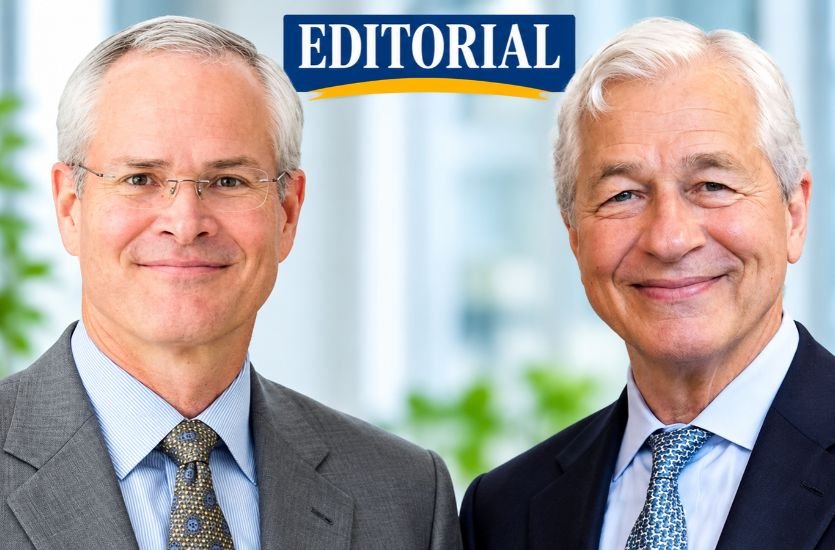
Jamie Dimon and Darren Woods are two influential American business executives whose careers have shaped major industries and attracted international attention. Jamie Dimon is widely recognized for his leadership in banking and financial services as the chairman and chief executive officer of JPMorganChase. Darren Woods is known for leading ExxonMobil, one of the world’s largest publicly traded energy companies. Although their professional responsibilities belong to different industries, both executives have played important roles in corporate leadership, investment decisions and the development of major American businesses.
Their professional backgrounds offer an interesting comparison between the financial services and energy sectors. Dimon’s career has involved banking, corporate acquisitions, financial management and economic strategy, while Woods has spent decades working in international energy operations, refining, chemicals and business development. Both have also participated in business organizations and discussions involving corporate governance, economic growth and long-term investment.
The connection between Jamie Dimon and Darren Woods is particularly interesting because their companies operate in industries that influence each other. Financial institutions support businesses through banking and capital markets, while energy companies provide resources essential to transportation, manufacturing and economic activity. Understanding their careers provides insight into how leadership decisions in different industries can influence the wider global economy.
Quick Biography of Jamie Dimon and Darren Woods
| Details | Jamie Dimon | Darren Woods |
|---|---|---|
| Full name | James Dimon | Darren W. Woods |
| Nationality | American | American |
| Profession | Banker and business executive | Energy executive |
| Company | JPMorganChase | ExxonMobil |
| Current leadership title | Chairman and CEO | Executive Chairman and CEO |
| Education | Tufts University, Harvard Business School | Texas A&M University, Northwestern University |
| Career industry | Banking and finance | Oil, gas and energy |
| Major leadership appointment | JPMorgan Chase CEO in 2006 | ExxonMobil CEO in 2017 |
Who Is Jamie Dimon?
Jamie Dimon is an American banking executive recognized for his long-standing leadership at JPMorganChase. He has become one of the most recognizable figures in the financial services industry through his involvement in major banking operations, corporate strategy and economic discussions. His professional experience includes several major financial organizations, where he developed a reputation for managing complex businesses and overseeing significant corporate transactions.
Born on March 13, 1956, in New York City, Dimon grew up in a family with connections to the financial industry. His father and grandfather worked as stockbrokers, giving him early exposure to the business environment. However, his professional achievements developed through his own education, experience and leadership responsibilities.
Dimon attended Tufts University, where he studied psychology and economics. After completing his undergraduate education, he continued his studies at Harvard Business School, earning a Master of Business Administration degree in 1982. His academic background provided him with knowledge of economics, management, business strategy and organizational leadership.
His career demonstrates how experience across different financial institutions can contribute to senior corporate leadership. Before becoming the head of JPMorganChase, Dimon worked in several important positions that helped shape his understanding of banking, investment management and business operations.
Jamie Dimon’s Early Career and Professional Development
Jamie Dimon began his professional career at American Express, where he worked under Sandy Weill, an influential figure in the financial services industry. His early experience exposed him to corporate management and financial operations. He later followed Weill into Commercial Credit, where he held important leadership responsibilities.
Commercial Credit became an important stage in Dimon’s career because the company participated in acquisitions and business expansion. During this period, Dimon developed experience in corporate transactions, financial planning and organizational restructuring. These responsibilities helped prepare him for more senior positions in the financial sector.
Commercial Credit eventually became part of a broader corporate structure that included Travelers Group. Dimon served as president and chief operating officer of Travelers from 1990 through 1998. He also held leadership responsibilities involving Smith Barney, a major brokerage business.
In 1998, Dimon became president of Citigroup following the combination of Travelers Group and Citicorp. His appointment placed him in a senior position within one of the largest financial services organizations of that period. However, his time at Citigroup ended after a disagreement with Sandy Weill, and Dimon left the organization.
His departure did not end his career in banking. Instead, it created an opportunity for him to take leadership of another major financial institution.
Jamie Dimon’s Leadership at Bank One and JPMorganChase
In 2000, Jamie Dimon became chairman and chief executive officer of Bank One Corporation. The company was an important American banking organization that had faced financial and operational challenges. During his leadership, Dimon worked on improving its financial position, management structure and business operations.
His work at Bank One attracted attention across the banking industry. He focused on financial discipline, operational improvements and building a stronger organization. These efforts contributed to the company’s improved performance and eventually positioned it for a major corporate combination.
In July 2004, JPMorgan Chase completed its merger with Bank One. Following the transaction, Dimon became president and chief operating officer of the combined company. This merger represented an important stage in his career because it brought him into a senior leadership position at a major financial institution with extensive domestic and international operations.
On January 1, 2006, Dimon became chief executive officer of JPMorganChase. He subsequently became chairman of the board in 2007. Under his leadership, the organization continued developing its investment banking, commercial banking, consumer finance and asset management operations.
One of the most significant periods of his leadership was the global financial crisis of 2008. During this period, financial institutions faced serious difficulties involving mortgage markets, credit availability and economic instability. JPMorganChase remained a major participant in the banking industry, and Dimon’s management decisions received considerable attention.
His leadership has also involved discussions about financial regulation, economic policy, international markets and the future of banking. Through shareholder letters and public appearances, he regularly communicates his views about the challenges facing the financial system.
Who Is Darren Woods?
Darren Woods is an American business executive recognized for his leadership at ExxonMobil. He has spent most of his professional career within the energy industry, working across international business operations, chemicals, refining and supply management.
His career is particularly notable because he progressed through different positions within the same corporate organization before becoming its chief executive. Unlike executives who move between several unrelated industries, Woods developed extensive experience in the operations and management of a major energy company.
Woods studied electrical engineering at Texas A&M University, where he earned a Bachelor of Science degree. He later completed a Master of Business Administration at Northwestern University’s Kellogg School of Management.
His combination of engineering education and business administration provided a foundation for understanding both technical operations and corporate management. These areas are particularly important in the energy industry, where companies manage complex infrastructure, international supply chains and capital-intensive projects.
Woods joined Exxon Company International in 1992 as a planning analyst. His initial responsibilities were connected to business planning, but his career gradually expanded into different operational and management areas.
Over the following years, he worked in domestic and international assignments involving Exxon Company International, ExxonMobil Chemical Company and ExxonMobil Refining and Supply Company.
Darren Woods’s Career at ExxonMobil
Darren Woods developed his professional experience through several leadership positions within ExxonMobil. His early assignments helped him understand international business operations and the commercial challenges associated with the energy industry.
In 2005, he was appointed vice president of ExxonMobil Chemical Company in Houston, Texas. In this position, he managed global specialty chemical businesses. This responsibility gave him experience in an important part of the company’s operations beyond traditional oil and gas production.
In 2008, Woods became director of refining for Europe, Africa and the Middle East at ExxonMobil Refining and Supply Company. Based in Brussels, he worked with international refining operations and regional business responsibilities.
In 2010, he became vice president of supply and transportation. This position involved responsibilities connected to the movement and distribution of energy products. Such operations are essential to energy companies because production, transportation, refining and distribution must function together.
In 2012, Woods was appointed president of ExxonMobil Refining and Supply Company and vice president of Exxon Mobil Corporation. He later became a senior vice president in 2014.
His progression through these positions gave him experience in several major areas of the company’s business. Rather than focusing on only one department, Woods developed an understanding of the broader organization and its international operations.
In January 2016, he became president of ExxonMobil and joined its board of directors. On January 1, 2017, he became chairman and chief executive officer.
His appointment placed him in charge of a major international energy company at a time when the industry was experiencing changes involving oil prices, environmental expectations, technological development and global energy demand.
Darren Woods’s Leadership and Energy Strategy
As a senior leader at ExxonMobil, Darren Woods oversees a company operating across several important areas of the energy industry. These include oil and natural gas exploration, production, refining, chemicals and lower-carbon solutions.
One of the major responsibilities of his leadership is managing long-term investment decisions. Energy companies frequently need substantial capital to develop production facilities, transportation systems, refining operations and new technologies. These projects can require years of planning before generating commercial returns.
Woods has emphasized the importance of maintaining the company’s operational capabilities while adapting to changing energy requirements. His approach involves balancing traditional energy production with investments in selected lower-carbon technologies.
ExxonMobil has developed its Low Carbon Solutions business to pursue opportunities involving carbon capture and storage, hydrogen and other technologies. The company has presented these activities as part of its strategy for addressing industrial emissions and developing new energy-related markets.
However, the energy transition remains a subject of international debate. Different governments, investors and environmental organizations have different expectations regarding the speed of the transition away from fossil fuels. ExxonMobil’s strategy reflects its own assessment of future energy demand, investment opportunities and technological development.
Woods’s position requires him to consider these developments while managing the company’s financial performance, production responsibilities and long-term business objectives.
How Are Jamie Dimon and Darren Woods Connected?
Jamie Dimon and Darren Woods are connected through their positions as leaders of major American corporations and their involvement in wider business organizations.
Dimon leads JPMorganChase, while Woods leads ExxonMobil. Their companies operate in different sectors, but both participate in the wider economic system through investment, corporate planning and international business operations.
One documented connection between the two executives is their membership in Business Roundtable, an association of chief executive officers from major American companies. The organization provides a platform for business leaders to discuss economic growth, corporate governance, competitiveness and public policy.
Their professional connection also became visible through the Council of Institutional Investors’ Fall Conference in September 2024. Both executives were announced as speakers for the event, which brought together institutional investors and corporate governance professionals.
Jamie Dimon was listed as a speaker for a conference session on September 10, while Darren Woods was scheduled for a live remote interview. The event included discussions involving capital allocation, corporate oversight and other important business subjects.
This appearance demonstrates that their professional interests overlap in areas such as corporate governance and long-term investment. However, their participation in the same business organization or conference should not be interpreted as evidence of a personal friendship, private partnership or specific joint business agreement.
Comparing Jamie Dimon and Darren Woods
Although both executives lead major corporations, their professional responsibilities are considerably different.
Jamie Dimon’s work primarily involves financial services. JPMorganChase provides banking services to individuals, businesses, governments and institutional investors. Its operations include investment banking, commercial banking, consumer finance, payment processing and asset management.
Dimon’s responsibilities therefore involve managing financial risks, maintaining customer confidence, overseeing regulatory requirements and developing business opportunities across different financial markets.
Darren Woods operates in a different environment. ExxonMobil’s business is connected to energy production, industrial operations, refining, chemical manufacturing and international energy markets. His responsibilities involve managing production assets, evaluating investment opportunities and responding to changes in global energy demand.
Another difference concerns the nature of their companies’ operations. Financial institutions manage financial assets, transactions and credit-related risks, while energy companies operate physical infrastructure that includes production facilities, pipelines, refineries and chemical plants.
Despite these differences, both leaders must consider economic conditions, geopolitical developments, technological changes and the expectations of shareholders.
Their careers demonstrate how executive leadership requires industry-specific knowledge as well as an understanding of broader business conditions.
The Relationship Between Banking and the Energy Industry
The financial services and energy industries are closely connected through investment and economic activity. Large energy projects require considerable funding, while financial institutions provide services that support companies operating in capital-intensive sectors.
Oil and gas exploration, refining facilities, transportation networks and chemical plants require significant financial resources. Companies may use different financing methods, including internal funds, debt markets, equity investment and commercial banking services.
Banks also support businesses through financial advice, underwriting, foreign exchange services and international transactions. These services can help companies manage their operations across different countries and markets.
JPMorganChase operates within this financial environment, while ExxonMobil represents a major participant in the energy sector. Their industries therefore share economic connections even though the two companies have different primary business activities.
The relationship also becomes important during periods of economic uncertainty. Changes in interest rates can affect borrowing costs and investment decisions, while changes in energy prices can influence inflation, transportation expenses and industrial production.
This illustrates why the decisions made by leaders in banking and energy can attract attention beyond their individual companies.
Jamie Dimon and Darren Woods on Global Economic Challenges
Both executives operate in industries influenced by international developments. Economic uncertainty, geopolitical tensions, inflation, interest rates and technological change can affect their companies in different ways.
For Jamie Dimon, economic conditions influence consumer spending, business borrowing, investment activity and financial market stability. Banking institutions must also consider credit quality, liquidity, regulation and the possibility of economic downturns.
Dimon’s shareholder communications frequently address these issues. His discussions have included global competition, public policy, technological development, energy security and the importance of maintaining a stable financial system.
For Darren Woods, international developments influence energy demand, commodity prices, supply chains and investment planning. Political instability in energy-producing regions can affect global markets, while changes in government policies may influence production and infrastructure decisions.
Technological developments are another important consideration. Improvements in artificial intelligence, industrial processes and energy technologies can create new opportunities while changing existing business models.
Both executives therefore operate in environments where long-term planning requires an understanding of economic developments that extend beyond their individual industries.
Their Influence on American Business Leadership
Jamie Dimon and Darren Woods represent two different forms of leadership within major American corporations.
Dimon’s career illustrates the importance of financial knowledge, organizational management and experience across different banking institutions. His progression from American Express and Commercial Credit to leadership at JPMorganChase demonstrates how professional experience can develop through increasingly complex responsibilities.
Woods’s career illustrates a different path. He spent decades developing expertise within the energy industry, progressing from a planning analyst to senior operational positions and eventually becoming the company’s chief executive.
Both executives have participated in organizations that bring together senior business leaders. Their involvement reflects the role that corporate executives can play in discussions about investment, economic competitiveness, governance and the future of American businesses.
Their influence should also be understood through their respective responsibilities rather than treated as evidence that they share identical business philosophies. Banking and energy involve different regulatory environments, operational challenges and investment requirements.
Nevertheless, their careers provide useful examples of how leadership experience, industry knowledge and strategic decision-making contribute to the management of large international organizations.
Conclusion
Jamie Dimon and Darren Woods are prominent American executives whose professional careers represent two important parts of the global economy. Dimon has built his reputation through decades of experience in banking and financial services, eventually becoming chairman and CEO of JPMorganChase. Woods developed his career within ExxonMobil, progressing through international operational and management positions before becoming its chairman and CEO.
Their documented professional connection includes their involvement in Business Roundtable and their participation in the Council of Institutional Investors’ 2024 Fall Conference. Although they lead companies in different industries, their responsibilities overlap in broader economic discussions involving corporate governance, capital allocation, investment and international business conditions.
The story of Jamie Dimon and Darren Woods is therefore more than a comparison of two corporate executives. It provides an opportunity to understand how financial institutions and energy companies contribute to the global economy and how their leaders navigate complex business environments. Their careers continue to offer valuable examples of executive responsibility, corporate strategy and the importance of long-term decision-making.
READ MORE : George Clooney and Joaquin Duato
READ MORE : Jennifer Lawrence and Robert Downey Jr



One thought on “Jamie Dimon and Darren Woods: Careers, Leadership and Business Influence”