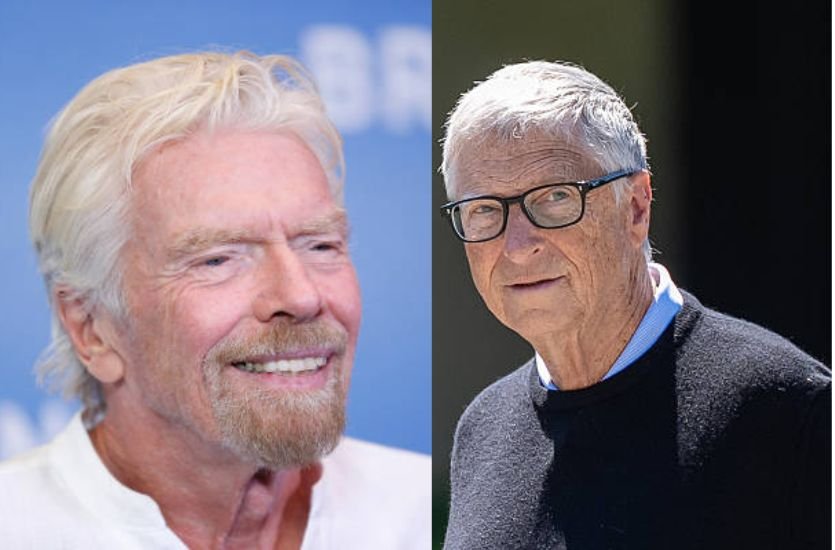
Richard Branson and Bill Gates are two of the most recognizable entrepreneurs of the modern era. Both built successful businesses, influenced global industries, and used their wealth and public influence to support causes beyond commercial success. However, their paths to achievement were remarkably different. Branson became famous for building the Virgin brand across multiple industries, while Gates helped transform personal computing through Microsoft before dedicating much of his attention to philanthropy and global challenges.
Their stories demonstrate how entrepreneurial vision, innovation, strategic decisions, and a willingness to challenge established practices can shape business success. Although they pursued different opportunities, their careers offer valuable insights into leadership, risk management, technology, and social responsibility.
Quick Bio Table
| Detail | Richard Branson | Bill Gates |
|---|---|---|
| Full name | Richard Charles Nicholas Branson | William Henry Gates III |
| Date of birth | July 18, 1950 | October 28, 1955 |
| Birthplace | Surrey, England | Seattle, Washington, United States |
| Nationality | British | American |
| Profession | Entrepreneur and business leader | Technology entrepreneur and philanthropist |
| Best known for | Founding the Virgin business group | Co-founding Microsoft |
| Major business | Virgin Group | Microsoft |
| Main industries | Travel, entertainment, telecommunications, and spaceflight | Software, technology, and digital services |
| Philanthropic initiative | Virgin Unite | Gates Foundation |
| Notable interests | Entrepreneurship, environmental issues, and commercial spaceflight | Global health, education, and clean-energy innovation |
Who Is Richard Branson?
Richard Branson is a British entrepreneur best known for establishing the Virgin Group, a business organization associated with travel, music, entertainment, telecommunications, and other industries. His career is an example of how a small commercial venture can develop into a widely recognized international brand through creativity, customer awareness, and calculated risk-taking.
Born on July 18, 1950, in Surrey, England, Branson demonstrated an interest in entrepreneurship at a young age. Instead of following a traditional academic and professional path, he began exploring business opportunities while still a teenager. His early experiences helped shape his approach to identifying market gaps and developing new ideas.
Richard Branson’s Early Life and Education
Branson attended Stowe School in Buckinghamshire, England. He experienced difficulties with conventional education, partly because of dyslexia, which made some traditional learning tasks challenging. Nevertheless, he developed an interest in practical projects, communication, and entrepreneurship.
As a teenager, he launched Student, a magazine intended to provide a platform for young people and explore subjects relevant to their generation. The project gave him experience in publishing, advertising, communication, and business management.
Although the magazine was not the foundation of the Virgin Group itself, it helped Branson develop the confidence and commercial awareness that influenced his later ventures. His early career illustrates that professional success can emerge through different learning experiences, including practical experimentation and independent projects.
The Beginning of the Virgin Business Empire
In 1970, Branson and his business partner Nik Powell established a mail-order record business under the Virgin name. The venture benefited from growing consumer interest in recorded music and offered customers an alternative way to purchase records.
The business subsequently expanded into record retailing and music production. Virgin Records became an important independent record label, working with successful artists and helping establish the Virgin name in the entertainment industry.
The music business gave Branson a foundation for expansion. Instead of limiting his ambitions to one market, he explored opportunities where the Virgin brand could offer a distinctive customer experience.
This approach eventually led to businesses in aviation, telecommunications, leisure, and other sectors. The company’s development demonstrates how a strong brand identity can support diversification, although each new industry still requires specialist knowledge, investment, and effective management.
Virgin Atlantic and the Travel Industry
One of Branson’s most notable ventures was Virgin Atlantic, which began operating in 1984. The airline entered a competitive industry dominated by established carriers and sought to differentiate itself through service, branding, and customer experience.
Entering aviation involved substantial financial and operational risks. Airlines must manage aircraft costs, fuel expenses, staffing, maintenance, regulatory requirements, and changing travel demand. Virgin Atlantic’s development therefore represented a significant departure from Branson’s earlier experience in music.
The venture reinforced his reputation for challenging established businesses rather than simply competing on their existing terms. It also demonstrated that entering a new market requires more than publicity. A company must deliver reliable services and maintain a business model capable of supporting long-term operations.
Virgin Galactic and Commercial Spaceflight
Branson’s interest in ambitious ventures extended beyond traditional industries. Virgin Galactic was established to pursue commercial spaceflight and make space experiences available to paying customers.
In July 2021, Branson participated in the Unity 22 mission aboard Virgin Galactic’s VSS Unity spacecraft. The flight represented a major milestone in the company’s efforts to develop commercial suborbital spaceflight.
The project also illustrates the difference between entrepreneurial vision and commercial viability. Spaceflight requires extensive engineering, safety systems, testing, regulatory oversight, and substantial capital. Progress in this sector can be expensive and technically challenging.
Branson’s involvement in Virgin Galactic reflects his willingness to pursue unfamiliar markets, but the long-term success of any such venture depends on safety, customer demand, operating costs, and the ability to develop sustainable commercial services.
Richard Branson’s Leadership Style
Branson is widely associated with an informal leadership style, a focus on customer experience, and an interest in empowering employees. His public image emphasizes experimentation and a willingness to challenge established assumptions.
The Virgin brand has often positioned its businesses as alternatives to conventional providers. This strategy can help companies attract attention, establish a clear identity, and encourage customers to consider different products or services.
However, diversification can also create challenges. Businesses operating in aviation, entertainment, healthcare, and financial services face different competitive conditions and regulatory requirements. A recognizable brand cannot automatically guarantee success in every market.
Branson’s career therefore offers two important lessons: entrepreneurs can benefit from questioning established practices, but they must also evaluate risks carefully and build capable teams for each business.
Who Is Bill Gates?
Bill Gates is an American technology entrepreneur, software pioneer, and philanthropist best known for co-founding Microsoft with Paul Allen in 1975. His work helped make personal-computer software more widely accessible and contributed to the development of the modern technology industry.
Born on October 28, 1955, in Seattle, Washington, Gates developed an early interest in computers and programming. He recognized that software would become increasingly important as computers spread into homes, schools, and businesses.
His career later extended beyond commercial technology into global health, education, climate innovation, and other philanthropic priorities. Gates provides an example of how expertise and wealth developed through entrepreneurship can be applied to problems outside a founder’s original industry.
Bill Gates’s Early Life and Education
Gates grew up in Seattle in a family that valued education and intellectual achievement. He attended Lakeside School, where he gained access to computer equipment at a time when computing was still unfamiliar to many students.
He became interested in programming and developed practical experience writing computer programs. This early exposure helped him understand both the technical possibilities of computing and its potential commercial applications.
Gates enrolled at Harvard University but left before completing his degree to concentrate on the emerging software industry. His decision was based on the opportunity he and Paul Allen saw in the growing market for personal computers.
Leaving university is not a universally appropriate path to entrepreneurship. Gates’s experience reflects the circumstances of a particular period and the opportunities available to him, rather than proof that formal education is unnecessary.
The Founding and Growth of Microsoft
Gates and Paul Allen founded Microsoft in 1975. They believed software would become an essential component of the computer industry and that demand for programming languages and operating systems would expand as computer hardware became more widely available.
Microsoft developed software products for a growing market of computer manufacturers, businesses, and individual users. Over time, its operating systems and productivity applications became central to personal computing.
The company’s growth was supported by its ability to develop software for large markets and establish relationships with hardware manufacturers and business customers. Microsoft also benefited from the increasing importance of standardized software that could be used across many different organizations.
Gates played a major role in Microsoft’s product strategy and business development. His experience demonstrates the importance of recognizing changes in technology early and creating products that can reach a broad audience.
Windows and the Personal Computing Revolution
Microsoft Windows became one of the company’s most influential products. Its graphical interface made personal computers more accessible to users who did not want to rely exclusively on command-based interaction.
As computers became common in offices, schools, and homes, Windows and Microsoft’s productivity software became familiar tools for document creation, spreadsheets, presentations, and other everyday tasks.
The widespread adoption of these products helped Microsoft establish a strong position in the software market. It also contributed to a broader shift in how organizations stored information, communicated, managed operations, and performed administrative work.
Microsoft’s history was not without controversy. The company faced significant antitrust scrutiny over its competitive practices, including legal proceedings related to its position in the operating-system market. A balanced account of Gates’s legacy should acknowledge both Microsoft’s technological influence and the concerns raised about market competition.
Bill Gates’s Transition Beyond Microsoft
Gates gradually reduced his day-to-day responsibilities at Microsoft as his interests expanded into philanthropy and other initiatives. In 2008, he transitioned to full-time work on the foundation he had established with Melinda French Gates.
This transition represented a major change in his professional priorities. Instead of concentrating primarily on commercial software, he increasingly focused on issues such as infectious diseases, poverty, education, and access to healthcare.
Gates has continued to maintain interests in technology and innovation through his private office and other initiatives. His work illustrates how the skills developed in business, including research, strategic planning, investment, and partnerships, can also be applied to large-scale social challenges.
The Gates Foundation and Global Philanthropy
The Gates Foundation was established in 2000 and became a major philanthropic organization working on global health and development. Its activities include supporting vaccination programs, disease prevention, maternal and child health, education, agricultural development, and economic opportunity.
The foundation works with governments, scientists, nonprofit organizations, research institutions, and international partners. Its approach often involves funding research, supporting the development of new solutions, and helping effective programs reach more people.
Gates has also supported efforts to improve access to healthcare and reduce the impact of diseases that disproportionately affect disadvantaged communities. These activities demonstrate how philanthropy can contribute to research and public-health initiatives that may not attract sufficient commercial investment on their own.
Philanthropic programs also require accountability and careful evaluation. Funding decisions can influence public priorities, and large initiatives must assess whether their approaches produce meaningful results. Gates’s philanthropic work is therefore part of a broader discussion about the opportunities and responsibilities associated with concentrated private wealth.
Bill Gates and Clean-Energy Innovation
Beyond public health, Gates has supported efforts to accelerate the development of technologies that could reduce greenhouse-gas emissions. Through Breakthrough Energy and related initiatives, he has promoted innovation in areas such as energy production, industrial processes, and other technologies relevant to climate change.
Many climate-related technologies face barriers involving research costs, infrastructure, regulation, and the challenge of competing with established alternatives. Investment and technical development can help address these obstacles, but commercial adoption depends on practical performance and economic conditions.
Gates’s interest in clean energy reflects his belief that technological progress can contribute to solving complex global problems. It also connects his philanthropic work with his earlier experience in the technology industry, where research and scalable products helped transform markets.
Richard Branson and Bill Gates: Comparing Their Business Strategies
Richard Branson and Bill Gates both became internationally recognized entrepreneurs, but their business strategies developed around different strengths.
Branson built a diversified brand and entered multiple industries. His approach emphasizes customer experience, distinctive marketing, and opportunities to challenge established businesses. The Virgin name has helped connect a wide range of ventures, although each business has its own operating requirements.
Gates concentrated on software and the growing importance of personal computing. Microsoft’s products benefited from technological development, broad adoption, and the ability to serve businesses and consumers at scale. His business history demonstrates the commercial importance of software platforms and the competitive advantages that can develop around widely used products.
Their approaches also reveal different forms of risk. Branson’s diversification exposed the Virgin network to the challenges of multiple industries, while Microsoft’s concentration in software exposed it to technological change, competition, and regulatory scrutiny.
Neither strategy is automatically superior. A diversified business may have opportunities in several markets, but managing unrelated operations can be complicated. A focused technology company can build deep expertise and scale efficiently, but it must adapt when competitors introduce new technologies or customers change their preferences.
What Entrepreneurs Can Learn From Richard Branson and Bill Gates
The careers of Branson and Gates provide several lessons for aspiring entrepreneurs.
First, both recognized opportunities that were becoming more important. Branson saw possibilities in music retail and later in travel and leisure, while Gates and Allen anticipated the growing demand for software as personal computers developed.
Second, both adapted their ambitions as their businesses evolved. Branson expanded into new industries, while Gates moved from commercial technology leadership toward philanthropy and research-oriented initiatives.
Third, their experiences highlight the importance of building capable teams. Large companies cannot depend entirely on a founder’s personal abilities. They require specialists, managers, employees, and partners who understand their respective responsibilities.
Finally, their careers show that success involves more than generating revenue. Business leaders must consider competition, operational performance, employee relationships, customer expectations, and the wider consequences of their decisions.
These lessons should not be interpreted as a formula for guaranteed success. Both men benefited from particular market conditions, opportunities, partnerships, and resources. Entrepreneurs can learn from their experiences while recognizing that every business operates under different circumstances.
Conclusion
Richard Branson and Bill Gates represent two influential approaches to entrepreneurship. Branson built the Virgin brand through music, aviation, travel, and other ventures, becoming known for customer-focused businesses and ambitious projects. Gates helped establish Microsoft as a major force in personal computing before directing much of his attention toward philanthropy, global health, and technological innovation.
Their careers demonstrate the value of identifying opportunities, adapting to change, and developing solutions that reach large audiences. They also reveal that business success comes with challenges, including financial risk, competitive pressure, and the responsibility to use influence thoughtfully.
Although their paths differ, Richard Branson and Bill Gates remain useful examples for anyone interested in business leadership, innovation, and philanthropy. Their experiences show that there is no single route to achievement, but long-term influence often depends on combining vision with execution, learning, and the ability to respond to changing circumstances.
READ MORE : Joel Greenblatt and Jim Farley
READ MORE : Walt Disney and Javier Bardem

One thought on “Richard Branson and Bill Gates: Two Entrepreneurs Who Changed the World”