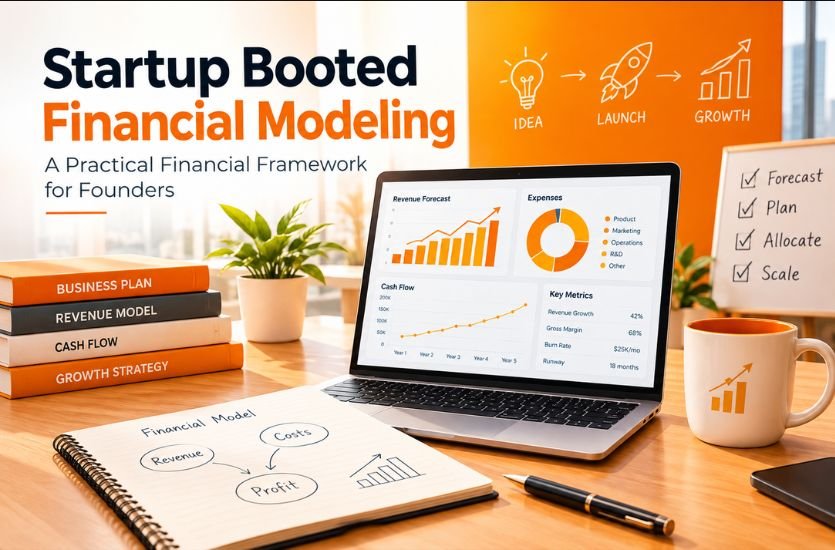
Starting a business without relying heavily on outside funding requires more than a strong product or a growing customer base. Founders also need a clear understanding of how money moves through the company, how quickly expenses are increasing, and how much revenue is required to reach sustainable operations. This is where startup booted financial modeling becomes valuable.
The phrase “booted” is generally used in this context as a variation of “bootstrapped,” referring to startups that build and grow primarily through founder resources, customer revenue, and internally generated cash rather than depending on repeated venture capital rounds. For these businesses, financial modeling is not simply something prepared for an investor presentation. It can become a practical operating system for making decisions about spending, hiring, pricing, marketing, growth, and cash management.
A well-designed model helps founders turn business assumptions into measurable financial projections. It can show what may happen if customer growth accelerates, sales slow down, expenses rise, or a major customer leaves. More importantly, it gives a founder a structured way to compare expectations with actual business performance.
Quick Bio
| Detail | Information |
|---|---|
| Subject | Startup Booted Financial Modeling |
| Meaning | Financial planning for a bootstrapped or self-funded startup |
| Primary Focus | Revenue, expenses, cash flow, profitability, and sustainability |
| Common Users | Startup founders, entrepreneurs, operators, and small business owners |
| Key Metrics | MRR, CAC, LTV, churn, burn rate, runway, and break-even |
| Typical Tools | Excel, Google Sheets, accounting software, and AI tools |
| Main Objective | Build sustainable growth through disciplined financial planning |
What Is Startup Booted Financial Modeling?
Startup booted financial modeling refers to the process of creating financial projections for a startup that is primarily funded through its own resources and business revenue. Instead of assuming that future investment rounds will provide additional capital whenever expenses exceed income, the model places greater emphasis on cash generation, cost control, profitability, and financial sustainability.
A bootstrapped founder usually has less room for prolonged losses. If a company spends significantly more than it earns, there may not be an external investor ready to provide another large injection of capital. This makes accurate financial planning particularly important.
The model typically brings together revenue assumptions, operating expenses, customer acquisition, retention, cash flow, hiring plans, taxes, technology costs, and other financial variables. By connecting these components, founders can see how individual business decisions affect the overall financial position.
For example, hiring an additional employee does not only create a salary expense. It may also create payroll taxes, equipment costs, software expenses, training requirements, and potentially additional office or infrastructure costs. A financial model allows these effects to be considered before the decision is made.
Why Financial Modeling Matters for Bootstrapped Startups
External funding can sometimes provide a company with additional time to experiment, but a self-funded startup usually has to pay close attention to the relationship between revenue and expenses. This makes financial modeling particularly useful.
One of the most important reasons is cash visibility. A company can report increasing sales while still experiencing financial pressure because customers may pay late, expenses may arrive before revenue, or the business may be investing heavily in growth.
Financial modeling also provides a framework for setting realistic targets. Instead of simply deciding that revenue should double, a founder can work backward from the desired result. The model can determine how many customers would be required, what average revenue per customer would be necessary, and how much acquisition spending could be supported.
Another advantage is improved decision-making. When founders consider launching a new product, increasing advertising, hiring staff, or changing prices, they can test the potential financial consequences before committing actual cash.
The Difference Between Bootstrapped and VC-Funded Financial Models
The fundamental difference between these models is the role of external capital.
A venture-backed startup may deliberately operate at a loss while investing heavily in product development, sales, marketing, and market expansion. Its financial plan can include future funding rounds as part of its capital strategy.
A bootstrapped startup generally has to place greater emphasis on the money already available and the revenue the business can generate. Growth still matters, but growth needs to be connected more closely to financial capacity.
This does not mean that every bootstrapped business must grow slowly. A self-funded company can grow rapidly when its revenue model, margins, and cash generation support that expansion. The important difference is that growth is constrained by the company’s ability to finance it.
For this reason, startup booted financial modeling usually pays particularly close attention to cash flow, burn rate, runway, gross margin, customer economics, and break-even performance.
The Core Components of a Startup Financial Model
A useful financial model does not have to be extremely complicated. In many early-stage businesses, a carefully structured spreadsheet can provide enough visibility to support important decisions.
Revenue Forecasting
Revenue forecasting is one of the foundations of financial modeling. A strong forecast begins with measurable business activity rather than an arbitrary growth percentage.
A SaaS company, for example, might begin with its current number of paying customers, average subscription price, expected new customers, expansion revenue, and monthly churn. An ecommerce company may instead focus on website traffic, conversion rates, average order value, repeat purchases, and product margins.
The objective is to connect revenue projections to operational drivers. When the assumptions are visible, founders can identify which variables are responsible for changes in the forecast.
A bottom-up forecast is particularly useful for bootstrapped businesses because it forces the founder to consider what must actually happen for projected revenue to become reality.
Expense Forecasting
Expenses should be modeled with the same discipline as revenue.
Some expenses remain relatively stable regardless of sales. These can include salaries, software subscriptions, rent, insurance, accounting services, and certain administrative costs. Other expenses change as the business grows. Advertising, sales commissions, payment processing fees, contractors, shipping, and production costs can fall into this category.
Separating fixed and variable expenses makes the model easier to understand. It also helps founders determine which costs can be reduced if revenue falls below expectations.
One-time costs should also receive attention. Website development, equipment purchases, legal services, branding, initial setup costs, and other irregular expenses can have a significant effect on cash even though they do not occur every month.
Cash Flow Forecasting and Cash Management
For a bootstrapped company, cash flow is one of the most important sections of the financial model.
The basic concept is straightforward. Beginning cash is combined with cash received during the period, while cash payments and expenses are subtracted to determine the ending cash balance.
The challenge is that cash does not always move at the same time as revenue is recorded. A customer may receive an invoice today but pay thirty or sixty days later. Meanwhile, salaries, software bills, suppliers, and other expenses may need to be paid immediately.
This timing difference can create financial pressure even when the income statement appears healthy.
A rolling cash-flow forecast allows founders to identify upcoming periods in which cash could become tight. It can also reveal whether the company has enough financial capacity to make a planned investment.
For companies experiencing significant fluctuations in cash, a shorter-term cash forecast can complement the longer-term financial model. The long-term model shows strategic direction, while the shorter forecast provides greater visibility into immediate cash requirements.
Burn Rate and Runway
Burn rate describes how quickly a startup is consuming cash.
A company spending $20,000 per month while receiving $12,000 in operating cash has an approximate net burn of $8,000 per month. If its available cash is $80,000 and the burn remains unchanged, a simple runway calculation would suggest approximately ten months of available cash.
The basic formula is:
Runway = Available Cash ÷ Monthly Net Burn
However, founders should not treat this as a permanent prediction. Burn can change as revenue increases or expenses rise. A more detailed monthly forecast can provide a better picture when the company’s financial situation changes frequently.
Runway becomes especially important when a startup is not yet profitable. A founder needs to know not only how much cash is available today, but also how long that cash can support the current operating plan.
Break-Even Analysis
Break-even analysis identifies the level of sales required for revenue to cover the company’s costs.
A simplified break-even calculation uses fixed costs and contribution margin. If a business has $10,000 in monthly fixed expenses and generates a 50 percent contribution margin, it would require approximately $20,000 in revenue to cover those fixed expenses.
The formula can be expressed as:
Break-Even Revenue = Fixed Costs ÷ Contribution Margin Percentage
Break-even analysis helps turn a broad financial objective into an operational target. Instead of simply saying that the company needs to become profitable, a founder can determine approximately how much revenue, how many customers, or how many transactions are needed.
For a bootstrapped startup, this can influence decisions about pricing, sales targets, hiring, marketing expenditure, and product strategy.
Unit Economics: CAC, LTV, and Payback Period
Company-level financial results are important, but founders also need to understand the economics of individual customers.
Customer Acquisition Cost, commonly called CAC, measures how much a company spends to acquire a new customer. A simple calculation divides relevant sales and marketing expenditure by the number of newly acquired customers during the same period.
Customer Lifetime Value, or LTV, estimates the economic value generated by a customer over the duration of the relationship. The calculation can vary considerably depending on the business model.
The payback period focuses on how long it takes to recover customer acquisition costs from the gross profit generated by the customer.
These metrics should be interpreted together rather than individually. A company might have strong revenue growth but still face cash pressure if it spends too much to acquire customers and takes too long to recover that expenditure.
Modeling Customer Growth and Churn
Customer acquisition alone does not determine growth. Retention is equally important for businesses that depend on recurring revenue.
Suppose a subscription company begins a month with 100 customers and loses three percent of them through churn. It would lose approximately three customers before considering newly acquired customers.
If the company acquires ten new customers during that month, its customer count would increase to approximately 107.
This simple example shows why churn should be incorporated directly into a startup financial model. Ignoring customer losses can produce revenue projections that look attractive but are difficult to achieve.
Cohort analysis can provide even deeper insight. Customers can be grouped according to their acquisition month or another relevant characteristic, allowing the founder to observe how retention and revenue develop over time.
How to Build a Startup Booted Financial Model
Creating a useful model begins with collecting reliable information.
The first stage is to define the company’s revenue streams. Each revenue stream should have measurable assumptions such as price, customer volume, transaction frequency, or subscription level.
The next stage is to establish the expense structure. Founders should identify recurring expenses, variable costs, one-time expenditures, taxes, payroll-related costs, and other obligations.
After that, the assumptions can be converted into monthly projections. A twelve-month model is often useful for operational planning, while a longer horizon can provide additional strategic visibility.
The model should then connect revenue and expenses to cash flow. This makes it possible to determine whether the company is generating enough cash to support its current operating plan.
Finally, the founder should create alternative scenarios. A model becomes significantly more useful when it can show what happens under different assumptions rather than providing only one fixed forecast.
Base, Upside, and Downside Scenarios
Scenario planning allows founders to understand uncertainty.
The base case represents the assumptions the founder considers most reasonable based on current information. It should not be an unnecessarily optimistic projection.
The upside case assumes stronger performance. Customer acquisition may be higher, churn may be lower, or average revenue per customer may increase.
The downside case assumes more difficult conditions. Sales may grow more slowly, customer losses may increase, advertising may become more expensive, or an expected contract may be delayed.
The purpose of the downside scenario is not to predict failure. It is to determine whether the company has enough financial flexibility to respond if actual performance differs from expectations.
Using AI in Startup Financial Modeling
AI tools can make financial modeling more accessible to founders who do not have extensive financial backgrounds.
An AI assistant can help explain financial concepts, suggest spreadsheet formulas, organize assumptions, identify relationships between variables, and generate scenario structures. It can also help founders examine a model by asking questions such as what happens if customer growth falls by twenty percent or expenses increase by fifteen percent.
However, AI-generated financial models should not be accepted without review. An incorrect formula, unrealistic assumption, or misunderstood accounting concept can produce misleading results.
AI is most useful as a support tool. The founder still needs to provide accurate business information, understand the assumptions, and verify important calculations.
Spreadsheet Tools for Financial Modeling
Google Sheets and Microsoft Excel remain practical choices for early-stage financial modeling because they are flexible and accessible.
A startup model can be separated into different worksheets for assumptions, revenue, expenses, cash flow, profit and loss, unit economics, and scenarios.
The model should be designed so that important assumptions are easy to locate and update. Hard-coding numbers throughout formulas makes a model difficult to maintain and increases the possibility of errors.
Clear labels and consistent formulas are also important. A founder should be able to understand where a number came from without spending significant time tracing complicated calculations.
As a startup becomes more complex, accounting and financial planning software can complement the spreadsheet. The underlying principles remain the same: accurate data, transparent assumptions, and regular comparison between forecasts and actual results.
Common Financial Modeling Mistakes
One common mistake is relying entirely on top-down market projections. A large addressable market does not automatically translate into customers or revenue. Operational assumptions should support the forecast.
Another mistake is underestimating expenses. Founders may focus heavily on visible costs while overlooking taxes, professional services, software, equipment, payment fees, maintenance, and unexpected expenditures.
Ignoring churn can also distort projections for subscription businesses. Revenue growth should account for customers who leave as well as customers who join.
Another problem is building a financial model once and never updating it. A forecast should change as new information becomes available. Actual performance provides evidence that can improve future assumptions.
Finally, founders sometimes create complicated models that they do not understand. Complexity does not automatically produce accuracy. A simpler model with clear assumptions can be more useful than a highly detailed spreadsheet filled with unsupported estimates.
Comparing Forecasts With Actual Results
A financial model becomes more valuable when founders compare projections with actual performance.
If projected revenue for a month was $20,000 but actual revenue was $15,000, the next question should be why the difference occurred.
Perhaps customer acquisition was lower than expected. Maybe conversion rates declined. A major customer could have delayed a purchase. The average transaction value might also have been lower.
The same process should be applied to expenses.
If actual spending was substantially higher than projected, the founder should identify the source of the variance. This creates a feedback loop in which each month of actual data improves future forecasting.
Over time, the model becomes increasingly grounded in the company’s own operating history.
Hiring and Growth Decisions
Hiring is one of the most important decisions that financial modeling can support.
A new employee creates an immediate expense but may also increase the company’s capacity to generate revenue. The model should therefore consider both sides of the decision.
For example, a sales hire may create salary and related costs during the first few months before producing meaningful revenue. A financial model can estimate how much additional revenue would be required to justify the position.
The same approach can be used for contractors, marketing campaigns, new software, equipment, and geographic expansion.
Rather than asking only whether the company can afford a particular expense today, the founder can ask whether the expense fits within the company’s expected cash position over the coming months.
Pricing Decisions and Financial Modeling
Pricing has a direct effect on almost every part of a startup model.
Increasing prices can improve revenue per customer, but it may also affect conversion and retention. Lower prices can make acquisition easier in some circumstances but may reduce margins or increase the number of customers required to reach profitability.
A financial model allows founders to test these possibilities.
For example, a company can compare different pricing levels and examine their effects on revenue, gross margin, customer volume, and break-even requirements.
This makes pricing analysis more structured than simply selecting a price based on competitors.
Monthly Review of the Financial Model
A startup financial model should be treated as a living planning document.
Each month, the founder can update actual revenue and expenses, revise customer numbers, calculate current churn, update cash balances, and review runway.
The founder can then extend the forecast forward by another month while replacing outdated assumptions with current information.
Large differences between forecast and actual results deserve particular attention. They may reveal changes in customer behavior, unexpected expenses, inaccurate assumptions, or new opportunities.
Regular reviews also prevent financial planning from becoming disconnected from day-to-day business operations.
What a Strong Bootstrapped Financial Model Should Reveal
A useful model should answer practical questions.
It should show how much revenue the company expects to generate, how much it expects to spend, and how much cash should remain after those transactions.
It should also show when the company may reach break-even under current assumptions, what level of customer acquisition is required, how sensitive the business is to churn, and how long available cash could support the current operating plan.
Most importantly, it should reveal which assumptions have the greatest influence on the business.
If a small change in customer churn dramatically changes the company’s cash position, churn deserves close monitoring. If marketing expenditure produces little incremental revenue, the founder can investigate the underlying acquisition economics.
Final Thoughts
Startup booted financial modeling provides founders with a structured way to understand the financial consequences of their decisions. For a self-funded business, the model can connect everyday operating choices with larger goals such as profitability, sustainable growth, and financial independence.
The strongest model does not depend on complicated formulas or unrealistic projections. It begins with honest assumptions and measurable business drivers. Revenue, expenses, customer behavior, cash flow, burn rate, runway, break-even performance, and unit economics should work together rather than exist as isolated numbers.
A financial model also should not remain unchanged after it is created. Actual business performance should continuously inform future projections. When founders compare their expectations with real results, they can identify weaknesses in their assumptions and make more informed adjustments.
For an early-stage startup, a simple and transparent model may be enough to create meaningful financial visibility. As the company grows, that model can become more detailed, incorporating additional revenue streams, employees, departments, customer cohorts, taxes, financing decisions, and long-term planning.
Ultimately, the purpose of startup booted financial modeling is not to make a startup look successful on paper. Its purpose is to help founders understand what the business needs financially to continue operating and grow sustainably. When the numbers are connected to real business activity, financial modeling becomes a practical management tool rather than just another spreadsheet.
If you want more informative articles like this on different categories, visit our website editorialmagazine.co.uk.
READ MORE : Urlwo
READ MORE : Tips Lifestyle PushYourDesign



One thought on “Startup Booted Financial Modeling: A Practical Financial Framework for Founders”