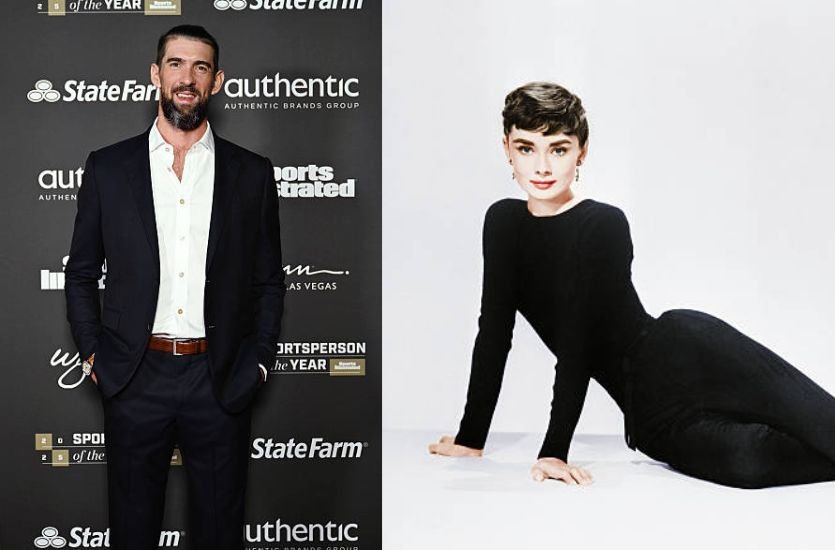
When people search for Michael Phelps and Audrey Hepburn, one obvious question comes to mind: were these two
internationally famous figures actually connected?
The answer is that no documented family, professional, or notable personal relationship between Michael Phelps and Audrey Hepburn has been established. Their lives did overlap briefly, but they became famous in very different eras and fields. Phelps became one of the most decorated Olympic swimmers in history, while Hepburn became an internationally recognized actress and later a prominent UNICEF humanitarian.
Their stories are nevertheless interesting to compare. Both developed extraordinary international profiles, both became recognizable far beyond their original professions, and both eventually used their public platforms for causes beyond entertainment or competition.
This article examines Michael Phelps and Audrey Hepburn, including their backgrounds, careers, achievements, timelines, humanitarian work, and the reason their names may appear together in online searches.
Quick Answer
Michael Phelps and Audrey Hepburn were not known to be related, and there is no established evidence of a significant personal or professional relationship between them.
Phelps was born in Baltimore in 1985 and became an Olympic swimming legend, winning 28 Olympic medals, including 23 gold medals across five Olympic Games.
Hepburn was born in Brussels in 1929 and became one of the most recognized actresses of her generation before devoting much of her later life to humanitarian work with UNICEF. She died in 1993.
Their lives therefore represent two separate stories rather than a documented partnership or family connection.
Who Is Michael Phelps?
Michael Phelps is an American former competitive swimmer who became one of the most successful athletes in Olympic history.
Born on June 30, 1985, in Baltimore, Maryland, Phelps began swimming at the age of seven. Team USA records that he quickly progressed through competitive swimming and established a national age-group record only three years after beginning the sport.
His Olympic career began at the Sydney 2000 Olympics, where he competed at just 15 years old. Although he did not win a medal in Sydney, the appearance marked the beginning of a five-Olympics career that eventually produced an unprecedented medal collection.
Phelps competed at:
- Sydney 2000
- Athens 2004
- Beijing 2008
- London 2012
- Rio 2016
Across those Games, he won 28 Olympic medals: 23 gold, 3 silver, and 2 bronze. World Aquatics independently confirms the same Olympic total.
His specialties included butterfly, individual medley, freestyle, and backstroke.
Michael Phelps at a Glance
| Detail | Information |
|---|---|
| Full name | Michael Fred Phelps II |
| Born | June 30, 1985 |
| Birthplace | Baltimore, Maryland, USA |
| Profession | Former competitive swimmer |
| Olympic appearances | 2000, 2004, 2008, 2012, 2016 |
| Olympic medals | 28 |
| Olympic gold medals | 23 |
| Main specialties | Butterfly, individual medley, freestyle, backstroke |
| Education | University of Michigan |
| Final Olympics | Rio 2016 |
Phelps was inducted into the U.S. Olympic & Paralympic Hall of Fame in 2022, further recognizing his contribution to American Olympic history.
Who Was Audrey Hepburn?
Audrey Hepburn was an actress whose career became an important part of classic international cinema. She later became equally associated with humanitarian advocacy.
Hepburn was born on May 4, 1929, in Brussels, Belgium. UNICEF records that her father was an English banker and her mother was a Dutch baroness. She studied ballet before moving toward acting.
Her breakthrough came with Roman Holiday, the 1953 film starring Gregory Peck. The movie established her as an international star and earned her the Academy Award for Best Actress.
She subsequently appeared in major films including:
- Sabrina
- Funny Face
- The Nun’s Story
- Breakfast at Tiffany’s
- Charade
- My Fair Lady
- Wait Until Dark
Her screen career established her as a major cultural figure, while her distinctive fashion image helped make her an enduring popular-culture icon.
Audrey Hepburn at a Glance
| Detail | Information |
|---|---|
| Full name | Audrey Kathleen Hepburn |
| Born | May 4, 1929 |
| Birthplace | Brussels, Belgium |
| Profession | Actress and humanitarian |
| Major breakthrough | Roman Holiday |
| Major humanitarian role | UNICEF Goodwill Ambassador |
| Died | January 20, 1993 |
| Major areas of influence | Film, fashion and humanitarian advocacy |
Hepburn’s later years were increasingly devoted to humanitarian work. UNICEF states that she became a Goodwill Ambassador in 1988 and devoted significant energy to advocating for children around the world.
Were Michael Phelps and Audrey Hepburn Related?
There is no documented evidence establishing a family relationship between Michael Phelps and Audrey Hepburn.
Their biographies describe completely different family backgrounds and geographical origins. Phelps was born and raised in Maryland, while Hepburn was born in Belgium and had English and Dutch family roots.
The fact that two famous names appear together in online searches does not establish a family connection.
There is also no reliable evidence indicating that they were part of the same extended family.
Therefore, the most accurate description is that Michael Phelps and Audrey Hepburn were two separate internationally recognized personalities whose lives and legacies can be compared, but for whom no documented family connection has been established.
Did Michael Phelps Ever Meet Audrey Hepburn?
No notable or significant meeting between Michael Phelps and Audrey Hepburn is documented in the major biographical records reviewed.
There is, however, an important timeline detail.
Phelps was born on June 30, 1985, while Hepburn died on January 20, 1993. Their lives therefore overlapped for approximately seven years and seven months.
Phelps was seven years old when Hepburn died.
His Olympic career did not begin until 2000, seven years after her death.
This means that the two were not professional contemporaries in any meaningful sense.
It is more accurate to say that no notable documented meeting or relationship has been identified rather than claiming that an encounter was absolutely impossible.
Michael Phelps and Audrey Hepburn: A Timeline
Their timeline makes the lack of a direct professional connection easier to understand.
| Year | Audrey Hepburn | Michael Phelps |
|---|---|---|
| 1929 | Born in Brussels | — |
| 1953 | Stars in Roman Holiday | — |
| 1960s | Major film career | — |
| 1985 | — | Born in Baltimore |
| 1988 | Becomes UNICEF Goodwill Ambassador | Age 3 |
| 1993 | Dies in Switzerland | Age 7 |
| 2000 | — | Makes Olympic debut |
| 2004 | — | Wins 8 Olympic medals |
| 2008 | — | Wins 8 gold medals |
| 2012 | — | Wins 6 medals |
| 2016 | — | Competes in final Olympics |
This timeline shows that Hepburn had already established her film career decades before Phelps became a major international athlete.
Michael Phelps’ Olympic Achievements
Phelps’ Olympic record is the most measurable part of his legacy.
He won 28 Olympic medals, consisting of:
- 23 gold
- 3 silver
- 2 bronze
World Aquatics confirms this exact breakdown.
Athens 2004
At the Athens Olympics, Phelps won six gold medals and two bronze medals.
This made him one of the dominant athletes of the Games and established the foundation for his later Olympic records.
Beijing 2008
The 2008 Beijing Olympics became one of the defining moments of his career.
Phelps won eight gold medals at those Games, setting a record for the most gold medals won by an athlete at a single Olympic Games at the time.
His victories covered butterfly, freestyle, individual medley and relay events.
London 2012
Phelps added six medals in London: four gold and two silver.
Rio 2016
After returning to competition, Phelps competed at the Rio Olympics in 2016 and won another five gold medals and one silver.
Rio became his final Olympic appearance.
Audrey Hepburn’s Film Career
Audrey Hepburn’s achievements came from an entirely different world.
Her performance in Roman Holiday transformed her into a major international film star. She subsequently appeared in a series of successful productions that established her reputation across Hollywood and international cinema.
Her filmography included Sabrina, Funny Face, The Nun’s Story, Breakfast at Tiffany’s, Charade, My Fair Lady, and Wait Until Dark.
Her 1961 appearance in Breakfast at Tiffany’s became especially important to her cultural legacy. The film and Hepburn’s portrayal of Holly Golightly have continued to influence discussions about classic Hollywood and fashion.
Unlike Phelps’ career, which can be measured through medals and records, Hepburn’s influence developed through performances, awards, cultural recognition and her later humanitarian activities.
Audrey Hepburn and the Academy Awards
Hepburn won the Academy Award for Best Actress for Roman Holiday.
That achievement came at the beginning of her major film career and helped establish her as one of the leading actresses of her generation.
Her later career included additional Academy Award recognition, including a nomination for Breakfast at Tiffany’s and another for Wait Until Dark. Her acting achievements are an important part of understanding why her name remains prominent decades after her death.
Her legacy also expanded beyond acting. The Academy later recognized her humanitarian contribution with the Jean Hersholt Humanitarian Award, presented posthumously in 1993.
Audrey Hepburn and UNICEF
Humanitarian work became one of the most significant parts of Hepburn’s later life.
UNICEF records that Hepburn became a Goodwill Ambassador in 1988. Her work included traveling to countries where children faced poverty, displacement, malnutrition and limited access to basic services.
She visited UNICEF projects in countries including:
- Ethiopia
- Turkey
- Venezuela
- Ecuador
- Guatemala
- Honduras
- El Salvador
- Bangladesh
- Thailand
- Vietnam
- Sudan
Her involvement went beyond appearances. UNICEF records that she testified before the U.S. Congress, participated in the World Summit for Children, promoted UNICEF reports, attended fundraising events and spoke publicly about children’s welfare.
She continued this work even while seriously ill.
Hepburn died in Switzerland on January 20, 1993, at the age of 63.
Michael Phelps and the Michael Phelps Foundation
Phelps also developed a major public role outside competitive swimming.
He founded the Michael Phelps Foundation in 2008. According to the Foundation, its purpose is to empower people through water safety, mental wellness and healthy-living education.
Its programs have expanded beyond swimming instruction to include broader concepts such as confidence, emotional resilience and wellbeing.
The Foundation says its IM Program operates through partnerships including Boys & Girls Clubs of America and Special Olympics International.
Phelps has also become a prominent public voice around mental health. His Foundation states that he publicly shared his personal experiences with mental health in 2015, helping advance conversations about emotional wellbeing in sports.
This is one of the more meaningful similarities between Phelps and Hepburn: both eventually used their public visibility for purposes beyond the professions that initially made them famous.
What Do Michael Phelps and Audrey Hepburn Have in Common?
Although there is no established direct relationship between them, several broad similarities can be identified.
International Recognition
Both became internationally recognizable.
Phelps reached a global audience through the Olympic Games, while Hepburn reached audiences through international cinema.
Careers That Extended Beyond Their Original Fields
Phelps became more than an Olympic swimmer through foundation work, youth programs and public advocacy.
Hepburn became more than an actress through her extensive UNICEF work.
Long-Lasting Public Legacies
Both remain recognizable long after their defining professional periods.
Phelps’ Olympic achievements remain part of sports history, while Hepburn’s films, style and humanitarian work continue to be discussed.
Different Forms of Influence
Their influence developed in different ways.
Phelps influenced sports through extraordinary competitive results.
Hepburn influenced film and fashion while also using her celebrity to promote humanitarian causes.
These similarities explain why their individual stories can be compared without suggesting that they actually knew or worked with each other.
Michael Phelps vs. Audrey Hepburn
| Category | Michael Phelps | Audrey Hepburn |
|---|---|---|
| Main profession | Competitive swimmer | Actress |
| Born | 1985 | 1929 |
| Birthplace | Baltimore, USA | Brussels, Belgium |
| Major field | Olympic sport | Film and theater |
| Major achievement | 28 Olympic medals | Academy Award-winning acting career |
| International platform | Olympic Games | Cinema |
| Humanitarian focus | Water safety, wellness and youth | Children and humanitarian causes |
| Major organization | Michael Phelps Foundation | UNICEF |
| Final major professional era | 2016 Olympics | Later humanitarian years |
| Death | — | 1993 |
The table demonstrates why the two should not be treated as collaborators or professional partners. Their achievements belong to different industries and historical contexts.
Why Are Michael Phelps and Audrey Hepburn Mentioned Together?
The exact origin of the online search pairing is not established by the historical record.
There is no major historical event, famous collaboration or documented family connection that naturally links their names.
Instead, the pairing appears to be a search-driven comparison involving two highly recognizable public figures.
When two famous names appear together online, websites may publish articles answering questions such as whether the people are related, whether they met, or what they have in common. Once several pages discuss the same pairing, the association can become more visible in search results.
That does not necessarily mean there is a hidden historical story behind it.
For that reason, reliable institutional sources are more useful than assuming that a repeated online association represents a real relationship.
Their Different Generations of Fame
The generational difference is especially important.
Hepburn’s most influential film years were concentrated largely in the 1950s and 1960s. By the time Phelps was born in 1985, she had already become an established international celebrity.
Phelps’ international sporting fame developed mainly in the 2000s and 2010s.
This means their careers belong to substantially different periods.
Hepburn’s legacy was built during the golden era of international cinema, while Phelps’ reputation developed during the modern Olympic and global sports-media era.
Two Different Paths to Lasting Fame
Michael Phelps and Audrey Hepburn demonstrate two very different routes to worldwide recognition.
For Phelps, the defining evidence is numerical and competitive:
28 Olympic medals.
For Hepburn, the story is broader. It includes major film performances, awards, fashion influence and humanitarian advocacy.
Neither legacy can be accurately measured using the other’s standards.
An Olympic medal cannot be directly compared with an Academy Award, just as a humanitarian campaign cannot be measured in the same way as a world-record swimming performance.
The more useful comparison is how both individuals transformed professional success into a broader cultural legacy.
Michael Phelps’ Legacy After Swimming
Phelps retired from competitive swimming following the 2016 Olympics.
His post-competition activities have included work through the Michael Phelps Foundation and continued involvement with swimming and youth-oriented initiatives. Team USA notes that he has remained connected to the sport and has worked with young swimmers and other initiatives after retirement.
The Foundation’s current mission emphasizes water safety, mental wellness and healthy living rather than simply competitive swimming.
This represents a significant change in emphasis: his competitive career was about performance in the pool, while much of his later public work focuses on helping others develop skills and wellbeing.
Audrey Hepburn’s Legacy After Hollywood
Hepburn’s later life followed a similar pattern of moving beyond her original profession, although the cause and circumstances were very different.
UNICEF became a major part of her public identity.
She used her celebrity to visit humanitarian projects, speak about children affected by poverty and conflict, and encourage international attention to their needs.
Her humanitarian activities eventually became inseparable from how her overall legacy was remembered.
This makes her more than a classic-film icon. Her life contains two major chapters: international acting fame and humanitarian advocacy.
Did Michael Phelps and Audrey Hepburn Have Similar Careers?
No.
Their professional careers were fundamentally different.
Phelps was an elite athlete whose achievements were determined through competitive sporting results.
Hepburn was a performer whose career involved acting, theater, cinema and cultural influence.
However, both demonstrate how a successful public career can evolve.
Phelps moved from competitive swimming toward foundation work and public advocacy.
Hepburn moved from acting toward humanitarian service.
That is a legitimate similarity, even though their actual careers were unrelated.
Common Misconceptions About Michael Phelps and Audrey Hepburn
They Were Related
There is no documented evidence supporting a family relationship.
They Were Professional Partners
No documented collaboration between Phelps and Hepburn has been established.
They Were Major Celebrity Contemporaries
Their lives overlapped, but their major professional eras were separated by decades.
They Had the Same Type of Legacy
Their legacies are fundamentally different. Phelps is primarily associated with Olympic swimming, while Hepburn is associated with cinema, fashion and humanitarian work.
Their Names Appearing Together Proves a Connection
It does not. Search-engine associations can bring unrelated public figures together.
Frequently Asked Questions
Are Michael Phelps and Audrey Hepburn related?
No documented family relationship between Michael Phelps and Audrey Hepburn has been established.
Did Michael Phelps know Audrey Hepburn?
There is no widely established public record documenting a notable personal relationship or meeting between them.
How old was Michael Phelps when Audrey Hepburn died?
Phelps was seven years old when Hepburn died on January 20, 1993.
When was Michael Phelps born?
Michael Phelps was born on June 30, 1985, in Baltimore, Maryland.
When was Audrey Hepburn born?
Audrey Hepburn was born on May 4, 1929, in Brussels, Belgium.
How many Olympic medals did Michael Phelps win?
Phelps won 28 Olympic medals: 23 gold, three silver and two bronze.
How many Olympic Games did Michael Phelps compete in?
He competed in five Olympic Games, from Sydney 2000 through Rio 2016.
What was Audrey Hepburn famous for?
Hepburn was famous primarily for her acting career and later for humanitarian work with UNICEF.
Did Audrey Hepburn work for UNICEF?
Yes. She became a UNICEF Goodwill Ambassador in 1988 and conducted extensive humanitarian work on behalf of children.
Did Michael Phelps have a foundation?
Yes. He founded the Michael Phelps Foundation in 2008, which focuses on water safety, mental wellness and healthy living education.
Did Audrey Hepburn and Michael Phelps work in the same industry?
No. Phelps was a competitive swimmer, while Hepburn was an actress and humanitarian.
Final Thoughts
The search for Michael Phelps and Audrey Hepburn does not uncover a documented secret family connection, professional partnership or significant personal relationship.
Instead, it brings together two remarkable figures whose lives followed very different paths.
Michael Phelps became an Olympic swimming legend, earning 28 Olympic medals, including 23 gold medals, during five Olympic Games.
Audrey Hepburn became an internationally celebrated actress and later devoted substantial time to UNICEF’s humanitarian work for children.
Their lives overlapped for about seven years, but their defining careers belonged to different generations. Phelps was seven when Hepburn died, and his Olympic career began seven years later.
The most meaningful connection between Michael Phelps and Audrey Hepburn is therefore not a hidden relationship. It is the broader idea that internationally famous people can use their public platforms in different ways. Phelps extended his legacy into water safety, wellness and youth programs, while Hepburn used her celebrity to advocate for children through UNICEF.
Their stories remain separate, but both demonstrate how a person’s influence can extend beyond the profession that first made them famous.
Also Visit: Editorial Magazine