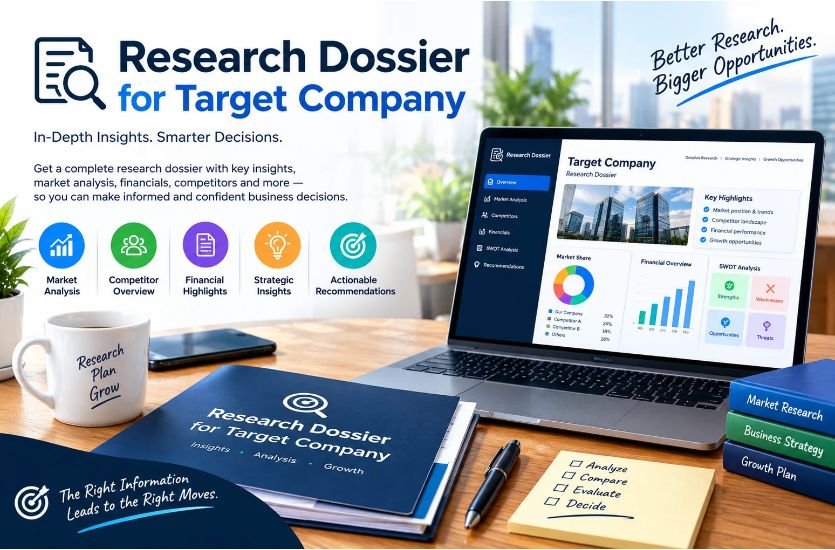
A research dossier for target company is a structured collection of information designed to provide a detailed understanding of a particular business. It can bring together company history, ownership, leadership, products, customers, competitors, financial information, industry conditions, reputation, legal matters, risks, and potential opportunities in one organized document.
A company dossier is useful when researching a potential client, business partner, supplier, employer, competitor, investment opportunity, or acquisition target. Instead of relying on information from one website, the researcher gathers information from multiple sources and checks important facts before drawing conclusions.
A strong dossier does not simply become a long collection of company facts. It explains what is known, where the information came from, how reliable it is, and why it may matter.
Quick Answer: What Is a Research Dossier for Target Company?
A research dossier for target company is a detailed research document prepared to understand a specific business from multiple perspectives. It usually covers the company’s identity, history, management, products and services, customers, business model, competitors, industry, financial position, reputation, recent developments, legal information, risks, and opportunities.
The purpose is to turn scattered information into an organized company profile that can support informed business research and decision-making.
What Is a Research Dossier for Target Company?
A research dossier can be thought of as a business background file.
When researching a company, useful information may be spread across its official website, annual reports, regulatory records, news publications, industry websites, customer reviews, social media platforms, job listings, government databases, and other public sources.
Finding information from all of these places can be time-consuming. A dossier brings the relevant findings together in a structured format.
The term target company does not necessarily refer to Target Corporation. In business research, it generally means the company that has been selected for investigation.
For example, a sales team may create a dossier about a potential customer before contacting its decision-makers. An investor may research a company before evaluating an investment. A business owner may prepare a dossier on a competitor to understand its products and market position.
The contents of the dossier should therefore depend on the reason for conducting the research.
Why Create a Company Research Dossier?
Business decisions are often made with incomplete information. A company may present itself positively through its marketing materials, while independent sources may reveal additional information that deserves consideration.
A research dossier helps organize these different perspectives.
A well-prepared dossier can help answer questions such as:
- Who owns the company?
- When was it established?
- What does it sell?
- Who are its customers?
- Where does it operate?
- How does it make money?
- Who are its competitors?
- What industry trends affect it?
- What financial information is available?
- What recent developments have occurred?
- What risks could affect the business?
- What opportunities could support future growth?
The answers can then be used according to the researcher’s specific objective.
Start With the Company’s Basic Information
The first section of a dossier should establish the identity of the company.
Important details can include its legal name, trading name, website, headquarters, founding year, industry, ownership structure, business type, and geographic presence.
If the business operates through subsidiaries or multiple brands, those relationships should also be documented.
Basic company information may include:
- Official company name
- Trading or brand names
- Founding date
- Founders
- Headquarters
- Main locations
- Industry
- Official website
- Legal structure
- Parent company
- Subsidiaries
- Public or private status
This information creates the foundation for the rest of the research.
It is particularly important to verify the company’s identity before continuing because different businesses can have similar names. Mixing information from two unrelated companies can compromise the entire dossier.
Research the Company’s History
A company’s history can help explain its current position.
Instead of recording every event since the company was founded, focus on developments that changed its direction or operations.
Important events may include:
- Company formation
- Major product launches
- Funding rounds
- Acquisitions
- Mergers
- Leadership changes
- Expansion into new countries
- Major partnerships
- Rebranding
- Restructuring
- Significant legal events
A timeline can make this information easier to understand.
For example, if a company acquired another business, the dossier can explain when the acquisition happened, what business was acquired, and how the transaction affected the company’s products, customers, or market presence.
The purpose of historical research is not simply to collect dates. It is to understand the developments that shaped the company.
Examine the Company’s Products and Services
Understanding what the company actually sells is one of the most important parts of company research.
List the company’s major products and services and explain what they do, who uses them, and how they are delivered.
Useful questions include:
What problem does each product solve?
Who is the intended customer?
How is the product priced?
How does the company distribute it?
What alternatives are available?
Does the company depend heavily on one product?
A company with one major product may have a different business structure from a company with many independent products and revenue streams.
Customer reviews and independent industry publications can also provide information that is not obvious from official product descriptions.
Understand the Company’s Business Model
Products alone do not explain how a company operates.
A research dossier should also examine the company’s business model.
This means understanding how the business creates value and generates revenue.
Depending on the company, revenue may come from:
- Product sales
- Subscriptions
- Licensing
- Advertising
- Commissions
- Consulting
- Professional services
- Memberships
- Enterprise contracts
- Marketplace transactions
The dossier can also examine customer acquisition, distribution channels, suppliers, partnerships, and major operating costs.
Understanding the business model makes it easier to interpret other information later in the research.
Identify the Target Company’s Customers
Customers are another important part of a company dossier.
First determine whether the company primarily serves consumers, businesses, governments, or a combination of customer types.
For business-to-business companies, research can focus on the industries served, typical customer size, geographic markets, and major publicly identified clients.
For consumer businesses, researchers may examine geographic markets, customer demographics, purchasing behavior, and product preferences.
Customer concentration can also be important.
If a company receives a substantial amount of business from only a small number of customers, losing one major customer could potentially have a significant effect.
However, customer concentration should only be described as a fact when reliable evidence is available.
Study the Management Team
Leadership research provides another perspective on the target company.
Depending on the company’s size and ownership structure, research may cover:
- Chief executive
- Founders
- Chief financial officer
- Chief technology officer
- Board members
- Senior executives
- Major owners
Look at professional backgrounds, previous companies, areas of expertise, and responsibilities.
Recent leadership changes may also deserve attention.
For example, the appointment of a new chief executive or financial officer may coincide with a change in corporate strategy.
However, a leadership change alone does not prove that the company is changing direction. The dossier should connect such observations with documented evidence such as announcements, strategic plans, financial reports, or statements from the company.
Analyze the Company’s Competitors
No business operates independently from its competitive environment.
A useful research dossier should identify both direct and indirect competitors.
Direct competitors generally offer similar products or services to similar customers. Indirect competitors may solve the same customer problem through a different product, technology, or business model.
Competitors can be compared across areas such as:
- Products and services
- Pricing
- Geographic reach
- Customer segments
- Distribution
- Technology
- Brand presence
- Market positioning
- Online visibility
The objective is not to create a huge database of every company in the industry.
Instead, focus on competitors that could realistically influence the target company’s customers, pricing, market share, or future strategy.
Research the Industry
A company cannot be fully understood without examining the industry around it.
Industry research can reveal whether certain challenges are specific to the company or common across the entire market.
Relevant areas include:
- Industry growth
- Consumer behavior
- Technology changes
- Regulation
- Market demand
- Supply-chain conditions
- New competitors
- Economic conditions
- Emerging business models
For example, a software company may be affected by artificial intelligence, cybersecurity requirements, cloud computing, and changes in software development.
A manufacturing company may be more exposed to raw-material costs, transportation, labor availability, and supply-chain disruptions.
Industry context gives the company research greater meaning.
Examine Financial Information
Financial information can be one of the most valuable parts of a research dossier when reliable data is available.
For public companies, researchers can often find information through annual reports, financial statements, investor-relations pages, and regulatory filings.
Potential areas of research include:
- Revenue
- Profit or loss
- Operating expenses
- Cash
- Debt
- Assets
- Liabilities
- Cash flow
- Funding
- Financial trends
The most useful approach is to examine trends rather than focus on one number.
For example, revenue growth can provide useful information, but it should be considered alongside profitability, debt, cash flow, and operating expenses.
Private companies may disclose far less financial information. In those situations, estimates from third-party sources should be clearly identified as estimates rather than presented as confirmed financial facts.
Look at Recent News and Developments
A company dossier should have a clear research date because business information changes over time.
Search for recent developments involving the company.
These may include:
- New products
- New contracts
- Acquisitions
- Partnerships
- Leadership appointments
- Layoffs
- Expansion
- New offices
- Regulatory actions
- Lawsuits
- Strategic changes
- Major investments
Recent developments can change how older information should be interpreted.
For example, an old article may describe a company as expanding into a particular market, while a later announcement may show that the company has changed its strategy.
For this reason, recent sources should be checked before finalizing the dossier.
Investigate Online Reputation
A company’s reputation can affect customers, employees, suppliers, investors, and business partners.
Research should therefore go beyond the company’s own marketing material.
Potential sources include:
- Customer reviews
- Industry publications
- News coverage
- Professional forums
- Social media discussions
- Employee-review platforms
- Business directories
However, individual reviews should be treated carefully.
One negative review does not necessarily establish a company-wide problem. Similarly, several positive comments do not automatically prove that every customer has the same experience.
Look for recurring patterns and compare them with other available evidence.
Review the Company’s Online Presence
The company’s digital presence can provide useful clues about its priorities and operations.
Review areas such as:
- Official website
- About page
- Product pages
- Company blog
- Newsroom
- Careers page
- Investor-relations section
- Social media profiles
- Press releases
The careers section can sometimes reveal which departments are actively recruiting.
For example, repeated hiring for engineering roles may indicate investment in technology, while increased sales vacancies may reflect an effort to expand commercial operations.
These observations should be treated as indicators rather than confirmed strategic decisions unless supported by direct evidence.
Check Legal and Regulatory Information
Legal research can be particularly important when the company operates in a regulated industry.
Depending on the purpose of the dossier, researchers may investigate:
- Court records
- Regulatory filings
- Government databases
- Enforcement actions
- Intellectual-property disputes
- Trademark information
- Regulatory investigations
- Public legal proceedings
Careful terminology is essential.
A lawsuit does not necessarily mean that a company has been found responsible for wrongdoing. Likewise, an investigation is not the same as a final regulatory decision.
A professional dossier should clearly distinguish allegations, investigations, lawsuits, settlements, and final judgments.
Identify Strengths and Weaknesses
Once the main information has been collected, organize the findings into meaningful strengths and weaknesses.
Potential strengths may include:
- Strong customer relationships
- Recognized technology
- Diversified products
- Experienced leadership
- Strong distribution
- Growing demand
- Geographic reach
Potential weaknesses could include:
- Dependence on a single product
- Customer concentration
- High operating costs
- Limited geographic presence
- Strong competitive pressure
- Regulatory exposure
- Supply-chain dependence
These should not be based on assumptions.
Each important strength or weakness should connect to evidence found during the research.
Identify Opportunities and Risks
The final analytical section can examine factors that may influence the company’s future.
Potential opportunities may involve:
- New markets
- New products
- Partnerships
- Technology adoption
- Growing customer demand
- Geographic expansion
- Industry growth
Potential risks may include:
- New competitors
- Changing regulations
- Economic pressure
- Cybersecurity incidents
- Supply-chain disruptions
- Changing customer behavior
- Technological disruption
- Financial pressure
The dossier should explain why each factor matters and identify the evidence supporting it.
How to Organize the Final Dossier
A clear structure makes a research dossier much easier to use.
A practical format can include:
- Executive summary
- Company overview
- Company history
- Products and services
- Business model
- Customers and markets
- Leadership and ownership
- Competitor analysis
- Industry analysis
- Financial information
- Recent developments
- Online reputation
- Legal and regulatory information
- Strengths and weaknesses
- Opportunities and risks
- Information gaps
- Source list
The executive summary is often best written after the research is complete. At that point, the researcher has enough information to summarize the most important findings accurately.
Keep Sources Organized
Source management is one of the most important parts of a research dossier.
For each significant claim, record where the information came from.
Useful source details include:
- Source name
- Publisher
- Article or document title
- Publication date
- URL
- Access date
- Relevant quotation or data
- Reliability notes
Primary sources are particularly useful for important factual claims. These can include government records, regulatory filings, company reports, official announcements, and original research.
Independent news organizations and established industry publications can provide additional context.
Using multiple reliable sources is especially important when researching information that could materially affect the company’s reputation, financial position, legal status, or ownership.
Separate Facts From Estimates
One of the biggest differences between basic online research and professional company research is the treatment of uncertainty.
Not every piece of information has the same level of reliability.
A dossier can classify findings as:
Officially reported: Information directly published by the company or an authoritative organization.
Independently verified: Information confirmed through reliable independent sources.
Third-party estimate: A figure or assessment produced by another organization without direct confirmation.
Unconfirmed: Information that has been reported but cannot currently be verified adequately.
Conflicting: Different reliable sources provide different information.
Researcher interpretation: An analytical conclusion based on documented facts.
This approach prevents estimates and assumptions from being presented as established facts.
Common Mistakes to Avoid
Several mistakes can reduce the quality of a company dossier.
Relying Only on the Company Website
A company’s website is an important source, but it generally represents the company’s own presentation of its business.
Independent sources can provide additional context.
Using Outdated Information
Leadership, financial performance, products, ownership, and strategy can change.
Always record dates and check recent developments.
Treating Estimates as Facts
Third-party estimates can be useful, but they should remain clearly labeled as estimates.
Overusing One Source
Important information should be cross-checked when possible.
Confusing Allegations With Findings
A complaint, investigation, lawsuit, settlement, and final judgment are different events.
Collecting Irrelevant Information
More information does not automatically create better research.
Every section should contribute to the purpose of the dossier.
Ignoring Information Gaps
Sometimes reliable information simply is not publicly available.
Instead of guessing, document the gap and explain that the information could not be verified.
Final Thoughts
A research dossier for target company turns scattered business information into a structured resource that can be used for company research, competitor analysis, sales preparation, partnership evaluation, investment research, and other business purposes.
The strongest dossier combines company background with deeper research into leadership, products, customers, business models, competitors, industry conditions, finances, reputation, legal matters, opportunities, and risks.
The most important principle is to distinguish facts from estimates and interpretation. Official company information can explain how a business presents itself, while independent sources can provide additional context. Comparing different sources creates a more complete picture.
A useful dossier also has a defined research date, organized sources, clear evidence, and documented information gaps. It should be detailed enough to answer important questions without becoming a collection of unrelated facts.
When research is organized carefully and important claims are verified, a company dossier becomes a practical reference document that helps readers understand a business and the environment in which it operates.
Visit: Editorial Magazine